
Trauerdrongo vs Grünmantel-Bogenflügel
Dicrurus adsimilis gegen Camaroptera brachyura
Ein Quiz mit Trauerdrongo und Grünmantel-Bogenflügel spielen
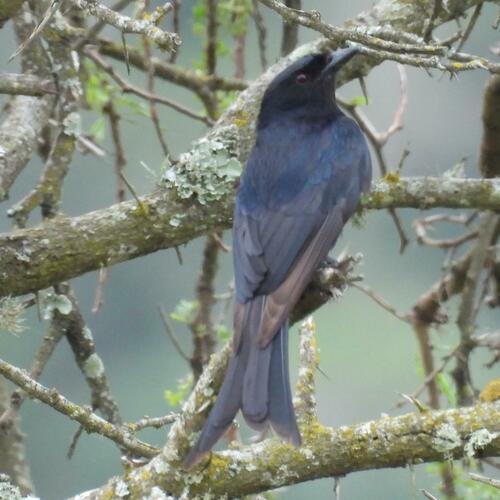 Trauerdrongo
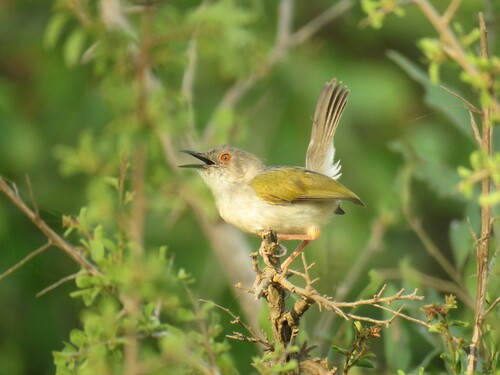 Grünmantel-Bogenflügel
Kurz gesagt
The most reliable field mark to separate Fork-tailed Drongo from Green-backed Camaroptera is overall color and structure: drongos are glossy black with a deeply forked tail and robust bill, while camaropteras are small, green-backed warblers with olive wings, whitish-grey underparts, and a short, rounded tail. Juvenile drongos are brownish with buff feather tips and a less pronounced fork in the tail, but still never show the green and grey tones of camaroptera. In flight or perched, the drongo's size, long forked tail, and upright posture contrast sharply with the camaroptera's small, round-bodied, short-tailed, and skulking appearance. Even at a distance, the drongo's black coloration and silhouette are diagnostic.
Bestimmungstipps
- Tail shape: Fork-tailed Drongo has a long, deeply forked tail in all plumages (juveniles less so, but still longer and more pointed than camaroptera). Green-backed Camaroptera has a short, rounded, non-forked tail. This is the single most reliable structural mark.
- Overall color: Drongo is glossy black (adults) or dark brown (juveniles), never green or olive. Camaroptera is green above, olive-winged, and whitish-grey below, never black or brown overall.
- Size and structure: Drongo is much larger and heavier (over 4x the mass), with a robust body and upright stance. Camaroptera is tiny, round-bodied, and delicate, with a short bill and tail.
- Bill: Drongo has a thick, robust black bill; camaroptera's bill is fine and short, typical of insectivorous warblers.
- Eye color: Adult drongo has red eyes; camaroptera's eyes are not described as red. Juvenile drongo has brown or grey eyes.
- Perching behavior: Drongo often perches openly and conspicuously, sometimes high up. Camaroptera stays low in dense cover, rarely perching in the open.
- Flight silhouette: Drongo in flight shows a long, forked tail and strong, direct flight. Camaroptera is weak-flying, with a short, rounded tail and compact shape.
- Juvenile plumage: Juvenile drongo is dark brown with buff tips and a less forked tail, but still lacks any green or olive tones. Juvenile camaroptera is paler yellow on the breast but always green-backed.
- Underparts: Drongo is uniformly black below; camaroptera is whitish-grey below (adults) or pale yellowish (juveniles).
- Habitat context: Drongo is found in open woodlands, savannas, and sometimes near wetlands or farms; camaroptera is always in thick, tangled vegetation.
- Behavioral cues: Drongo is bold, aggressive, and often seen mobbing other birds. Camaroptera is shy, skulking, and rarely emerges from cover.
- Nest placement: Drongo nests high (2.2–17m) in trees; camaroptera binds leaves together low in bushes.
- Sexes: Both species are sexually monomorphic in plumage, so sex is not a useful field mark.
- Molt timing: Drongo adults molt after breeding (Dec–Mar in Southern Africa); camaroptera's molt is not described, but this is not a field mark.
- Leucism: Rare leucistic drongos may appear paler, but structure and tail shape still separate them from camaroptera.
Größe
Fork-tailed Drongo is substantially larger and heavier (body mass ~43.4g) than Green-backed Camaroptera (~10.0g). The drongo is a robust, medium-small passerine with a long, deeply forked tail (tail length 115–126 mm), while the camaroptera is a tiny, compact warbler with a short tail (the species name 'brachyura' literally means 'short-tailed'). In the field, the drongo appears much bulkier and longer, especially when perched or in flight, whereas the camaroptera is easily overlooked due to its small size and tendency to stay low in dense cover.
Gefieder
Juvenile Fork-tailed Drongos are dark brown with buff tips and a less pronounced tail fork, and have brown or grey eyes and a pale mouth; they lack the adult's blue-green gloss but remain dark overall. Adults are glossy black with blue-green iridescence on the upperparts and a uniformly black underside, plus a long, deeply forked black tail. Green-backed Camaroptera of all ages have green upperparts, olive wings, and whitish-grey underparts; juveniles are paler yellow on the breast but never approach the drongo's dark coloration. The camaroptera's tail is short and rounded, never forked. No age of camaroptera shows the black or iridescent tones of drongo, and no drongo is ever green or olive. In flight, the drongo's forked tail and glossy black wings stand out, while camaroptera is small, rounded, and inconspicuous.
Verhalten
Fork-tailed Drongo is often seen perched conspicuously on open branches, wires, or exposed perches, sallying out to catch insects in the air and returning to the same spot. It is bold and aggressive, sometimes mobbing larger birds. Green-backed Camaroptera is secretive and skulking, typically staying low in dense thickets or undergrowth, rarely perching in the open. It moves quickly and quietly through foliage, often binding leaves together for its nest. Drongo's upright, alert posture and open behavior contrast with the camaroptera's furtive, low-to-the-ground movements.
Lebensraum
Both species occur in sub-Saharan Africa, but Fork-tailed Drongo favors more open wooded habitats, woodlands, and savannas, often near forest edges or open country. It is frequently seen in open areas, sometimes near wetlands or farms during breeding. Green-backed Camaroptera is a specialist of dense cover, preferring thick undergrowth, tangled bushes, and low vegetation, where it remains hidden. If the bird is seen in the open or high up, drongo is much more likely; camaroptera is almost always close to the ground in dense foliage.
Trauerdrongo · Grünmantel-Bogenflügel · Meine schwierigen Vögel