

Motmot

Baumfalke vs Gerfalke

Falco subbuteo gegen Falco rusticolus

Ein Quiz mit Baumfalke und Gerfalke spielen
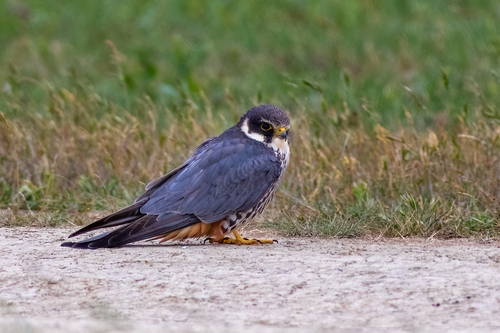
Baumfalke (Falco subbuteo) Baumfalke
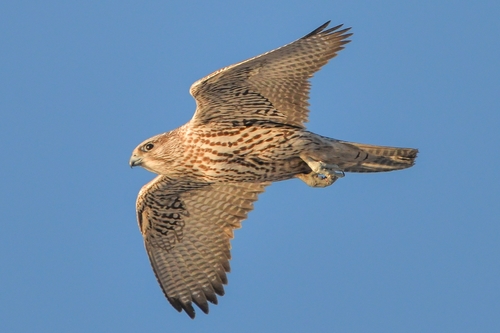
Gerfalke (Falco rusticolus) Gerfalke

Medien

Laden…

Kurz gesagt

The most reliable way to separate Eurasian Hobby from Gyr Falcon is by size and structure: the Hobby is a small, slim falcon with long, pointed wings and a square tail, while the Gyr Falcon is massive, broad-winged, and longer-tailed, often appearing bulkier than even large buzzards. In flight, adult Hobbies show a swift-like, sickle-winged profile and rufous 'trousers,' while Gyr Falcons (of any morph) are much larger, with variable plumage but never show the Hobby's red thighs. Juvenile Hobbies are browner and show scaled upperparts, but still appear much daintier than any Gyr. Even at a distance, the sheer size difference is usually unmistakable, but confusion can arise with lone, distant, or fast-flying birds, especially immatures. Always check for the Hobby's slim, swift-like shape and the Gyr's heavy, broad-winged build.

Bestimmungstipps

  1. Size is decisive: If the falcon is truly large (approaching buzzard or eagle size), it's a Gyr Falcon. Hobbies are much smaller, only slightly larger than a kestrel.
  2. Shape in flight: Hobbies have long, pointed, sickle-shaped wings and a square-cut tail, giving a swift-like appearance. Gyr Falcons are broad-winged, heavy-bodied, and long-tailed, lacking the Hobby's aerodynamic look.
  3. Adult plumage: Look for the Hobby's slate-grey upperparts, dark crown, two short moustache stripes, and especially the rufous (red) thighs and vent. Gyr Falcons never show rufous thighs; their underparts and thighs are variably streaked or spotted but never this color.
  4. Juvenile plumage: Young Hobbies are browner above with scaled upperparts and buffy, streaked thighs, but still slim and small. Juvenile Gyrs are darker and browner than adults, but always massive and broad-winged.
  5. Plumage variability in Gyr: Gyr Falcons come in white, silver, brown, and black morphs, but even the darkest Gyr is much larger and bulkier than a Hobby. No Gyr morph has the Hobby's color pattern or proportions.
  6. Facial pattern: Hobbies have a neat, dark crown and two short moustache marks; Gyr Falcons lack a strong malar stripe and have a more diffuse facial pattern, especially in brown morphs.
  7. Underpart streaking: Hobby underparts are white with fine black streaks; Gyr underparts are variable but often more heavily streaked or spotted, especially in dark morphs.
  8. Perched posture: Hobbies look slim and upright on a perch; Gyrs are thickset, with a broad chest and heavy build.
  9. Flight style: Hobbies are agile, fast, and often seen hawking insects or small birds, sometimes eating on the wing. Gyrs are powerful, with slower, deeper wingbeats and less acrobatic flight.
  10. Habitat context: Hobbies are found in open lowlands with scattered trees; Gyrs are birds of the far north, tundra, and cliffs. If you're in central Europe or temperate Asia in summer, a large falcon is almost never a Gyr.
  11. Group behavior: Hobbies may migrate in small groups; Gyr Falcons are almost always solitary or in pairs.
  12. Bill and feet: Not usually visible at distance, but Gyr Falcons have a much heavier bill and feet than the delicate Hobby.
  13. Sex differences: Both species show minimal sexual dimorphism in plumage; size difference is more pronounced in Gyr Falcons, with females being much larger.
  14. Vocalizations: Not diagnostic for separation in the field; both are generally silent away from the nest.
  15. Common pitfalls: Distant or fast-flying birds can be confusing, especially juveniles. Always use a combination of size, shape, and plumage, not just one feature.

Größe

Size is the most immediate and reliable distinction. The Eurasian Hobby is a small falcon (body mass ~211g, length 29–36 cm, wingspan 74–84 cm), while the Gyr Falcon is the largest falcon in the world (males 805–1350g, females 1180–2100g; length 48–65 cm, wingspan 110–134 cm). Even the smallest Gyr is several times heavier and much longer-winged than the largest Hobby. In the field, a Hobby is barely pigeon-sized, while a Gyr Falcon is closer to a large buzzard or small eagle. If you see a falcon that looks huge and powerful, it's not a Hobby.

Gefieder

Juvenile and immature Hobbies are much browner than adults, with scaled upperparts and streaked buff thighs and undertail coverts. Adults are slate-grey above, with a dark crown, two short black moustache stripes, unstreaked white throat, and distinctive rufous (red) thighs and vent. Underparts are whitish with black streaks. Gyr Falcons are highly variable: adults can be white, silver, brown, or black, with plumage ranging from all-white to dark brown or black. Brown morphs show cream streaking on the nape and crown, and lack a strong malar stripe. Juveniles are darker and browner than adults but are always much larger and bulkier than any Hobby. No Gyr Falcon, regardless of age or morph, shows the Hobby's rufous thighs or the slim, swift-like wing shape. In flight, Hobbies have a sickle-winged look with a square tail, while Gyrs are broad-winged and long-tailed. There are no age-specific upperwing patterns in either species that mimic the other's appearance.

Verhalten

Eurasian Hobbies are agile, fast, and aerobatic, often hunting insects and small birds on the wing, sometimes eating prey in flight. Their flight is swift-like, with rapid, graceful maneuvers. Gyr Falcons are powerful, heavy fliers, typically hunting larger birds or mammals, and often use direct, forceful flight or stoops. Hobbies may be seen hawking in small groups on migration, while Gyrs are usually solitary or in pairs. Perched, Hobbies look slim and upright; Gyrs appear massive and broad-shouldered.

Lebensraum

Eurasian Hobbies prefer open country with scattered woods, farmland, marshes, and taiga, usually in lowland areas. Gyr Falcons breed in Arctic and subarctic tundra, often on cliff faces, and are rarely found far from open, treeless landscapes in their breeding range. While Gyrs can disperse widely in winter, they are still most likely in northern or high-latitude habitats. If you are in temperate farmland or lowland marshes, a large falcon is almost certainly not a Gyr.

Eine bessere Beschreibung senden

Nutze dieselben Abschnitte wie der Vergleich. Dein Text ist sofort veröffentlicht.

The most reliable way to separate Eurasian Hobby from Gyr Falcon is by size and structure: the Hobby is a small, slim falcon with long, pointed wings and a square tail, while the Gyr Falcon is massive, broad-winged, and longer-tailed, often appearing bulkier than even large buzzards. In flight, adult Hobbies show a swift-like, sickle-winged profile and rufous 'trousers,' while Gyr Falcons (of any morph) are much larger, with variable plumage but never show the Hobby's red thighs. Juvenile Hobbies are browner and show scaled upperparts, but still appear much daintier than any Gyr. Even at a distance, the sheer size difference is usually unmistakable, but confusion can arise with lone, distant, or fast-flying birds, especially immatures. Always check for the Hobby's slim, swift-like shape and the Gyr's heavy, broad-winged build.

  1. Size is decisive: If the falcon is truly large (approaching buzzard or eagle size), it's a Gyr Falcon. Hobbies are much smaller, only slightly larger than a kestrel.
  2. Shape in flight: Hobbies have long, pointed, sickle-shaped wings and a square-cut tail, giving a swift-like appearance. Gyr Falcons are broad-winged, heavy-bodied, and long-tailed, lacking the Hobby's aerodynamic look.
  3. Adult plumage: Look for the Hobby's slate-grey upperparts, dark crown, two short moustache stripes, and especially the rufous (red) thighs and vent. Gyr Falcons never show rufous thighs; their underparts and thighs are variably streaked or spotted but never this color.
  4. Juvenile plumage: Young Hobbies are browner above with scaled upperparts and buffy, streaked thighs, but still slim and small. Juvenile Gyrs are darker and browner than adults, but always massive and broad-winged.
  5. Plumage variability in Gyr: Gyr Falcons come in white, silver, brown, and black morphs, but even the darkest Gyr is much larger and bulkier than a Hobby. No Gyr morph has the Hobby's color pattern or proportions.
  6. Facial pattern: Hobbies have a neat, dark crown and two short moustache marks; Gyr Falcons lack a strong malar stripe and have a more diffuse facial pattern, especially in brown morphs.
  7. Underpart streaking: Hobby underparts are white with fine black streaks; Gyr underparts are variable but often more heavily streaked or spotted, especially in dark morphs.
  8. Perched posture: Hobbies look slim and upright on a perch; Gyrs are thickset, with a broad chest and heavy build.
  9. Flight style: Hobbies are agile, fast, and often seen hawking insects or small birds, sometimes eating on the wing. Gyrs are powerful, with slower, deeper wingbeats and less acrobatic flight.
  10. Habitat context: Hobbies are found in open lowlands with scattered trees; Gyrs are birds of the far north, tundra, and cliffs. If you're in central Europe or temperate Asia in summer, a large falcon is almost never a Gyr.
  11. Group behavior: Hobbies may migrate in small groups; Gyr Falcons are almost always solitary or in pairs.
  12. Bill and feet: Not usually visible at distance, but Gyr Falcons have a much heavier bill and feet than the delicate Hobby.
  13. Sex differences: Both species show minimal sexual dimorphism in plumage; size difference is more pronounced in Gyr Falcons, with females being much larger.
  14. Vocalizations: Not diagnostic for separation in the field; both are generally silent away from the nest.
  15. Common pitfalls: Distant or fast-flying birds can be confusing, especially juveniles. Always use a combination of size, shape, and plumage, not just one feature.

Size is the most immediate and reliable distinction. The Eurasian Hobby is a small falcon (body mass ~211g, length 29–36 cm, wingspan 74–84 cm), while the Gyr Falcon is the largest falcon in the world (males 805–1350g, females 1180–2100g; length 48–65 cm, wingspan 110–134 cm). Even the smallest Gyr is several times heavier and much longer-winged than the largest Hobby. In the field, a Hobby is barely pigeon-sized, while a Gyr Falcon is closer to a large buzzard or small eagle. If you see a falcon that looks huge and powerful, it's not a Hobby.

Juvenile and immature Hobbies are much browner than adults, with scaled upperparts and streaked buff thighs and undertail coverts. Adults are slate-grey above, with a dark crown, two short black moustache stripes, unstreaked white throat, and distinctive rufous (red) thighs and vent. Underparts are whitish with black streaks. Gyr Falcons are highly variable: adults can be white, silver, brown, or black, with plumage ranging from all-white to dark brown or black. Brown morphs show cream streaking on the nape and crown, and lack a strong malar stripe. Juveniles are darker and browner than adults but are always much larger and bulkier than any Hobby. No Gyr Falcon, regardless of age or morph, shows the Hobby's rufous thighs or the slim, swift-like wing shape. In flight, Hobbies have a sickle-winged look with a square tail, while Gyrs are broad-winged and long-tailed. There are no age-specific upperwing patterns in either species that mimic the other's appearance.

Eurasian Hobbies are agile, fast, and aerobatic, often hunting insects and small birds on the wing, sometimes eating prey in flight. Their flight is swift-like, with rapid, graceful maneuvers. Gyr Falcons are powerful, heavy fliers, typically hunting larger birds or mammals, and often use direct, forceful flight or stoops. Hobbies may be seen hawking in small groups on migration, while Gyrs are usually solitary or in pairs. Perched, Hobbies look slim and upright; Gyrs appear massive and broad-shouldered.

Eurasian Hobbies prefer open country with scattered woods, farmland, marshes, and taiga, usually in lowland areas. Gyr Falcons breed in Arctic and subarctic tundra, often on cliff faces, and are rarely found far from open, treeless landscapes in their breeding range. While Gyrs can disperse widely in winter, they are still most likely in northern or high-latitude habitats. If you are in temperate farmland or lowland marshes, a large falcon is almost certainly not a Gyr.

Änderungen verwerfen?

Du hast ungespeicherte Änderungen. Wenn du jetzt gehst, gehen sie verloren.

Baumfalke · Gerfalke · Meine schwierigen Vögel