

Ringelgans vs Singschwan
Branta bernicla gegen Cygnus cygnus
Ein Quiz mit Ringelgans und Singschwan spielen
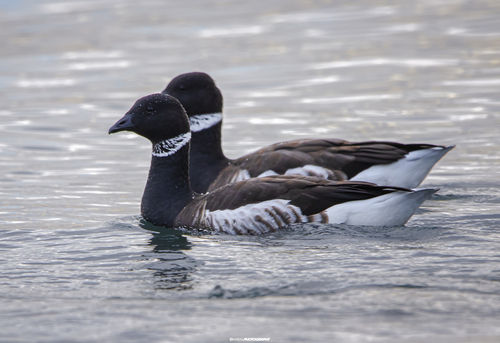 Ringelgans
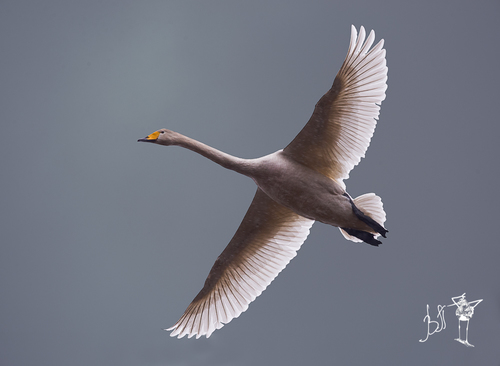 Singschwan
Kurz gesagt
The most reliable way to separate Brent Goose from Whooper Swan is by overall size and structure: Whooper Swan is vastly larger, with a long neck and heavy body, while Brent Goose is compact with a short neck and stubby bill. In flight or at rest, Brent Goose shows a dark body with a small white neck patch and a very short black tail, whereas Whooper Swan is pure white (except for occasional rusty staining on the head/neck) with a long, rounded tail. Juvenile Whooper Swans are pale grey and uniform, while Brent Goose juveniles resemble adults but are smaller and darker. Even at a distance, the swan's size and white plumage are unmistakable compared to the much smaller, darker goose.
Bestimmungstipps
- Size is the single most reliable field mark: Whooper Swan is enormous, more than twice the length and many times the mass of Brent Goose. Even at a distance or in poor light, the swan’s bulk and long neck stand out.
- Neck length and shape: Whooper Swan has a very long, straight neck held upright or outstretched in flight. Brent Goose has a short, thick neck that looks stubby by comparison.
- Bill shape and color: Whooper Swan has a long, wedge-shaped bill with a distinctive yellow and black pattern (adults) or pinkish-grey and blackish (juveniles). Brent Goose has a short, stubby black bill with no yellow or pink.
- Plumage color: Adult Whooper Swan is pure white (sometimes rusty-stained on head/neck), while Brent Goose is always dark-bodied, with black head and neck and a small white neck patch. There is no white-bodied Brent Goose.
- Juvenile contrast: Juvenile Whooper Swans are uniform pale grey, never dark or patchy. Juvenile Brent Geese are dark like adults, never pale grey.
- Tail shape and length: Whooper Swan has a long, rounded tail; Brent Goose has a very short, black tail with a pure white undertail.
- Flight silhouette: Whooper Swan in flight shows long neck, large rounded wings, and all-white plumage. Brent Goose is compact, short-necked, with dark wings and body and a small white tail patch.
- Subspecies variation in Brent Goose: All Brent Goose subspecies are much darker than Whooper Swan. Pale-bellied forms have paler flanks but are still dark overall; black brant is especially dark with a white flank patch.
- Vocalization: Whooper Swan is very vocal, with loud trumpeting calls; Brent Goose is much quieter and lacks the swan’s resonant calls.
- Habitat context: Brent Goose is almost always coastal in winter, especially on saltmarshes and estuaries. Whooper Swan is more often inland on lakes and rivers, but can occur in coastal wetlands.
- Group structure: Whooper Swans often occur in family groups or large, noisy flocks. Brent Geese also flock, but are less vocal and more compact in appearance.
- Feeding posture: Whooper Swan often upends in deeper water, showing its long neck and rounded tail. Brent Goose grazes or dabbles, rarely upending.
- Tail pattern in flight: Whooper Swan shows a rounded, white tail; Brent Goose shows a very short black tail with a white undertail.
- Bill color in juveniles: Juvenile Whooper Swans have a pinkish bill with blackish areas; Brent Goose juveniles have a dark bill like adults.
- Potential confusion: At extreme distance or in poor light, a flock of pale-bellied Brent Geese might appear paler, but the size, structure, and neck length will still separate them from any swan.
Größe
Whooper Swan is one of the heaviest flying birds, averaging over 11 kg for males and 8–9 kg for females, with a length of 140–165 cm and a wingspan up to 275 cm [wikidata][wikipedia]. Brent Goose is much smaller, measuring 55–66 cm in length and with a wingspan of 106–121 cm [wikipedia]. The swan is more than twice as long and many times heavier than the goose. Even at great distance, Whooper Swan's size, long neck, and bulk are obvious, while Brent Goose appears compact and short-necked.
Gefieder
- Juveniles: Juvenile Whooper Swans are uniform pale grey to grey-brown, lacking the brown-and-white patchiness of young Mute Swans, and have a pinkish bill with blackish-grey rather than yellow and black. Juvenile Brent Geese resemble adults of their respective subspecies, being overall dark with a small white neck patch (if present), and never show the uniform pale grey of young swans.
- Adults: Adult Whooper Swans are pure white except for possible rusty staining on the head/neck from feeding. Brent Geese are always dark-bodied, with black head and neck, a small white neck patch, and a short, pure white undertail. The three main subspecies of Brent Goose vary in belly and flank contrast, but all are much darker than any Whooper Swan. In flight, Whooper Swan shows all-white wings, while Brent Goose shows dark wings and body with a small white tail patch.
- Tail: Whooper Swan has a rounded, relatively long tail; Brent Goose has the shortest tail of any goose, which is black and sharply contrasts with the white undertail.
Verhalten
Whooper Swans are often seen in family groups or large flocks, especially in migration or winter, and are highly vocal. They communicate with head bobs and wing flaps before flight. Brent Geese also form flocks, especially in winter, but are less vocal and generally feed by grazing or dabbling. In flight, Whooper Swans have slow, powerful wingbeats and fly with necks outstretched, while Brent Geese have faster wingbeats and a more compact silhouette.
Lebensraum
Both species can be found in coastal or wetland habitats in winter, but Brent Goose is strongly associated with temperate-zone sea-coasts, saltmarshes, and estuaries, especially in western Europe and North America. Whooper Swan is more often found on large lakes, rivers, and flooded fields, especially inland, but can also occur on estuaries. Overlap is possible in some coastal wintering areas, but Whooper Swan is rarely as tied to saltmarsh as Brent Goose.
Stimme
Whooper Swan is very noisy, with loud, resonant trumpeting calls (kloo-kloo-kloo) in groups of three or four, especially when flocking or in flight. Brent Goose is much quieter and less vocal overall; its calls are not described in the notes, but it does not produce the loud, trumpeting sounds of Whooper Swan. In mixed flocks, the swan’s calls are distinctive and carry far.