

Ringelgans vs Reiherente
Branta bernicla gegen Aythya fuligula
Ein Quiz mit Ringelgans und Reiherente spielen
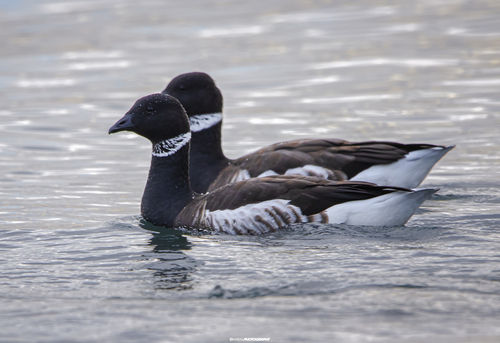 Ringelgans
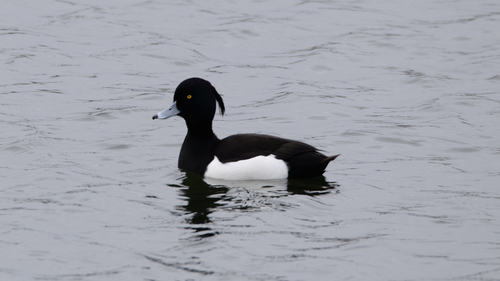 Reiherente
Kurz gesagt
The most reliable field mark to separate Brent Goose from Tufted Duck is overall structure and plumage contrast: Brent Goose is a compact, short-billed goose with a black neck and small white neck patch, while Tufted Duck is a small, round-headed diving duck with a distinct head tuft (on males) and a blue-grey bill. In flight or at rest, Brent Goose always shows a pure white under-tail and very short black tail, while Tufted Duck males show white flanks and a black back, and females are brown with paler flanks. Juvenile and immature upperwing patterns are not described as diagnostic for either species in the sources, so focus on body shape, bill, and head pattern. Both species can occur together on coastal waters in winter, but their jizz and plumage are quite distinct with careful observation.
Bestimmungstipps
- Size and shape: Brent Goose is much larger, with a long neck and goose-like proportions. Tufted Duck is distinctly smaller, with a short neck and compact, rounded body. This is obvious when both are present, but even singly, the jizz is different.
- Bill: Brent Goose has a short, stubby, black bill typical of geese. Tufted Duck has a blue-grey bill (not black), broader at the tip, and never goose-like.
- Head and neck: Brent Goose always shows a black head and neck with a small, neat white patch on each side of the neck (all ages and subspecies). Tufted Duck males have a black head with a long, drooping tuft at the rear, while females are brown with no tuft or just a slight bump. No white neck patch is ever present on Tufted Duck.
- Tail and undertail: Brent Goose has a very short, black tail and a pure white under-tail, which is diagnostic when seen from behind or in flight. Tufted Duck has a standard duck tail, not especially short, and the undertail is not pure white.
- Body plumage: Brent Goose is dark grey-brown (dark-bellied) or has paler flanks (pale-bellied), but never shows the sharp black-and-white contrast of a male Tufted Duck. Black Brant is very dark with a prominent white flank patch, but still has the goose shape and neck patch.
- Male Tufted Duck: Striking black-and-white pattern with pure white flanks and a glossy black back and head, plus a long head tuft. No goose shows this pattern or tuft.
- Female Tufted Duck: Brown overall with paler flanks, sometimes with a small white patch at the bill base, but never a white neck patch or the uniform dark body of Brent Goose. Can be confused with other ducks, but not with geese.
- Flight silhouette: Brent Goose in flight shows a compact, short-tailed, long-necked shape, with steady wingbeats. Tufted Duck is compact, short-necked, and rounded, with rapid wingbeats.
- Flock behavior: Brent Goose flocks are loose and often in lines or V-formations. Tufted Duck flocks are tight, compact, and often take off together in a rush.
- Feeding behavior: Brent Goose grazes on land or mud, rarely dives. Tufted Duck is almost always seen diving for food, rarely on land.
- Habitat context: Brent Goose is almost always coastal, on saltmarsh or estuary. Tufted Duck is more often on freshwater, but can be coastal in winter.
- Voice: Not usually helpful, but Tufted Duck females may give a harsh 'karr' in flight; Brent Goose is mostly silent.
- Juvenile/immature confusion: No distinctive juvenile upperwing marks for either species, so rely on structure and head/neck pattern for all ages.
- Pitfalls: Female Tufted Duck is the most likely confusion risk due to subdued colors, but lacks the white neck patch and goose structure. Black Brant (darkest Brent Goose form) is very dark with a white flank patch, but still has a goose's neck and white neck patch.
- Seasonal variation: All key marks (size, structure, neck patch, tuft, bill color) are present year-round, so separation is reliable in all seasons.
Größe
Brent Goose is significantly larger and heavier than Tufted Duck. Brent Goose measures 55–66 cm in length with a wingspan of 106–121 cm and weighs 0.88–2.2 kg. In contrast, Tufted Duck is a small diving duck (exact measurements not given here, but much smaller and lighter than any goose). Brent Goose has a bulkier body, longer neck, and a distinctly goose-like silhouette, while Tufted Duck is compact, with a short neck and round head. Even at a distance, the size difference is usually apparent when both species are seen together.
Gefieder
- Juvenile/immature wing pattern: No distinctive age-specific upperwing marks are described for either species in the sources, so focus on body and head plumage.
- Brent Goose: All forms have a black head and neck with a small white patch on the side of the neck. The under-tail is always pure white, and the tail is very short and black. The body color varies by subspecies: dark-bellied birds are uniformly dark grey-brown, pale-bellied birds have paler flanks and belly, and black brant are strongly black-and-white with a prominent white flank patch and larger white neck patch (almost forming a collar). The overall impression is of a dark goose with a neat, small white neck patch and a very short tail.
- Tufted Duck: Adult males are glossy black with striking white flanks, a blue-grey bill, golden yellow eyes, and a long, drooping black head tuft. Females are brown with lighter flanks and may show some white at the bill base, but never as much as scaup species. Both sexes lack any white on the neck. The male's black-and-white contrast is sharp, but the pattern is very different from any Brent Goose. Females are more subdued but still lack the goose's neck pattern and tail/undertail contrast.
Verhalten
Brent Goose is a grazing goose, often seen in flocks on coastal saltmarshes, mudflats, or grassy fields, feeding on vegetation. It walks with a horizontal posture, and in flight, flocks move in loose lines or V-formations, with steady, deep wingbeats. Tufted Duck is a diving duck, usually seen swimming low in the water, diving frequently for food. It sits higher on the water than a goose, often in tight flocks, and takes off with rapid wingbeats. In flight, Tufted Duck flocks are compact and fast, with rapid, shallow wingbeats, and individuals show a more rounded, duck-like profile. Brent Goose rarely dives and is almost never seen feeding underwater.
Lebensraum
Both species can be found in coastal habitats in winter, but Brent Goose is strongly associated with saltmarshes, tidal mudflats, and estuaries, rarely venturing far from the coast. Tufted Duck prefers freshwater lakes, reservoirs, and slow rivers, but in winter can be found on sheltered coastal waters, especially where freshwater meets the sea. If seen together, Brent Goose will be grazing or loafing on mud or grass, while Tufted Duck will be swimming and diving. Tufted Duck is much more likely inland, while Brent Goose is almost exclusively coastal.
Stimme
Brent Goose is generally quiet, with only soft grunting or murmuring calls in flocks, rarely heard at a distance. Tufted Duck females give a harsh, growling 'karr' usually in flight, and males whistle 'wit-oo' during courtship, but are mostly silent otherwise. In the field, vocalizations are not usually a primary separation tool between these species.