

Bolivienameisenpitta vs Caucaameisenpitta
Grallaria cochabambae gegen Grallaria alvarezi
Ein Quiz mit Bolivienameisenpitta und Caucaameisenpitta spielen
 Bolivienameisenpitta
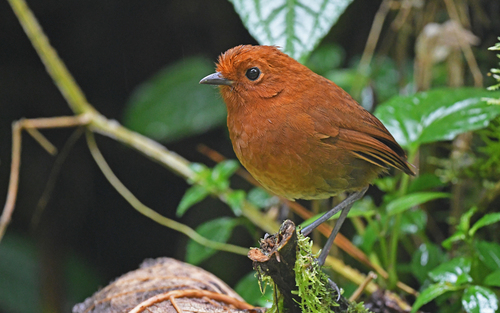 Caucaameisenpitta
Kurz gesagt
The most reliable way to separate Bolivian Antpitta from Chami Antpitta is by overall plumage tone and belly pattern: Chami Antpitta is a deep, intense reddish-brown above and on the breast, with a paler, buffy-brown center to the belly showing a subtle scaly pattern, while Bolivian Antpitta differs in overall coloration (details below) and was split as a species based on these plumage differences. Both are plump, round antpittas with short tails and similar jizz, but their ranges do not overlap: Bolivian is endemic to Bolivia, Chami to Colombia. In the field, focus on the intensity and uniformity of the reddish tones, the contrast with the belly, and any hint of scaling. Age-specific wing pattern is not described for either species, so rely on body plumage and context.
Bestimmungstipps
- Geographic range is the first check: Bolivian Antpitta is only found in Bolivia, Chami only in Colombia. If you are outside these countries, reconsider the ID.
- Overall plumage tone: Chami Antpitta is a deep, intense reddish-brown above and on the breast, noticeably richer than most rufous antpitta complex members. Bolivian Antpitta is less intensely reddish; if the bird looks very rich and uniform, favor Chami.
- Belly contrast and pattern: Chami shows a lighter, buffy-brown center to the belly with a subtle scaly pattern on the lower part. Look for this paler, slightly patterned belly as a key mark. Bolivian is expected to have less contrast and less obvious scaling.
- Breast tone: Chami's breast is even deeper reddish than the rest of the body, creating a subtle gradient. This may not be as pronounced in Bolivian.
- Ventral and tail feather color: Chami's vent and outer tail feathers are slightly paler than the rest of the body. If you see this contrast, it supports Chami.
- Wing and covert pattern: Chami's flight feathers and wing coverts have slightly dusky inner webs, but this is a subtle mark and not likely to separate from Bolivian in the field.
- Bill, tail, and structure: Both are plump, round, with short tails and stout bills; these features will not help separate them.
- Sex and age: Sexes are alike in Chami, and no sexual dimorphism is noted for Bolivian. No age-specific wing or flight marks are described for either, so do not rely on these.
- Voice: If you hear a rapid, descending trill lasting 2.5–3.5 seconds, or a short, stuttering trill after a clear note, you are likely hearing Chami. Bolivian's vocalizations are not described here, so absence of these songs is not diagnostic.
- Behavior: Both species forage by hopping or running on the forest floor, pausing to flip leaf litter and probe for prey. Behavior is not a separator.
- Context: If you are in montane forest in Bolivia, expect Bolivian Antpitta; in Colombia, expect Chami. Misidentifications are most likely in photos or in captivity, not in the wild.
- Pitfalls: The biggest risk is assuming all rufous antpitta complex birds are the same; subtle differences in belly color and pattern are key. Lighting can affect perceived color, so try to see the bird in good light.
- When marks fail: If you cannot see the belly or the bird is in deep shadow, identification may not be possible to species. Use range and vocalizations as supporting evidence.
- Summary for field use: Focus on the intensity of reddish tones, the contrast and pattern of the belly, and the country you are birding in. If in doubt, document the bird with photos and sound recordings for expert review.
Größe
Chami Antpitta is about 14.5–15 cm (5.7–5.9 in) in length [wikipedia]. No direct measurement is given for Bolivian Antpitta, but as both are members of the rufous antpitta complex, they are likely similar in size and structure. Both species are described as plump and round with short tails and stout bills, so size and shape are not reliable for separation.
Gefieder
No age-specific wing or flight pattern differences are described for either species; both appear to lack distinctive juvenile or immature upperwing marks in the available notes. For adults, Chami Antpitta is described as almost entirely an intense reddish-brown, with the breast even deeper in tone. The center of the belly is a lighter buffy brown, showing a slight scaly pattern on the lower part, and the vent and outer tail feathers are paler than the body. The flight feathers and wing coverts have slightly dusky inner webs. Bolivian Antpitta was split from the rufous antpitta complex based on differences in plumage color and vocalizations, but the precise color differences are not detailed in the notes. However, the implication is that Bolivian Antpitta is less intensely reddish overall, and may lack the strong contrast and subtle scaling on the belly that is diagnostic for Chami. Sexes are alike in Chami; no sexual dimorphism is noted for Bolivian.
Verhalten
Both species are typical Grallaria antpittas: plump, round, and often fluffed up, with a tendency to hop or run on the forest floor, pausing to forage. Chami Antpitta is known to flip leaf litter and probe the soil for invertebrates and earthworms. There is no behavioral trait in the notes that reliably separates these two species in the field.
Lebensraum
Range is a strong separator: Bolivian Antpitta is endemic to Bolivia, while Chami Antpitta is endemic to Colombia. If you are birding in Bolivia, Chami is not expected, and vice versa. Both inhabit forest floor environments, but habitat details are not diagnostic beyond range.
Stimme
Chami Antpitta has a distinctive long song: a rapid, slightly descending trill of short, low-bandwidth notes lasting 2.5–3.5 seconds, and a short song: a quick (0.4–0.5 s) vocalization starting with a clear note, then a brief pause, followed by a fast, accelerating trill of 4–5 notes with a stuttering, purring quality. Chami sings mostly at dawn from low perches. Bolivian Antpitta was split from the rufous antpitta complex partly on vocal differences, but no specific description of its song is given here. Thus, Chami's described vocalizations can help confirm its identity, but lack of a detailed Bolivian song means this is not a complete separator.
Bolivienameisenpitta · Caucaameisenpitta · Meine schwierigen Vögel