

Saumschnabelente vs Augenbrauenente
Hymenolaimus malacorhynchos gegen Anas superciliosa
Ein Quiz mit Saumschnabelente und Augenbrauenente spielen
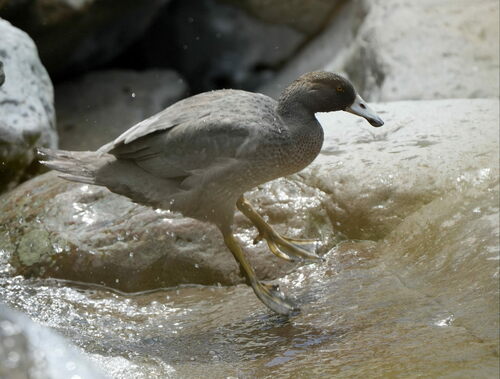 Saumschnabelente
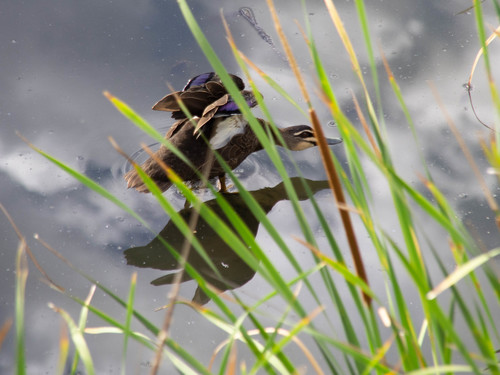 Augenbrauenente
Kurz gesagt
The most reliable field mark to separate Blue Duck from Pacific Black Duck is the overall plumage: Blue Duck is a uniform dark slate-grey with a subtle greenish sheen and chestnut-flecked breast, while Pacific Black Duck shows a contrasting pale face with bold dark eye-stripes and a green speculum in flight. Juvenile Blue Ducks lack the facial stripes and have oversized dark grey legs and feet, unlike the more typical duckling appearance of Pacific Black Duck. Bill structure and color are also distinctive, with Blue Duck showing a unique semicircular soft flap at the bill tip and color changes under stress. In flight or at rest, the Blue Duck's uniformity and lack of strong facial pattern are key, whereas Pacific Black Duck always shows a strong supercilium and facial contrast.
Bestimmungstipps
- Facial pattern: Pacific Black Duck always shows a pale face with a bold dark eye-stripe (supercilium) and dark crown; Blue Duck never shows any facial stripes or pale areas, appearing uniform slate-grey. This is the single most reliable mark at all ages and distances.
- Overall color: Blue Duck is dark slate-grey with a greenish head sheen and chestnut-flecked breast; Pacific Black Duck is darker-bodied but with a distinctly paler head and strong facial contrast.
- Speculum and wing pattern: In flight, Pacific Black Duck shows a green speculum and pale underwing; Blue Duck has white-tipped outer secondaries and black-margined inner secondaries, but no strong speculum or pale underwing. This is most useful on flying or flapping birds.
- Bill structure: Blue Duck has a unique semicircular soft flap at the bill tip, visible at close range, and the bill can turn pink when agitated. Pacific Black Duck has a standard duck bill with no flap and no color change.
- Legs and feet: Juvenile Blue Ducks have oversized, dark grey legs and feet; Pacific Black Duck juveniles have more typical proportions and coloration.
- Iris color: Juvenile Blue Ducks have a grey iris, turning yellow in adults; Pacific Black Duck iris color is not distinctive for separation.
- Size: Pacific Black Duck is larger and longer, but this is only useful with direct comparison or in hand.
- Behavior: Blue Duck is solitary or in pairs, fiercely territorial, and found only on fast-flowing rivers; Pacific Black Duck is gregarious, often in flocks, and uses a wide variety of wetlands.
- Habitat: Blue Duck is confined to rocky, forested mountain rivers in New Zealand; Pacific Black Duck is found in almost any wetland, including lowland lakes and urban ponds.
- Voice: Blue Duck gives a high-pitched 'whio' whistle (mainly males); Pacific Black Duck gives a loud, rapid quack (mainly females). If you hear a whistle, it's Blue Duck; a quack points to PBD.
- Chestnut breast: Blue Duck shows chestnut flecking on the breast (less in females), absent in Pacific Black Duck.
- Feet color: Blue Duck has dark grey legs and feet; PBD's are not specifically described but are not diagnostic.
- Aggressive display: Blue Duck may show a pink bill when agitated, which is unique among ducks in the region.
- Flight jizz: Blue Duck in flight appears uniformly dark with no pale underwing or strong speculum; PBD shows a pale underwing and green speculum, making it flashier in flight.
- Pitfalls: Do not rely on size or general darkness; always check for facial stripes and speculum. Juvenile Blue Ducks are especially easy to confuse with dark ducks, but lack any pale face or eye-stripe.
Größe
Pacific Black Duck is the larger of the two, averaging about 1035 g compared to the Blue Duck's 832.5 g. PBD is also longer (54–61 cm) than Blue Duck (50–55 cm), but this difference is subtle in the field and easily masked by posture or distance. Both species show some sexual size dimorphism, with males larger than females. Size alone is not a reliable separator unless both species are side by side.
Gefieder
- Juvenile/immature birds: Blue Duck juveniles are slate-grey all over, with oversized dark grey legs and feet and a grey iris; they lack any facial stripes or pale areas. Pacific Black Duck juveniles already show the pale face and strong dark eye-stripes, with a green speculum visible in flight and pale underwing.
- Adults: Blue Duck adults remain slate-grey with a greenish sheen on the head and chestnut-flecked breast, and have white-tipped outer secondaries and black-margined inner secondaries (not a strong speculum). The bill is pale grey but can turn pink when agitated. Pacific Black Duck adults have a dark body, but the head is distinctly paler with a dark crown and bold dark eye-stripes (supercilium), plus a green speculum and pale underwing in flight. All ages of PBD show this facial pattern, which is never present in Blue Duck.
- Sexes: Both species have similar plumage between sexes, though female Blue Ducks have slightly less chestnut on the breast.
Verhalten
Blue Duck is highly territorial, especially during breeding, and is almost always seen in pairs or alone on fast-flowing mountain rivers. They are strong swimmers and climbers, often seen perching on rocks in rapids. Pacific Black Duck is sociable, often in flocks, and uses a wider range of wetland habitats. PBD feeds by upending, while Blue Duck specializes in feeding in fast currents, sometimes diving or dabbling among rocks. Blue Duck's territorial defense includes aggressive postures and vocalizations, while Pacific Black Duck is more likely to be seen in mixed-species groups or with Mallards.
Lebensraum
Blue Duck is strictly endemic to New Zealand and confined to fast-flowing, rocky rivers in forested or mountainous areas. It is never found on lakes, ponds, or slow-moving water. Pacific Black Duck is widely distributed across Australasia and the Pacific, using almost any wetland, including lakes, ponds, rivers, estuaries, and even urban parks. In New Zealand, PBD is much more likely in lowland or open water, while Blue Duck is restricted to remote, upland rivers.
Stimme
Blue Duck males give a distinctive high-pitched 'whio' whistle, especially in the morning, while females are quieter. Pacific Black Duck females produce a loud, raucous quack, similar to a Mallard but more rapid and decreasing in volume. Voice is useful if heard well: a whistled 'whio' is diagnostic for Blue Duck, while quacking points to PBD.
Saumschnabelente · Augenbrauenente · Meine schwierigen Vögel