

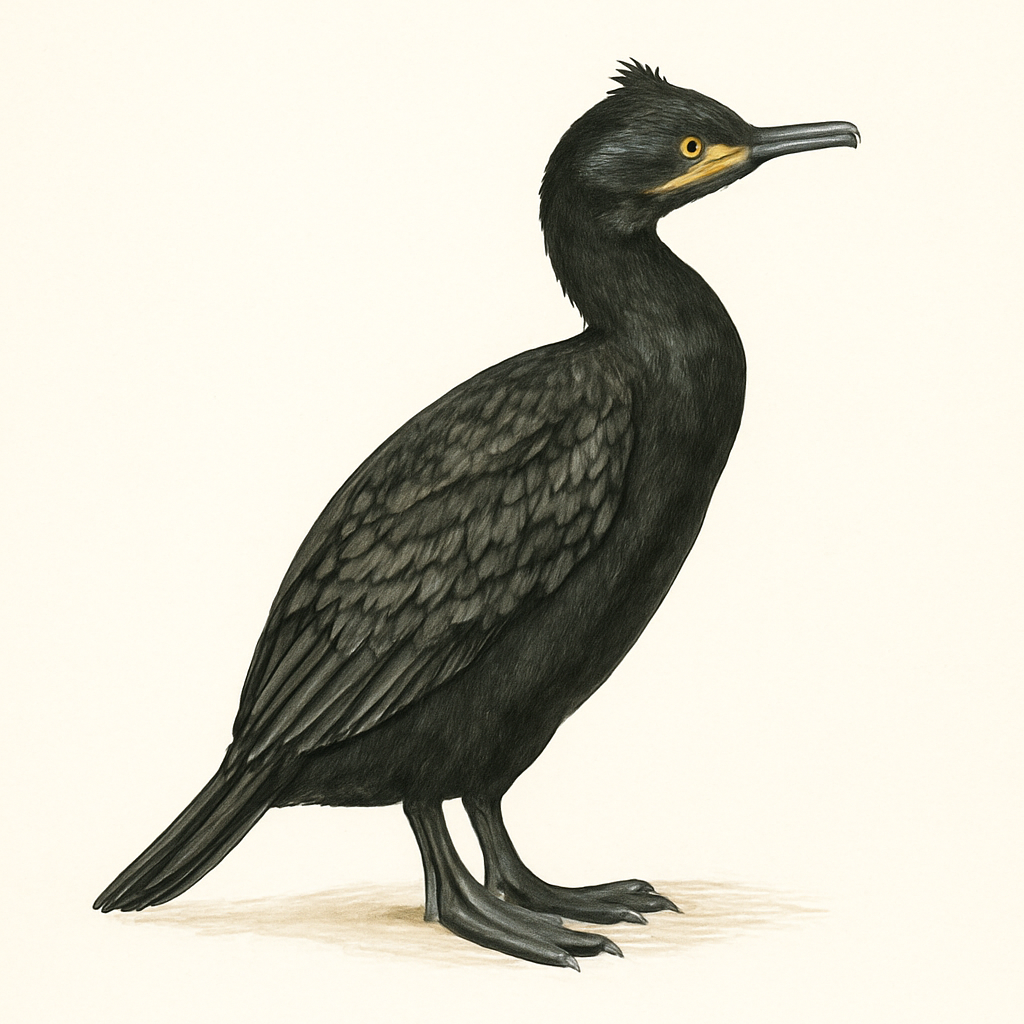
Krähenscharbe
Gulosus aristotelis
Cormorants and Shags (Phalacrocoracidae) · Suliformes · Scharben und Schlangenhalsvögel
Ein Quiz mit Krähenscharbe und ähnlichen Arten spielen
Alle Fotos, Videos und Töne ansehen
Geprüft
O-o, unsere KI-Credits sind alle. Ich entwickle Motmot in meiner Freizeit, und es gibt gerade keine Finanzierung. Wenn du helfen möchtest, dass es wächst, schreib mir an info@motmot.club.
So bestimmst du Krähenscharbe
Bestimmungshinweise werden geschrieben…
Dafür werden Bestimmungshinweise aus offenen Quellen gesucht und vom Modell zu einem Text verarbeitet. Das kann eine Minute dauern.
Melde dich an, um Bestimmungshinweise für diesen Vogel zu erstellen.
Oft verwechselt mit
In Quiz verwechseln Spieler Krähenscharbe am häufigsten mit diesen Vögeln—entweder wurde diese Art irrtümlich gewählt oder umgekehrt.
| Arten | Verwechslungen |
|---|---|
| Kormoran Phalacrocorax carbo | 221 |
| Zwergscharbe Microcarbo pygmaeus | 47 |
| Ohrenscharbe Nannopterum auritum | 23 |
| Basstölpel Morus bassanus | 14 |
| Weißstorch Ciconia ciconia | 3 |
Familie
Phalacrocoracidae is a family of approximately 40 species of aquatic birds found worldwide and commonly known as cormorants and shags. Several different classifications of the family have been proposed, but in 2021 the International Ornithologists' Union (IOU) adopted a consensus taxonomy of seven genera. The great cormorant (Phalacrocorax carbo) and the common shag (Gulosus aristotelis) are the only two species of the family commonly encountered in Britain and Ireland.
Ordnung
The order Suliformes (, dubbed "Phalacrocoraciformes" by Christidis & Boles 2008) is an order of birds that includes gannets, boobies, frigatebirds, cormorants and darters. The order is recognised by the International Ornithologist's Union. Regarding the recent evidence that the traditional Pelecaniformes is polyphyletic, it has been suggested that the group be divided to reflect the true evolutionary relationships; a 2017 study indicated that they are most closely related to Otidiformes (bustards) and Ciconiiformes (storks).