

Motmot

Yellow Tyrannulet vs Greenish Elaenia

Capsiempis flaveola versus Myiopagis viridicata

Play a quiz with Yellow Tyrannulet and Greenish Elaenia
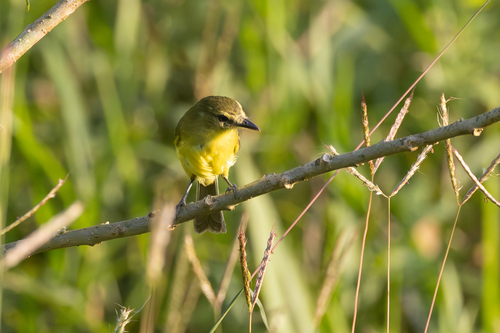
Yellow Tyrannulet (Capsiempis flaveola) Yellow Tyrannulet
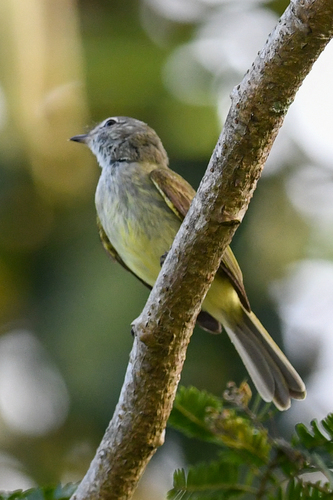
Greenish Elaenia (Myiopagis viridicata) Greenish Elaenia

Media

Loading…

In short

The most reliable field mark to separate Yellow Tyrannulet from Greenish Elaenia is the overall brightness and extent of yellow on the underparts and face: Yellow Tyrannulet is much brighter yellow below and on the supercilium, while Greenish Elaenia is paler below with a more whitish or grayish throat and a whitish (not yellow) supercilium. Greenish Elaenia is also noticeably larger and heavier-bodied, with a stouter appearance. Both species have olive upperparts and wingbars, but the Tyrannulet's are less distinct and its bill is longer and more curved. In the field, look for the Tyrannulet's compact, bright yellow look and the Elaenia's larger, duller, and more olive-green impression.

Identification tips

  1. Underpart color: Yellow Tyrannulet is bright yellow below (throat, breast, belly), while Greenish Elaenia has a pale gray to whitish throat and breast, with only pale yellow on the belly and undertail. This is often the quickest field check—if the bird looks very yellow below, it's a Tyrannulet.
  2. Supercilium color: Tyrannulet has a bright yellow supercilium (eyebrow), while Elaenia's is whitish gray. This is visible in good light and is a strong mark on perched birds.
  3. Facial pattern: Tyrannulet shows a bright yellow partial eye ring and a dark line through the eye on a yellowish face. Elaenia has a partial white eyering and grizzled whitish ear coverts, giving a more muted facial contrast.
  4. Crown: Tyrannulet's crown is dark yellowish olive with a bushy crest, but no central stripe. Elaenia's crown is greenish olive with a faint grayish tinge and a partially concealed yellow central stripe (best in males, but sometimes hard to see).
  5. Upperparts: Both are olive, but Tyrannulet is darker yellowish olive, Elaenia is more greenish-olive (sometimes brighter or duller depending on subspecies).
  6. Wingbars: Tyrannulet has two wide but indistinct pale yellow or buffy wingbars; Elaenia's are yellowish and more distinct. In poor light, this can be subtle, but Elaenia's wingbars often stand out more.
  7. Bill shape: Tyrannulet has a longer, somewhat curved black bill with a pale base to the mandible; Elaenia's bill is shorter, stouter, and brownish-black or black with a lighter base. Bill shape is best judged in profile views.
  8. Size and structure: Elaenia is much larger and heavier (13–14 cm, 11–14 g) than Tyrannulet (10–11.5 cm, ~8 g). Tyrannulet looks small, compact, and delicate, almost warbler-like; Elaenia is bulkier and longer-bodied.
  9. Leg color: Both have dark gray to blackish legs and feet, not a useful separator.
  10. Behavior: Tyrannulet is often more active and restless, flicking wings and tail; Elaenia is more deliberate and less frenetic.
  11. Habitat: Tyrannulet prefers dense shrubs and low trees, often in thickets or hedgerows; Elaenia is more often in open woodland, forest edge, or taller trees.
  12. Voice: Tyrannulet's song is a lively, sputtering, or trilled series, often rapid and variable; Elaenia's song is less described here but is generally less sputtering and more plaintive or whistled.
  13. Sex and age: Both sexes are similar in both species; no strong seasonal or sex differences. No distinctive juvenile wing patterns are described for either species.
  14. Pitfalls: In poor light, Elaenia's pale yellow belly can look brighter, and Tyrannulet's yellow may be muted by shade. Always check multiple features—especially underpart color and supercilium.
  15. When marks fail: If you only see the bird from above, both can look olive with wingbars. Try to get a side or front view to check underparts and face.

Size

Greenish Elaenia is substantially larger and heavier than Yellow Tyrannulet. Elaenia measures 13–14 cm in length and weighs 11–14 g, while Tyrannulet is only 10–11.5 cm and about 8 g. This size difference is often apparent in direct comparison: Elaenia looks bulkier and longer-bodied, with a stouter jizz, whereas Tyrannulet is notably small and delicate. If you see both species in the same area, the Tyrannulet will appear almost warbler-sized, while Elaenia is closer to a typical small flycatcher.

Plumage

No specific juvenile or immature wing patterns are described for either species, so focus on adult and general plumage. Yellow Tyrannulet is bright yellow below (throat, breast, belly) with an ochraceous or olive tinge on the breast and sides, and has a bright yellow supercilium and partial eye ring. Its upperparts are dark yellowish olive, and the wings and tail are dusky olive with pale yellow to buffy yellow edges and two wide, but indistinct, wingbars. Greenish Elaenia, in contrast, has a much paler underside: pale gray to whitish throat and breast (sometimes with faint olive streaks), and only pale yellow on the belly and undertail coverts. Its supercilium is whitish gray, not yellow, and the crown has a faint grayish tinge with a partially concealed yellow central stripe (more obvious in males). Elaenia's wingbars are yellowish and distinct, and its upperparts are olive-green. These differences are consistent across sexes and most subspecies, though some regional variation exists in both species.

Behaviour

Both species are active and vocal, often foraging in the midstory or canopy of shrubs and trees. Yellow Tyrannulet tends to be more restless and is often seen flicking its wings and tail, giving a very energetic impression. Greenish Elaenia, being larger, may appear more deliberate and less frenetic in its movements. Both can join mixed-species flocks but Tyrannulet's smaller size and brighter color can make it stand out in such groups.

Habitat

Both species have broad ranges and can overlap in Central and South America. Yellow Tyrannulet is found in a wide variety of shrubby or edge habitats, often in tall shrubs or small trees, and is generally more associated with dense, low vegetation. Greenish Elaenia is also widespread but is often found in taller forest edges, open woodlands, and sometimes more open or drier habitats. Both can occur in disturbed areas, but Tyrannulet is more likely in dense thickets and hedgerows, while Elaenia is more often in open woodland or forest edge.

Voice

Both species are vocal, but their songs and calls differ. Yellow Tyrannulet gives a variety of sputtering, chattering, or trilled notes, often described as 'wheep' or 'wee-deep' in series, or rapid rhythmic chatters and trills. Greenish Elaenia's vocalizations are not described in detail here, but are generally less sputtering and more typical of elaenias (often whistled or plaintive). In areas of overlap, the Tyrannulet's lively, rapid, and variable song can be a helpful clue, especially if you hear a sputtering or trilled series.

Submit a better description

Use the same sections as the comparison. Your text is published immediately.

The most reliable field mark to separate Yellow Tyrannulet from Greenish Elaenia is the overall brightness and extent of yellow on the underparts and face: Yellow Tyrannulet is much brighter yellow below and on the supercilium, while Greenish Elaenia is paler below with a more whitish or grayish throat and a whitish (not yellow) supercilium. Greenish Elaenia is also noticeably larger and heavier-bodied, with a stouter appearance. Both species have olive upperparts and wingbars, but the Tyrannulet's are less distinct and its bill is longer and more curved. In the field, look for the Tyrannulet's compact, bright yellow look and the Elaenia's larger, duller, and more olive-green impression.

  1. Underpart color: Yellow Tyrannulet is bright yellow below (throat, breast, belly), while Greenish Elaenia has a pale gray to whitish throat and breast, with only pale yellow on the belly and undertail. This is often the quickest field check—if the bird looks very yellow below, it's a Tyrannulet.
  2. Supercilium color: Tyrannulet has a bright yellow supercilium (eyebrow), while Elaenia's is whitish gray. This is visible in good light and is a strong mark on perched birds.
  3. Facial pattern: Tyrannulet shows a bright yellow partial eye ring and a dark line through the eye on a yellowish face. Elaenia has a partial white eyering and grizzled whitish ear coverts, giving a more muted facial contrast.
  4. Crown: Tyrannulet's crown is dark yellowish olive with a bushy crest, but no central stripe. Elaenia's crown is greenish olive with a faint grayish tinge and a partially concealed yellow central stripe (best in males, but sometimes hard to see).
  5. Upperparts: Both are olive, but Tyrannulet is darker yellowish olive, Elaenia is more greenish-olive (sometimes brighter or duller depending on subspecies).
  6. Wingbars: Tyrannulet has two wide but indistinct pale yellow or buffy wingbars; Elaenia's are yellowish and more distinct. In poor light, this can be subtle, but Elaenia's wingbars often stand out more.
  7. Bill shape: Tyrannulet has a longer, somewhat curved black bill with a pale base to the mandible; Elaenia's bill is shorter, stouter, and brownish-black or black with a lighter base. Bill shape is best judged in profile views.
  8. Size and structure: Elaenia is much larger and heavier (13–14 cm, 11–14 g) than Tyrannulet (10–11.5 cm, ~8 g). Tyrannulet looks small, compact, and delicate, almost warbler-like; Elaenia is bulkier and longer-bodied.
  9. Leg color: Both have dark gray to blackish legs and feet, not a useful separator.
  10. Behavior: Tyrannulet is often more active and restless, flicking wings and tail; Elaenia is more deliberate and less frenetic.
  11. Habitat: Tyrannulet prefers dense shrubs and low trees, often in thickets or hedgerows; Elaenia is more often in open woodland, forest edge, or taller trees.
  12. Voice: Tyrannulet's song is a lively, sputtering, or trilled series, often rapid and variable; Elaenia's song is less described here but is generally less sputtering and more plaintive or whistled.
  13. Sex and age: Both sexes are similar in both species; no strong seasonal or sex differences. No distinctive juvenile wing patterns are described for either species.
  14. Pitfalls: In poor light, Elaenia's pale yellow belly can look brighter, and Tyrannulet's yellow may be muted by shade. Always check multiple features—especially underpart color and supercilium.
  15. When marks fail: If you only see the bird from above, both can look olive with wingbars. Try to get a side or front view to check underparts and face.

Greenish Elaenia is substantially larger and heavier than Yellow Tyrannulet. Elaenia measures 13–14 cm in length and weighs 11–14 g, while Tyrannulet is only 10–11.5 cm and about 8 g. This size difference is often apparent in direct comparison: Elaenia looks bulkier and longer-bodied, with a stouter jizz, whereas Tyrannulet is notably small and delicate. If you see both species in the same area, the Tyrannulet will appear almost warbler-sized, while Elaenia is closer to a typical small flycatcher.

No specific juvenile or immature wing patterns are described for either species, so focus on adult and general plumage. Yellow Tyrannulet is bright yellow below (throat, breast, belly) with an ochraceous or olive tinge on the breast and sides, and has a bright yellow supercilium and partial eye ring. Its upperparts are dark yellowish olive, and the wings and tail are dusky olive with pale yellow to buffy yellow edges and two wide, but indistinct, wingbars. Greenish Elaenia, in contrast, has a much paler underside: pale gray to whitish throat and breast (sometimes with faint olive streaks), and only pale yellow on the belly and undertail coverts. Its supercilium is whitish gray, not yellow, and the crown has a faint grayish tinge with a partially concealed yellow central stripe (more obvious in males). Elaenia's wingbars are yellowish and distinct, and its upperparts are olive-green. These differences are consistent across sexes and most subspecies, though some regional variation exists in both species.

Both species are active and vocal, often foraging in the midstory or canopy of shrubs and trees. Yellow Tyrannulet tends to be more restless and is often seen flicking its wings and tail, giving a very energetic impression. Greenish Elaenia, being larger, may appear more deliberate and less frenetic in its movements. Both can join mixed-species flocks but Tyrannulet's smaller size and brighter color can make it stand out in such groups.

Both species have broad ranges and can overlap in Central and South America. Yellow Tyrannulet is found in a wide variety of shrubby or edge habitats, often in tall shrubs or small trees, and is generally more associated with dense, low vegetation. Greenish Elaenia is also widespread but is often found in taller forest edges, open woodlands, and sometimes more open or drier habitats. Both can occur in disturbed areas, but Tyrannulet is more likely in dense thickets and hedgerows, while Elaenia is more often in open woodland or forest edge.

Both species are vocal, but their songs and calls differ. Yellow Tyrannulet gives a variety of sputtering, chattering, or trilled notes, often described as 'wheep' or 'wee-deep' in series, or rapid rhythmic chatters and trills. Greenish Elaenia's vocalizations are not described in detail here, but are generally less sputtering and more typical of elaenias (often whistled or plaintive). In areas of overlap, the Tyrannulet's lively, rapid, and variable song can be a helpful clue, especially if you hear a sputtering or trilled series.

Discard your changes?

You have unsaved edits. If you leave now, those changes will be lost.

Yellow Tyrannulet · Greenish Elaenia · My Tricky Birds