

Yellow-browed Warbler vs Greenish Warbler
Phylloscopus inornatus versus Phylloscopus trochiloides
Play a quiz with Yellow-browed Warbler and Greenish Warbler
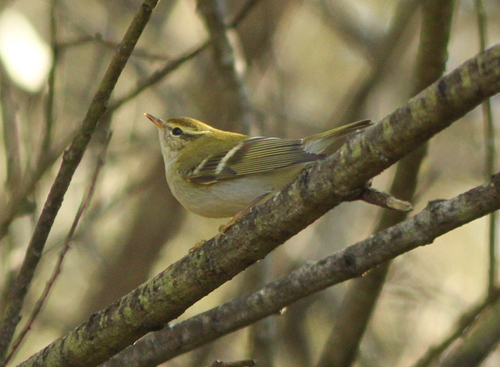 Yellow-browed Warbler
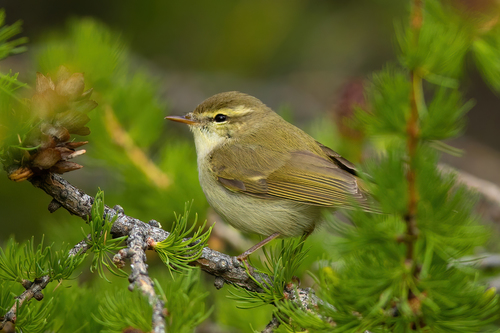 Greenish Warbler
In short
The most reliable field mark between Yellow-browed Warbler and Greenish Warbler is the presence of two clear wing bars on Yellow-browed (all ages), versus a single faint or absent wing bar on most Greenish Warblers. Yellow-browed also has a brighter, longer yellowish supercilium and more contrasting tertial edges, while Greenish is generally duller above and below with only a faint wing bar and less obvious facial markings. Structure is subtly different, with Yellow-browed being slightly smaller and more compact. Calls and songs are distinct, but may be hard to separate without experience. Focus on the wing bar pattern and supercilium for the most consistent field separation, especially in autumn and among immatures.
Identification tips
- Wing bars: Yellow-browed Warbler always shows two clear, pale wing bars (greater and median coverts) in all ages and seasons. Greenish Warbler usually has only a single faint wing bar (sometimes absent); a second bar, if present, is always much less distinct than in Yellow-browed.
- Tertial edges: Yellow-browed has bright yellowish edges to the tertials, giving a crisp, contrasting look. Greenish has less contrast on the tertials, blending more with the upperparts.
- Supercilium: Yellow-browed's supercilium is long, bright yellow, and very prominent, extending well behind the eye. Greenish's is shorter, duller, and less sharply defined.
- Crown stripe: Some Yellow-browed Warblers show a faint pale central crown stripe, but this is variable and not always present. Greenish Warbler lacks any crown stripe.
- Facial contrast: Yellow-browed has a more striking facial pattern overall, with a strong supercilium and darker eye-stripe. Greenish is more subdued, with less contrast.
- Upperpart color: Yellow-browed is greenish above and white below, often appearing brighter and more 'clean-cut.' Greenish is grayish-green above and off-white below, generally duller.
- Bill: Both have fine bills, but Greenish's is slightly thinner and lacks a dark tip to the lower mandible. This is subtle and rarely diagnostic in the field.
- Leg color: Not reliably diagnostic between these two (notes mention dark legs in Hume's, not Greenish).
- Size and structure: Yellow-browed is slightly smaller and more compact, but this is hard to judge without direct comparison.
- Behavior: Both are active and arboreal, but Yellow-browed may appear more restless. Not a reliable separator.
- Song and call: Yellow-browed gives a piercing, disyllabic 'tseeweest' call and high-pitched whistles. Greenish gives a high, jerky trill. With experience, these are separable, but not always easy for beginners.
- Season and location: In Britain and Western Europe, Yellow-browed is a much more regular autumn migrant and winterer. Greenish is rarer and more likely in spring or early autumn.
- Pitfalls: Do not confuse faint second wing bars on some Greenish Warblers (especially eastern birds) for the bold, crisp double bars of Yellow-browed. Always assess both wing bars and tertial edges together.
- In flight: Look for the double wing bars and yellow tertial edges on Yellow-browed, which are often visible even in brief views. Greenish will look plainer, with only a faint wing bar.
- Juvenile/immature birds: The wing bar and tertial pattern holds for all ages, making this the most robust field mark regardless of season.
Size
Yellow-browed Warbler is one of the smallest Old World warblers, measuring 9.5–11 cm and weighing 4–9 g [wikipedia]. Greenish Warbler is slightly larger, but still a small leaf warbler; exact measurements are not given here, but it is described as slightly smaller than Arctic Warbler and larger than Yellow-browed. In the field, the difference is subtle and not usually diagnostic unless both are seen side by side. Both are delicate, active birds, but Yellow-browed tends to look more compact.
Plumage
- Juvenile/First-winter/Immature (and adult non-breeding):
- Yellow-browed Warbler always shows two prominent pale wing bars (greater and median coverts) and yellowish edges to tertials, regardless of age or season. The supercilium is long, bright yellow, and stands out strongly. Some birds may show a faint pale crown stripe, but this is not always present.
- Greenish Warbler typically has only a single faint wing bar (sometimes absent) and less contrast on the tertials. The supercilium is present but duller and shorter, and the overall plumage is more subdued grayish-green above and off-white below. Some eastern populations may show a trace of a second wing bar, but it is never as bold as in Yellow-browed.
- Adult breeding: Both species become slightly duller, but the wing bar pattern remains the best separator. Greenish Warbler never shows the crisp double wing bars of Yellow-browed.
- In flight: The double wing bars and yellow tertial edges of Yellow-browed are often visible even in brief views, while Greenish looks plainer with only a faint wing bar at most.
Behaviour
Both species are highly active and arboreal, often foraging in the outer foliage and rarely sitting still. Yellow-browed Warbler is described as almost constantly in motion, which can make observation tricky. Greenish Warbler behaves similarly, but there are no strong behavioral differences noted that aid in separation. Both may descend lower in trees during migration or in winter, but this is not a reliable field mark.
Habitat
Yellow-browed Warbler breeds in the east Palearctic and winters mainly in tropical South and Southeast Asia, with small numbers regularly wintering in western Europe, especially in mild coastal areas. It favors lowland and montane forests, but in winter can be found in more open woods. Greenish Warbler breeds from northeastern Europe across temperate to subtropical Asia, wintering in India. It prefers lowland deciduous or mixed forest for breeding and may move to montane forest in the hot months. Both can occur as vagrants in Western Europe, especially in autumn, but Yellow-browed is more regular and numerous as a vagrant/winterer in Britain.
Voice
Yellow-browed Warbler has a high-pitched, loud, disyllabic call ('tseeweest') and a medley of high whistles. Greenish Warbler gives a high, jerky trill, sometimes with downslurred notes. The calls and songs are distinct with experience, but not always easy to separate in the field unless heard well. Yellow-browed's call is notably piercing for its size, while Greenish's song is more warbling and less sharp.