
Motmot

Wilson's Phalarope vs Grey Phalarope

Phalaropus tricolor versus Phalaropus fulicarius

Play a quiz with Wilson's Phalarope and Grey Phalarope
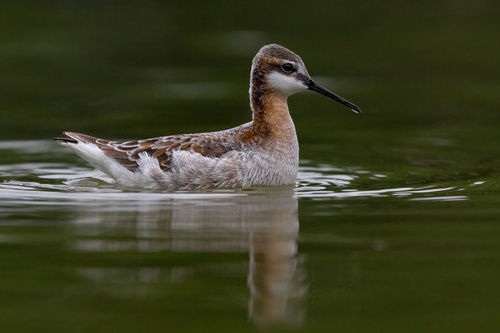
Wilson's Phalarope (Phalaropus tricolor) Wilson's Phalarope
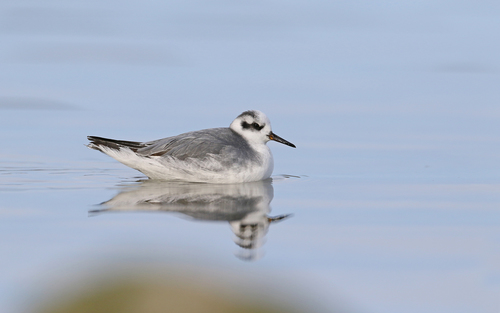
Grey Phalarope (Phalaropus fulicarius) Grey Phalarope

Media

Loading…

In short

The most reliable way to separate Wilson's Phalarope from Grey (Red) Phalarope is by noting bill color and structure, especially in breeding plumage: Wilson's always has a fine, straight, entirely black bill, while Grey Phalarope shows a thicker, yellow bill with a black tip in breeding plumage, turning all-black in winter. Both species show a dark eyepatch in juvenile and winter plumages, so this is not diagnostic on its own. Wilson's Phalarope is slightly larger and slimmer, with a longer, finer bill and a more elegant, dainty appearance, while Grey Phalarope is chunkier. In breeding plumage, Wilson's female is mostly gray and brown above with reddish patches on the neck and flanks, whereas Grey Phalarope female is much brighter, with rich red underparts and bold white cheek patches. In winter or juvenile plumage, both are gray above and white below, but Wilson's is paler and longer-necked. Habitat and context can help: Wilson's is a prairie and inland saline lake bird, while Grey Phalarope breeds in the high Arctic and winters at sea.

Identification tips

  1. Bill color and shape: In breeding plumage, Wilson's Phalarope always has a fine, straight, entirely black bill. Grey Phalarope has a thicker, yellow bill with a black tip (breeding), turning all-black in winter. This is the most reliable mark in adults.
  2. Size and structure: Wilson's is larger, longer-necked, and slimmer, with a more elegant, dainty look. Grey Phalarope is chunkier and shorter-necked. This is subtle but useful in direct comparison or with experience.
  3. Breeding female plumage: Wilson's female is gray and brown above, white below, with reddish neck and flank patches. Grey Phalarope female is much more vivid: dark above, rich red below, and with a bold white cheek patch. Males of both are duller but follow the same pattern.
  4. Juvenile and winter plumage: Both are gray above and white below with a dark eyepatch, but Wilson's is paler and cleaner-faced, while Grey Phalarope is more buff below and has a broader, more contrasting eyepatch. This is subtle and not always reliable.
  5. Eyepatch: Both species show a dark eyepatch in juvenile and winter plumages, so this feature alone does not separate them.
  6. Bill thickness: Even in winter, Wilson's bill is finer and needle-like, while Grey Phalarope's is stouter (though both are straight and black in winter).
  7. Habitat: Wilson's is almost always found on inland lakes and wetlands, especially saline lakes during migration. Grey Phalarope is a bird of the high Arctic and open ocean, rarely found inland except as a vagrant.
  8. Feeding behavior: Both spin in circles to feed, but Wilson's is more likely to be seen in large flocks on lakes, while Grey Phalarope may be seen at sea, sometimes near whales or upwellings.
  9. Sexual dimorphism: In both species, females are larger and more brightly colored than males. This is most apparent in breeding plumage.
  10. Flight jizz: Wilson's appears more elongated and elegant in flight, with a longer neck and finer bill. Grey Phalarope is more compact and robust.
  11. Context clues: Season and location are important. In North American prairies or saline lakes, especially in migration, Wilson's is expected. Offshore, especially in the Atlantic or Pacific, Grey Phalarope is far more likely.
  12. Plumage pitfalls: In non-breeding and juvenile plumages, both species look very similar; use structure, bill, and context for separation.
  13. Voice: Grey Phalarope gives a short 'beek' call, but this is not usually diagnostic in the field.
  14. Group size: Wilson's often forms very large flocks on migration; Grey Phalarope is usually seen in smaller groups or singly at sea.
  15. Aggressiveness: Not a field mark, but both species have reversed sex roles, with females being more aggressive and brighter.

Size

Wilson's Phalarope is the largest phalarope, averaging about 23 cm in length and 59 g in mass [wikidata], while Grey Phalarope is slightly smaller at about 21 cm. Wilson's is noticeably longer-necked and slimmer, with a more delicate build, especially compared to the chunkier, shorter-necked Grey Phalarope. Females of both species are larger and brighter than males, but the size difference is more apparent in Wilson's, where females can be up to 30% heavier than males. In the field, Wilson's often appears more elegant and elongated, while Grey Phalarope looks more compact and robust.

Plumage

Juvenile and winter birds of both species are gray and brown above with pale underparts and a dark eyepatch, so these ages are easily confused. However, Wilson's Phalarope juveniles and non-breeding birds are generally paler above, with a cleaner white face and underparts, and the eyepatch is less extensive than in Grey Phalarope. Grey Phalarope juveniles are more buff below and have a broader, more contrasting dark eye patch. In breeding plumage, Wilson's female is gray and brown above with white underparts and reddish neck/flank patches; the male is similar but duller. Grey Phalarope breeding females are strikingly red below with dark upperparts and a bold white cheek patch, while males are duller but still show some red. In winter, both species are gray above and white below, but Wilson's remains paler and longer-necked, and the bill stays black and fine, while Grey Phalarope's bill turns black and is thicker. Bill color is a key distinction in breeding adults: Wilson's is always black, Grey Phalarope is yellow with a black tip.

Behaviour

Both species share the unique phalarope feeding behavior of spinning in tight circles on water to create a vortex, drawing up prey. However, Wilson's Phalarope is more likely to be seen feeding in large flocks on saline inland lakes during migration, while Grey Phalarope is often found at sea, sometimes near upwellings or whales. Both are approachable and often tame. Grey Phalarope may also be seen flying up to catch insects, a behavior less often noted in Wilson's.

Habitat

Wilson's Phalarope breeds in the prairies and wetlands of western North America and migrates to inland salt lakes in South America. It is rarely found at sea. Grey Phalarope breeds in the Arctic tundra of North America and Eurasia and migrates mainly over oceanic routes, wintering far offshore on tropical oceans. During migration, Wilson's is found on saline lakes, while Grey Phalarope is most often seen at sea, only rarely coming to shore except during storms or on passage. Thus, finding a phalarope on an inland saline lake in North America strongly favors Wilson's, while a bird seen well offshore is almost certainly Grey Phalarope.

Voice

Grey Phalarope gives a short 'beek' call, but vocalizations are not a reliable field mark for separating these two species, especially outside the breeding grounds. Wilson's Phalarope is generally quiet, and no distinctive call is noted in the sources.

Submit a better description

Use the same sections as the comparison. Your text is published immediately.

The most reliable way to separate Wilson's Phalarope from Grey (Red) Phalarope is by noting bill color and structure, especially in breeding plumage: Wilson's always has a fine, straight, entirely black bill, while Grey Phalarope shows a thicker, yellow bill with a black tip in breeding plumage, turning all-black in winter. Both species show a dark eyepatch in juvenile and winter plumages, so this is not diagnostic on its own. Wilson's Phalarope is slightly larger and slimmer, with a longer, finer bill and a more elegant, dainty appearance, while Grey Phalarope is chunkier. In breeding plumage, Wilson's female is mostly gray and brown above with reddish patches on the neck and flanks, whereas Grey Phalarope female is much brighter, with rich red underparts and bold white cheek patches. In winter or juvenile plumage, both are gray above and white below, but Wilson's is paler and longer-necked. Habitat and context can help: Wilson's is a prairie and inland saline lake bird, while Grey Phalarope breeds in the high Arctic and winters at sea.

  1. Bill color and shape: In breeding plumage, Wilson's Phalarope always has a fine, straight, entirely black bill. Grey Phalarope has a thicker, yellow bill with a black tip (breeding), turning all-black in winter. This is the most reliable mark in adults.
  2. Size and structure: Wilson's is larger, longer-necked, and slimmer, with a more elegant, dainty look. Grey Phalarope is chunkier and shorter-necked. This is subtle but useful in direct comparison or with experience.
  3. Breeding female plumage: Wilson's female is gray and brown above, white below, with reddish neck and flank patches. Grey Phalarope female is much more vivid: dark above, rich red below, and with a bold white cheek patch. Males of both are duller but follow the same pattern.
  4. Juvenile and winter plumage: Both are gray above and white below with a dark eyepatch, but Wilson's is paler and cleaner-faced, while Grey Phalarope is more buff below and has a broader, more contrasting eyepatch. This is subtle and not always reliable.
  5. Eyepatch: Both species show a dark eyepatch in juvenile and winter plumages, so this feature alone does not separate them.
  6. Bill thickness: Even in winter, Wilson's bill is finer and needle-like, while Grey Phalarope's is stouter (though both are straight and black in winter).
  7. Habitat: Wilson's is almost always found on inland lakes and wetlands, especially saline lakes during migration. Grey Phalarope is a bird of the high Arctic and open ocean, rarely found inland except as a vagrant.
  8. Feeding behavior: Both spin in circles to feed, but Wilson's is more likely to be seen in large flocks on lakes, while Grey Phalarope may be seen at sea, sometimes near whales or upwellings.
  9. Sexual dimorphism: In both species, females are larger and more brightly colored than males. This is most apparent in breeding plumage.
  10. Flight jizz: Wilson's appears more elongated and elegant in flight, with a longer neck and finer bill. Grey Phalarope is more compact and robust.
  11. Context clues: Season and location are important. In North American prairies or saline lakes, especially in migration, Wilson's is expected. Offshore, especially in the Atlantic or Pacific, Grey Phalarope is far more likely.
  12. Plumage pitfalls: In non-breeding and juvenile plumages, both species look very similar; use structure, bill, and context for separation.
  13. Voice: Grey Phalarope gives a short 'beek' call, but this is not usually diagnostic in the field.
  14. Group size: Wilson's often forms very large flocks on migration; Grey Phalarope is usually seen in smaller groups or singly at sea.
  15. Aggressiveness: Not a field mark, but both species have reversed sex roles, with females being more aggressive and brighter.

Wilson's Phalarope is the largest phalarope, averaging about 23 cm in length and 59 g in mass [wikidata], while Grey Phalarope is slightly smaller at about 21 cm. Wilson's is noticeably longer-necked and slimmer, with a more delicate build, especially compared to the chunkier, shorter-necked Grey Phalarope. Females of both species are larger and brighter than males, but the size difference is more apparent in Wilson's, where females can be up to 30% heavier than males. In the field, Wilson's often appears more elegant and elongated, while Grey Phalarope looks more compact and robust.

Juvenile and winter birds of both species are gray and brown above with pale underparts and a dark eyepatch, so these ages are easily confused. However, Wilson's Phalarope juveniles and non-breeding birds are generally paler above, with a cleaner white face and underparts, and the eyepatch is less extensive than in Grey Phalarope. Grey Phalarope juveniles are more buff below and have a broader, more contrasting dark eye patch. In breeding plumage, Wilson's female is gray and brown above with white underparts and reddish neck/flank patches; the male is similar but duller. Grey Phalarope breeding females are strikingly red below with dark upperparts and a bold white cheek patch, while males are duller but still show some red. In winter, both species are gray above and white below, but Wilson's remains paler and longer-necked, and the bill stays black and fine, while Grey Phalarope's bill turns black and is thicker. Bill color is a key distinction in breeding adults: Wilson's is always black, Grey Phalarope is yellow with a black tip.

Both species share the unique phalarope feeding behavior of spinning in tight circles on water to create a vortex, drawing up prey. However, Wilson's Phalarope is more likely to be seen feeding in large flocks on saline inland lakes during migration, while Grey Phalarope is often found at sea, sometimes near upwellings or whales. Both are approachable and often tame. Grey Phalarope may also be seen flying up to catch insects, a behavior less often noted in Wilson's.

Wilson's Phalarope breeds in the prairies and wetlands of western North America and migrates to inland salt lakes in South America. It is rarely found at sea. Grey Phalarope breeds in the Arctic tundra of North America and Eurasia and migrates mainly over oceanic routes, wintering far offshore on tropical oceans. During migration, Wilson's is found on saline lakes, while Grey Phalarope is most often seen at sea, only rarely coming to shore except during storms or on passage. Thus, finding a phalarope on an inland saline lake in North America strongly favors Wilson's, while a bird seen well offshore is almost certainly Grey Phalarope.

Grey Phalarope gives a short 'beek' call, but vocalizations are not a reliable field mark for separating these two species, especially outside the breeding grounds. Wilson's Phalarope is generally quiet, and no distinctive call is noted in the sources.

Discard your changes?

You have unsaved edits. If you leave now, those changes will be lost.

Wilson's Phalarope · Grey Phalarope · My Tricky Birds