

Motmot

Whooper Swan vs Common Eider

Cygnus cygnus versus Somateria mollissima

Play a quiz with Whooper Swan and Common Eider
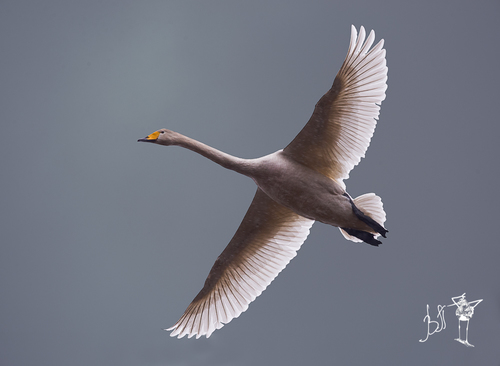
Whooper Swan (Cygnus cygnus) Whooper Swan
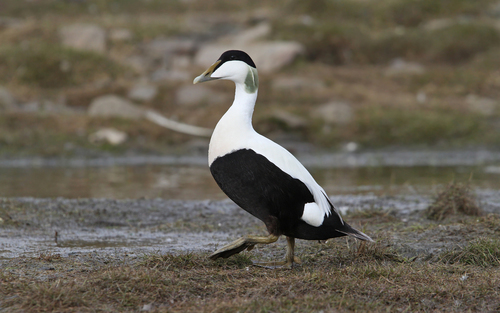
Common Eider (Somateria mollissima) Common Eider

Media

Loading…

In short

The most reliable way to separate Whooper Swan from Common Eider in any plumage is sheer size and structure: Whooper Swan is an enormous, long-necked bird with a straight, wedge-shaped bill, while Common Eider is a much smaller, heavy-bodied sea duck with a shorter neck and a sloping, wedge-shaped bill. Juvenile Whooper Swans are large, pale grey birds with pinkish bills, while juvenile eiders are brown and patterned. In flight, Whooper Swan shows long, broad wings and a short, rounded tail, while eiders have shorter wings and a more compact, duck-like profile. Habitat is also a major clue: Whooper Swans are found on lakes, rivers, and wetlands, while Common Eiders are almost always seen on coastal waters.

Identification tips

  1. Size is the most immediate clue: Whooper Swan is five times heavier and much longer than Common Eider; even distant birds show the swan's bulk and long neck.
  2. Neck length and posture: Swans have extremely long, straight necks, held upright or outstretched in flight; eiders have short, thick necks, never held as upright or as long.
  3. Bill shape: Whooper Swan has a long, straight, wedge-shaped bill with mostly yellow (adults) or pink (juveniles); Common Eider has a shorter, sloping, wedge-shaped bill, often with a more abrupt angle at the base.
  4. Tail shape: Swans have a short, rounded tail; eiders have a more typical duck tail, not as rounded or as short as the swan's.
  5. Juvenile plumage: Juvenile Whooper Swans are uniform pale grey with pinkish bills; juvenile eiders are brown and patterned, never as pale or as plain as young swans.
  6. Adult male plumage: Adult male eiders are strikingly black-and-white with a green nape; Whooper Swans are all-white (sometimes rusty-stained), never patterned black and white.
  7. Adult female/plumage confusion: Female eiders are brown and barred, but still much smaller and shorter-necked than swans; no swan is ever brown and barred.
  8. Flight silhouette: Whooper Swans in flight show long, broad wings and a long neck stretched out; eiders are compact, short-necked, and have faster, more duck-like wingbeats.
  9. Habitat context: Whooper Swans are almost never seen on the sea; eiders are almost never seen on freshwater lakes or rivers except in rare inland populations.
  10. Feeding behavior: Swans often feed by upending (tipping up) in shallow water; eiders dive completely underwater for food.
  11. Vocalizations: Whooper Swan's loud, trumpet-like 'kloo-kloo-kloo' is very different from the eider's 'ah-ooo' or quacks.
  12. Bill color in juveniles: Young Whooper Swans have pinkish bills with dark markings; young eiders have dark bills.
  13. Tail visibility when feeding: Whooper Swans show a short, rounded tail when upending; eiders rarely upend and have a less conspicuous tail.
  14. Group structure: Swans are often seen in family groups with cygnets (grey, large), while eiders form large, dense flocks, especially at sea.
  15. Confusion risk: In poor light or at long range, a distant swan may appear as a pale blob, but the neck length and size will always separate it from any eider. No eider, of any age or sex, ever approaches the size, neck length, or pure white plumage of an adult Whooper Swan.

Size

Whooper Swan is vastly larger than Common Eider: average adult mass is about 11,375 g for Whooper Swan versus 2,066 g for Common Eider [wikidata]. Whooper Swan measures 140–165 cm in length with a wingspan of 205–275 cm, while Common Eider is only 50–71 cm long with an 80–110 cm wingspan [wikipedia]. Even at a distance, the swan's size is unmistakable, towering over any duck, including eiders. The swan's long neck and massive body are diagnostic; eiders are bulky for ducks but never approach swan proportions.

Plumage

Juvenile Whooper Swans are uniform pale grey to grey-brown, lacking any strong pattern, and have a pinkish bill with dark markings; their tail is short and rounded. Juvenile Common Eiders are brown and patterned, with a more typical duck-like appearance and a sloping, wedge-shaped bill. Adult Whooper Swans are pure white (sometimes with rusty staining on the head/neck), while adult male eiders are boldly black-and-white with a green nape, and females are brown and heavily barred. In flight, Whooper Swans of all ages show long, broad wings and a short, rounded tail, while eiders show shorter, more pointed wings and a compact duck profile. No age of eider is ever as pale or as large as a Whooper Swan, and no swan shows the intricate barring or black-and-white contrast of an adult male eider.

Behaviour

Whooper Swans are typically seen in family groups or flocks, often swimming or feeding with their heads underwater in shallow lakes and wetlands. They use head bobs and wing flaps to communicate before taking flight. Common Eiders are almost always seen on the sea, diving for mussels and crustaceans, and may form large rafts on coastal waters. Eiders dive frequently and rarely tip up like swans. Swans fly with slow, deep wingbeats and long necks outstretched, while eiders have faster, more duck-like flight.

Habitat

Whooper Swans inhabit freshwater lakes, rivers, and wetlands, especially in the breeding season, and may be seen on estuaries or flooded fields in winter. They are rarely found on the open sea. Common Eiders are strictly marine outside rare inland populations, found on northern coasts, rocky shores, and sheltered bays. If you see a large white bird on the sea, it is almost never a Whooper Swan; if it is on a lake or river, it is almost never a Common Eider.

Voice

Whooper Swans are very vocal, giving loud, resonant 'kloo-kloo-kloo' calls in groups of three or four, lower-pitched and more trumpet-like than most ducks. Common Eider males give a strange, almost human 'ah-ooo' display call, while females give hoarse quacks. The swan's call is much louder and carries farther than the eider's, and the quality is very different.

Submit a better description

Use the same sections as the comparison. Your text is published immediately.

The most reliable way to separate Whooper Swan from Common Eider in any plumage is sheer size and structure: Whooper Swan is an enormous, long-necked bird with a straight, wedge-shaped bill, while Common Eider is a much smaller, heavy-bodied sea duck with a shorter neck and a sloping, wedge-shaped bill. Juvenile Whooper Swans are large, pale grey birds with pinkish bills, while juvenile eiders are brown and patterned. In flight, Whooper Swan shows long, broad wings and a short, rounded tail, while eiders have shorter wings and a more compact, duck-like profile. Habitat is also a major clue: Whooper Swans are found on lakes, rivers, and wetlands, while Common Eiders are almost always seen on coastal waters.

  1. Size is the most immediate clue: Whooper Swan is five times heavier and much longer than Common Eider; even distant birds show the swan's bulk and long neck.
  2. Neck length and posture: Swans have extremely long, straight necks, held upright or outstretched in flight; eiders have short, thick necks, never held as upright or as long.
  3. Bill shape: Whooper Swan has a long, straight, wedge-shaped bill with mostly yellow (adults) or pink (juveniles); Common Eider has a shorter, sloping, wedge-shaped bill, often with a more abrupt angle at the base.
  4. Tail shape: Swans have a short, rounded tail; eiders have a more typical duck tail, not as rounded or as short as the swan's.
  5. Juvenile plumage: Juvenile Whooper Swans are uniform pale grey with pinkish bills; juvenile eiders are brown and patterned, never as pale or as plain as young swans.
  6. Adult male plumage: Adult male eiders are strikingly black-and-white with a green nape; Whooper Swans are all-white (sometimes rusty-stained), never patterned black and white.
  7. Adult female/plumage confusion: Female eiders are brown and barred, but still much smaller and shorter-necked than swans; no swan is ever brown and barred.
  8. Flight silhouette: Whooper Swans in flight show long, broad wings and a long neck stretched out; eiders are compact, short-necked, and have faster, more duck-like wingbeats.
  9. Habitat context: Whooper Swans are almost never seen on the sea; eiders are almost never seen on freshwater lakes or rivers except in rare inland populations.
  10. Feeding behavior: Swans often feed by upending (tipping up) in shallow water; eiders dive completely underwater for food.
  11. Vocalizations: Whooper Swan's loud, trumpet-like 'kloo-kloo-kloo' is very different from the eider's 'ah-ooo' or quacks.
  12. Bill color in juveniles: Young Whooper Swans have pinkish bills with dark markings; young eiders have dark bills.
  13. Tail visibility when feeding: Whooper Swans show a short, rounded tail when upending; eiders rarely upend and have a less conspicuous tail.
  14. Group structure: Swans are often seen in family groups with cygnets (grey, large), while eiders form large, dense flocks, especially at sea.
  15. Confusion risk: In poor light or at long range, a distant swan may appear as a pale blob, but the neck length and size will always separate it from any eider. No eider, of any age or sex, ever approaches the size, neck length, or pure white plumage of an adult Whooper Swan.

Whooper Swan is vastly larger than Common Eider: average adult mass is about 11,375 g for Whooper Swan versus 2,066 g for Common Eider [wikidata]. Whooper Swan measures 140–165 cm in length with a wingspan of 205–275 cm, while Common Eider is only 50–71 cm long with an 80–110 cm wingspan [wikipedia]. Even at a distance, the swan's size is unmistakable, towering over any duck, including eiders. The swan's long neck and massive body are diagnostic; eiders are bulky for ducks but never approach swan proportions.

Juvenile Whooper Swans are uniform pale grey to grey-brown, lacking any strong pattern, and have a pinkish bill with dark markings; their tail is short and rounded. Juvenile Common Eiders are brown and patterned, with a more typical duck-like appearance and a sloping, wedge-shaped bill. Adult Whooper Swans are pure white (sometimes with rusty staining on the head/neck), while adult male eiders are boldly black-and-white with a green nape, and females are brown and heavily barred. In flight, Whooper Swans of all ages show long, broad wings and a short, rounded tail, while eiders show shorter, more pointed wings and a compact duck profile. No age of eider is ever as pale or as large as a Whooper Swan, and no swan shows the intricate barring or black-and-white contrast of an adult male eider.

Whooper Swans are typically seen in family groups or flocks, often swimming or feeding with their heads underwater in shallow lakes and wetlands. They use head bobs and wing flaps to communicate before taking flight. Common Eiders are almost always seen on the sea, diving for mussels and crustaceans, and may form large rafts on coastal waters. Eiders dive frequently and rarely tip up like swans. Swans fly with slow, deep wingbeats and long necks outstretched, while eiders have faster, more duck-like flight.

Whooper Swans inhabit freshwater lakes, rivers, and wetlands, especially in the breeding season, and may be seen on estuaries or flooded fields in winter. They are rarely found on the open sea. Common Eiders are strictly marine outside rare inland populations, found on northern coasts, rocky shores, and sheltered bays. If you see a large white bird on the sea, it is almost never a Whooper Swan; if it is on a lake or river, it is almost never a Common Eider.

Whooper Swans are very vocal, giving loud, resonant 'kloo-kloo-kloo' calls in groups of three or four, lower-pitched and more trumpet-like than most ducks. Common Eider males give a strange, almost human 'ah-ooo' display call, while females give hoarse quacks. The swan's call is much louder and carries farther than the eider's, and the quality is very different.

Discard your changes?

You have unsaved edits. If you leave now, those changes will be lost.

Whooper Swan · Common Eider · My Tricky Birds