

Motmot

White-tailed Hawk vs Hawaiian Hawk

Geranoaetus albicaudatus versus Buteo solitarius

Play a quiz with White-tailed Hawk and Hawaiian Hawk
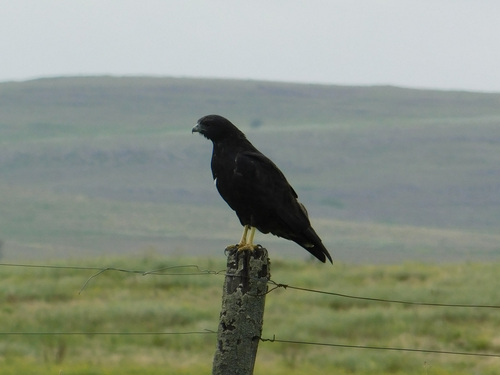
White-tailed Hawk (Geranoaetus albicaudatus) White-tailed Hawk
Hawaiian Hawk (Buteo solitarius) Hawaiian Hawk

Media

Loading…

In short

The most reliable field mark between White-tailed Hawk and Hawaiian Hawk is the tail: adult White-tailed Hawks show a striking white tail with a narrow black band near the tip, obvious in flight and at rest, while Hawaiian Hawks always have a brown tail lacking this bold contrast. Immature White-tailed Hawks are darker overall but still show a pale tail with dark barring, whereas Hawaiian Hawk immatures resemble adults in tail pattern. Structurally, White-tailed Hawks are bulkier and longer-winged, with a more prominent rusty shoulder patch (adults) and paler underparts, while Hawaiian Hawks are smaller, more compact, and come in both dark and light morphs. In the field, confusion is most likely with immature White-tailed Hawks, which can appear very dark, but careful attention to tail and wing pattern, as well as overall size, will separate them.

Identification tips

  1. Tail pattern is key: Adult White-tailed Hawks have a white tail with a narrow black band near the tip, visible in flight and at rest; Hawaiian Hawks always have a brown tail without a bold terminal band. This is the most reliable field mark at any age.
  2. Immature tail: Immature White-tailed Hawks show a pale (brownish) tail with several dark bars, transitioning to the adult pattern as they mature. Hawaiian Hawk immatures have the same brown tail as adults, lacking strong barring or a pale base.
  3. Rusty shoulder patch: Adult White-tailed Hawks have a conspicuous rusty-red shoulder patch, visible when perched with wings closed. Hawaiian Hawks never show this feature. Immature White-tailed Hawks lack the patch, so this mark is adult-specific.
  4. Underwing pattern (immatures): Immature White-tailed Hawks have black-and-white spotted underwing linings, a feature not present in Hawaiian Hawks of any age or morph. Look for this in flight, especially in young birds.
  5. Color morphs: Hawaiian Hawks come in dark and light morphs. Dark morphs are uniformly brown, including underwings and tail; light morphs have a dark head and light underparts/underwings. White-tailed Hawk does not show such strong color morphs.
  6. Overall coloration: Adult White-tailed Hawks are grey above and white below, with a white rump and tail; Hawaiian Hawks (light morph) have a dark head and light underparts, but the tail remains brown.
  7. Size and structure: White-tailed Hawk is larger, bulkier, and longer-winged, with a more robust build. Hawaiian Hawk is smaller, more compact, and shorter-winged. In direct comparison or with experience, this is noticeable in flight and perched.
  8. Flight style: White-tailed Hawk soars and hovers frequently, using its long wings to glide over open areas. Hawaiian Hawk is more likely to perch and make short flights, with less soaring.
  9. Bare parts: Both species have yellowish feet as adults, but Hawaiian Hawk juveniles have greenish legs and feet. In breeding season, Hawaiian Hawk may show a yellow forecap above the bill, a subtle mark not present in White-tailed Hawk.
  10. Underwing barring: Adult White-tailed Hawks have whitish underwings with faint brownish barring on coverts, extending to flanks and thighs. Hawaiian Hawks (light morph) have light underwings but lack the same barring pattern.
  11. Geographic context: If seen in Hawaiʻi, it is almost certainly Hawaiian Hawk; if on the mainland Americas, it is White-tailed Hawk. In a quiz or vagrant scenario, use plumage and structure.
  12. Habitat: White-tailed Hawk prefers open country, grasslands, and savannas; Hawaiian Hawk is more forest-associated, especially in native ʻōhiʻa stands.
  13. Sexual dimorphism: Hawaiian Hawk females are larger than males, but this is subtle in the field. White-tailed Hawk shows little visible sexual size difference.
  14. Pitfalls: Immature White-tailed Hawks can appear very dark, resembling dark morph Hawaiian Hawks, but the pale tail with dark barring and spotted underwing linings are diagnostic. Light morph Hawaiian Hawks may look pale below but always have a brown tail and lack the rusty shoulder patch.
  15. When marks fail: In poor light or distant views, rely on tail pattern, overall size, and flight style. If only perched views are available, look for the rusty shoulder (adults), tail color, and general bulk.

Size

White-tailed Hawk is a noticeably larger and heavier raptor, with adults measuring 44–60 cm in length and a wingspan of 118–143 cm, and weighing 865–1,240 g depending on subspecies ([wikipedia], [avonet]). In contrast, Hawaiian Hawk is smaller and lighter, at 40–46 cm in length, with females averaging 605 g and males 441 g ([wikipedia]). The White-tailed Hawk's wings are longer and broader, giving it a more substantial silhouette in flight, while the Hawaiian Hawk is more compact and proportionally shorter-winged.

Plumage

Immature White-tailed Hawks are overall darker than adults, sometimes nearly black in poor light, but always show a pale tail with dark barring that gradually becomes white with a narrow black band as they mature. Their underwing linings are conspicuously spotted black-and-white, and they lack the adult's rusty shoulder patch. In contrast, Hawaiian Hawks have two color morphs at all ages: dark phase birds are brown all over (including underwings and tail), while light phase birds have a dark head and light underparts and underwings. The tail in both morphs is brown, never white, and lacks a bold terminal band. Adult White-tailed Hawks are grey above and white below, with a white rump and tail, and a prominent rusty-red shoulder patch. The underwing is whitish with faint brownish barring. Hawaiian Hawks have yellowish feet and legs as adults (greenish in juveniles), and in breeding season may show a yellow forecap above the bill. Bare part coloration is otherwise similar. The most consistent difference at any age is the White-tailed Hawk's pale tail with a dark band versus the all-brown tail of Hawaiian Hawk.

Behaviour

White-tailed Hawk often hunts by hovering or soaring high over open country, using its long wings to glide and search for prey. It is typically seen alone or in pairs, rarely perching for long. Hawaiian Hawk is more likely to be seen perched in trees, scanning for prey, and is less prone to extended soaring or hovering. Its flight is more compact and direct, reflecting its smaller size and shorter wings. Both species are solitary hunters, but White-tailed Hawk is more likely to be noticed by its prominent flight style and larger size.

Habitat

White-tailed Hawk is found in tropical and subtropical open habitats across the Americas, including savannas, grasslands, and open woodlands. Hawaiian Hawk is endemic to the Big Island of Hawaiʻi, where it breeds in native ʻōhiʻa forests and adjacent open areas. Thus, geographic context is usually diagnostic: only White-tailed Hawk occurs on the mainland Americas, while Hawaiian Hawk is restricted to Hawaiʻi. However, in a quiz or vagrant scenario, habitat preference can help: White-tailed Hawk avoids dense forests, while Hawaiian Hawk is more forest-associated.

Submit a better description

Use the same sections as the comparison. Your text is published immediately.

The most reliable field mark between White-tailed Hawk and Hawaiian Hawk is the tail: adult White-tailed Hawks show a striking white tail with a narrow black band near the tip, obvious in flight and at rest, while Hawaiian Hawks always have a brown tail lacking this bold contrast. Immature White-tailed Hawks are darker overall but still show a pale tail with dark barring, whereas Hawaiian Hawk immatures resemble adults in tail pattern. Structurally, White-tailed Hawks are bulkier and longer-winged, with a more prominent rusty shoulder patch (adults) and paler underparts, while Hawaiian Hawks are smaller, more compact, and come in both dark and light morphs. In the field, confusion is most likely with immature White-tailed Hawks, which can appear very dark, but careful attention to tail and wing pattern, as well as overall size, will separate them.

  1. Tail pattern is key: Adult White-tailed Hawks have a white tail with a narrow black band near the tip, visible in flight and at rest; Hawaiian Hawks always have a brown tail without a bold terminal band. This is the most reliable field mark at any age.
  2. Immature tail: Immature White-tailed Hawks show a pale (brownish) tail with several dark bars, transitioning to the adult pattern as they mature. Hawaiian Hawk immatures have the same brown tail as adults, lacking strong barring or a pale base.
  3. Rusty shoulder patch: Adult White-tailed Hawks have a conspicuous rusty-red shoulder patch, visible when perched with wings closed. Hawaiian Hawks never show this feature. Immature White-tailed Hawks lack the patch, so this mark is adult-specific.
  4. Underwing pattern (immatures): Immature White-tailed Hawks have black-and-white spotted underwing linings, a feature not present in Hawaiian Hawks of any age or morph. Look for this in flight, especially in young birds.
  5. Color morphs: Hawaiian Hawks come in dark and light morphs. Dark morphs are uniformly brown, including underwings and tail; light morphs have a dark head and light underparts/underwings. White-tailed Hawk does not show such strong color morphs.
  6. Overall coloration: Adult White-tailed Hawks are grey above and white below, with a white rump and tail; Hawaiian Hawks (light morph) have a dark head and light underparts, but the tail remains brown.
  7. Size and structure: White-tailed Hawk is larger, bulkier, and longer-winged, with a more robust build. Hawaiian Hawk is smaller, more compact, and shorter-winged. In direct comparison or with experience, this is noticeable in flight and perched.
  8. Flight style: White-tailed Hawk soars and hovers frequently, using its long wings to glide over open areas. Hawaiian Hawk is more likely to perch and make short flights, with less soaring.
  9. Bare parts: Both species have yellowish feet as adults, but Hawaiian Hawk juveniles have greenish legs and feet. In breeding season, Hawaiian Hawk may show a yellow forecap above the bill, a subtle mark not present in White-tailed Hawk.
  10. Underwing barring: Adult White-tailed Hawks have whitish underwings with faint brownish barring on coverts, extending to flanks and thighs. Hawaiian Hawks (light morph) have light underwings but lack the same barring pattern.
  11. Geographic context: If seen in Hawaiʻi, it is almost certainly Hawaiian Hawk; if on the mainland Americas, it is White-tailed Hawk. In a quiz or vagrant scenario, use plumage and structure.
  12. Habitat: White-tailed Hawk prefers open country, grasslands, and savannas; Hawaiian Hawk is more forest-associated, especially in native ʻōhiʻa stands.
  13. Sexual dimorphism: Hawaiian Hawk females are larger than males, but this is subtle in the field. White-tailed Hawk shows little visible sexual size difference.
  14. Pitfalls: Immature White-tailed Hawks can appear very dark, resembling dark morph Hawaiian Hawks, but the pale tail with dark barring and spotted underwing linings are diagnostic. Light morph Hawaiian Hawks may look pale below but always have a brown tail and lack the rusty shoulder patch.
  15. When marks fail: In poor light or distant views, rely on tail pattern, overall size, and flight style. If only perched views are available, look for the rusty shoulder (adults), tail color, and general bulk.

White-tailed Hawk is a noticeably larger and heavier raptor, with adults measuring 44–60 cm in length and a wingspan of 118–143 cm, and weighing 865–1,240 g depending on subspecies ([wikipedia], [avonet]). In contrast, Hawaiian Hawk is smaller and lighter, at 40–46 cm in length, with females averaging 605 g and males 441 g ([wikipedia]). The White-tailed Hawk's wings are longer and broader, giving it a more substantial silhouette in flight, while the Hawaiian Hawk is more compact and proportionally shorter-winged.

Immature White-tailed Hawks are overall darker than adults, sometimes nearly black in poor light, but always show a pale tail with dark barring that gradually becomes white with a narrow black band as they mature. Their underwing linings are conspicuously spotted black-and-white, and they lack the adult's rusty shoulder patch. In contrast, Hawaiian Hawks have two color morphs at all ages: dark phase birds are brown all over (including underwings and tail), while light phase birds have a dark head and light underparts and underwings. The tail in both morphs is brown, never white, and lacks a bold terminal band. Adult White-tailed Hawks are grey above and white below, with a white rump and tail, and a prominent rusty-red shoulder patch. The underwing is whitish with faint brownish barring. Hawaiian Hawks have yellowish feet and legs as adults (greenish in juveniles), and in breeding season may show a yellow forecap above the bill. Bare part coloration is otherwise similar. The most consistent difference at any age is the White-tailed Hawk's pale tail with a dark band versus the all-brown tail of Hawaiian Hawk.

White-tailed Hawk often hunts by hovering or soaring high over open country, using its long wings to glide and search for prey. It is typically seen alone or in pairs, rarely perching for long. Hawaiian Hawk is more likely to be seen perched in trees, scanning for prey, and is less prone to extended soaring or hovering. Its flight is more compact and direct, reflecting its smaller size and shorter wings. Both species are solitary hunters, but White-tailed Hawk is more likely to be noticed by its prominent flight style and larger size.

White-tailed Hawk is found in tropical and subtropical open habitats across the Americas, including savannas, grasslands, and open woodlands. Hawaiian Hawk is endemic to the Big Island of Hawaiʻi, where it breeds in native ʻōhiʻa forests and adjacent open areas. Thus, geographic context is usually diagnostic: only White-tailed Hawk occurs on the mainland Americas, while Hawaiian Hawk is restricted to Hawaiʻi. However, in a quiz or vagrant scenario, habitat preference can help: White-tailed Hawk avoids dense forests, while Hawaiian Hawk is more forest-associated.

Discard your changes?

You have unsaved edits. If you leave now, those changes will be lost.

White-tailed Hawk · Hawaiian Hawk · My Tricky Birds