
White-tailed Eagle vs Rough-legged Buzzard
Haliaeetus albicilla versus Buteo lagopus
Play a quiz with White-tailed Eagle and Rough-legged Buzzard
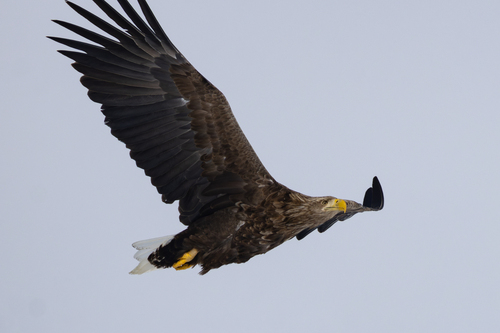 White-tailed Eagle
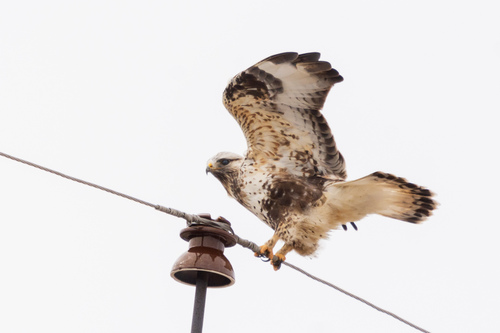 Rough-legged Buzzard
In short
The most reliable field mark between White-tailed Eagle and Rough-legged Buzzard—especially in flight—is overall size and structure: White-tailed Eagle is a massive, heavy-bodied raptor with extremely broad, deeply fingered wings and a relatively short, wedge-shaped tail, while Rough-legged Buzzard is much smaller, slimmer, and longer-tailed, with narrower wings and a distinctive dark carpal (wrist) patch on pale underwings in most plumages. Juvenile White-tailed Eagles show a washed-out, dirty whitish tail with dark edges, while all ages of Rough-legged Buzzard have a white tail with one or more dark subterminal bands. Perched, the eagle's huge bill, long neck, and upright stance are strikingly different from the buzzard's smaller, rounder-headed look. Both can be variable in plumage, but structural differences and tail pattern are the most reliable clues.
Identification tips
- Size is the single most reliable clue: White-tailed Eagle is enormous, with a wingspan and bulk that dwarfs Rough-legged Buzzard. If you see a raptor that looks 'vulture-sized' or much larger than any Buteo, it's almost certainly an eagle.
- Tail pattern in flight: Juvenile White-tailed Eagles have a dirty whitish tail with messy dark edges and tips, sometimes faintly barred, but never a crisp white tail with a single dark band. Rough-legged Buzzards of all ages show a white tail with one or more sharp, dark subterminal bands—never fully white or messy like the eagle.
- Underwing pattern: Rough-legged Buzzard (especially light morphs) shows a bold, square dark carpal (wrist) patch on otherwise pale underwings. White-tailed Eagle lacks this feature; its underwing is more uniformly dark or mottled, especially in juveniles and subadults.
- Wing shape in flight: White-tailed Eagle’s wings are extremely broad, long, and deeply fingered (at least six 'fingers' visible), giving a plank-like appearance. Rough-legged Buzzard’s wings are narrower and less deeply fingered, and the hand is less prominent.
- Tail shape and length: Eagle’s tail is relatively short and wedge-shaped (adults) or slightly longer in juveniles, but still short compared to wing length. Buzzard’s tail is longer and squarer, often extending beyond the wingtips when perched.
- Bill and head: White-tailed Eagle has a massive, high-crowned bill and a long neck, giving a vulturine look, especially when perched. Rough-legged Buzzard has a much smaller bill and a rounder, more compact head.
- Perched posture: Eagles perch upright, often on exposed branches or rocks, while buzzards are more horizontal and less imposing.
- Leg feathering: Both species have feathered legs, but buzzard’s feathering extends further down (to the toes), while eagle’s tarsi are bare.
- Plumage variability: Both species can be variable, but only the eagle develops a fully white tail and pale head as a mature adult (after several years). Buzzards never show this combination.
- Flight behavior: Rough-legged Buzzard often hovers in place, a behavior never shown by White-tailed Eagle. Eagles soar and glide with slow, deep wingbeats.
- Habitat context: If seen near large water bodies or coasts, especially in Eurasia, consider eagle. In open fields, marshes, or tundra, especially in winter, buzzard is more likely.
- Relative proportions: Eagle’s body is massive, legs thick, and the whole bird looks heavy and powerful. Buzzard is slimmer, with finer features.
- Age-related confusion: Immature eagles can be mistaken for buzzards due to mottled plumage, but structure and tail pattern remain reliable. Juvenile buzzards never show the eagle’s bulk or bill size.
- Wingbeats: Eagle’s wingbeats are shallow and slow for its size, sometimes surprisingly fast, but always powerful. Buzzard’s are lighter and more buoyant.
- When in doubt, use multiple clues: If plumage is confusing, rely on size, structure, tail pattern, and habitat together for the best chance of correct identification.
Size
White-tailed Eagle is vastly larger and heavier (average adult mass ~4793 g) than Rough-legged Buzzard (~926 g). The eagle is among the largest raptors in Eurasia, with a massive body, thick legs, and a huge bill, while Rough-legged Buzzard is a medium-large raptor, similar in size to a large Buteo but dwarfed by the eagle. In flight, the eagle’s wings are broader and longer relative to its body, and its tail is shorter and more wedge-shaped, while the buzzard has a longer tail and narrower wings for its size. Even at a distance, the eagle’s bulk and wingspan are unmistakable if seen alongside other raptors.
Plumage
- Juvenile/immature White-tailed Eagle: Shows a washed-out greyish-cream tail with messy dark edges and tips, sometimes faintly barred, and a uniformly dark brown to blackish-brown head and body. The upperwing is dark, with some buff-brown tones and variable blackish tips. As birds age, white mottling increases on the underwing and body, peaking in subadults, then fades as adults become more uniform with a fully white tail and pale head (not usually until 8 years old).
- Rough-legged Buzzard (all ages): Always shows a white tail with one or more dark subterminal bands—never fully white or messy like the eagle. Underwings are pale with a bold, square dark carpal patch (especially in light morphs), and the wing tips reach or extend past the tail when perched. Plumage is variable (light and dark morphs), but most show a broad brown chest-band and extensive speckling. The legs are feathered to the toes, but the toes themselves are bare.
- Adults: White-tailed Eagle adults are uniform brown with a pale head and fully white, short tail. Rough-legged Buzzard adults retain the white tail with dark band(s) and the carpal patch, and never develop a pale head or all-white tail.
Behaviour
White-tailed Eagles often perch upright and exposed, sometimes appearing vulturine due to their long neck and massive bill. In flight, they use slow, shallow wingbeats interspersed with long glides, and their wings appear extremely broad and deeply fingered. Rough-legged Buzzards are more buoyant and agile, often seen hovering in place (a behavior rare in eagles), and their flight is lighter, with narrower wings and a longer tail relative to body size. On the ground, buzzards are more horizontal and less imposing than eagles.
Habitat
White-tailed Eagle is typically found in temperate Eurasia, favoring large bodies of water, coasts, and open landscapes. Rough-legged Buzzard breeds in arctic and subarctic tundra and migrates south to open country, marshes, and fields in winter. While both can occur in open habitats, eagles are more closely tied to water, and buzzards are more likely in open, treeless areas, especially outside the breeding season.