

White-fronted Tern vs Fairy Prion
Sterna striata versus Pachyptila turtur
Play a quiz with White-fronted Tern and Fairy Prion
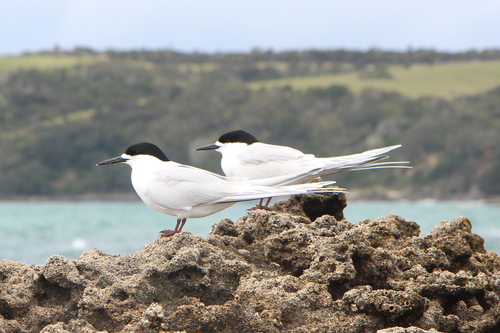 White-fronted Tern
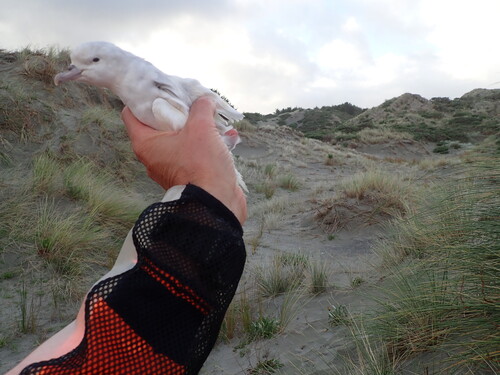 Fairy Prion
In short
The most reliable field mark to separate White-fronted Tern from Fairy Prion is the overall coloration and wing pattern: White-fronted Tern is strikingly white below and on the underwing, with a pale silvery-grey upperwing and a deeply forked tail, while Fairy Prion shows a blue-grey upperwing with a bold dark 'M' pattern and a wedge-shaped tail with a dark tip. Juvenile and immature White-fronted Terns have brownish, mottled upperparts but never the crisp 'M' of the prion. Bill and leg color also differ: the tern has a long, slender black bill and dark legs, while the prion’s bill is short, thick, and blue, with blue legs. In flight, the tern is sleek and swallow-like, the prion more compact and petrel-like. These differences are visible at all ages and seasons.
Identification tips
- Upperwing pattern in flight (all ages): Fairy Prion shows a bold dark 'M' across the blue-grey upperwing, visible even at distance; White-fronted Tern never shows this, instead having pale silvery-grey upperwings with no strong pattern.
- Tail shape: White-fronted Tern has a deeply forked, swallow-like tail (especially in breeding adults); Fairy Prion’s tail is wedge-shaped with a dark tip, never forked.
- Bill color and shape: Tern’s bill is long, slender, and black; prion’s bill is short, thick, and pale blue. This is visible at close range or in good light.
- Leg color: Tern has dark burgundy-black legs; prion’s legs and feet are blue. Usually only visible when perched or on land.
- Crown/cap: Breeding White-fronted Tern has a jet black cap with a narrow white forehead band; non-breeding and immature terns have a reduced, mottled cap. Fairy Prion never has a black cap, only blue-grey head.
- Underwing: White-fronted Tern is white below and on the underwing; Fairy Prion is also white below, but the upperwing 'M' pattern can show through in some angles.
- Juvenile/immature plumage: Young terns have brownish-cream mottling above, but never the crisp 'M' of prion. Prion juveniles look like adults, with the same upperwing pattern.
- Flight style: Tern is buoyant, agile, and swallow-like, often hovering; prion is more direct, gliding, and petrel-like, rarely hovers.
- Perched posture: Tern stands upright with long wings and tail extending well past the body; prion is more compact, with shorter tail and wings.
- Habitat: Tern is usually coastal or nearshore; prion is pelagic, rarely seen close to land except at colonies.
- Group size: Terns often in large, noisy flocks; prions usually solitary or in small groups at sea.
- Context: If seen feeding over shoaling fish near shore, likely a tern; if far offshore, especially in subantarctic waters, likely a prion.
- Size impression: Tern looks longer and more elegant; prion looks shorter and chunkier, despite being heavier.
- Tail in flight: Tern’s forked tail is obvious when spread; prion’s tail is never forked, and the dark tip is often visible.
- Cap in non-breeding/immature tern: The black cap recedes and becomes mottled, but still contrasts more than prion’s plain head.
Size
Despite appearances, Fairy Prion is slightly heavier (139 g vs 128 g) but noticeably shorter (25 cm vs 35–43 cm) and has a shorter wingspan (56 cm vs 79–82 cm) than White-fronted Tern [wikidata]. The tern looks longer and more slender, with a proportionally longer tail and wings, while the prion appears compact and stubby-winged. In the field, the tern’s length and deeply forked tail make it look larger and more graceful, even though the prion is technically heavier.
Plumage
Juvenile and immature White-fronted Terns show brownish-cream and grey mottling on the upperwing, back, and mantle, but never the crisp dark 'M' pattern of Fairy Prion. The prion, at all ages, has blue-grey upperparts with a prominent dark 'M' from wing to wingtip, and a white underside. The tern’s underwing is always white, while the prion’s underwing is white but bordered above by the dark 'M'. Adult White-fronted Terns in breeding plumage have a jet black cap with a narrow white forehead band, while non-breeding adults and immatures have a reduced, mottled cap. Fairy Prion never has a black cap; its head is blue-grey with no sharp contrast. The tern’s tail is deeply forked and white, while the prion’s tail is wedge-shaped with a dark tip. Bill color is diagnostic: black in the tern, pale blue in the prion.
Behaviour
White-fronted Tern is often seen in large, noisy flocks along coasts, feeding by plunge-diving or dipping for fish, and is highly aerial, often hovering or flying with rapid, swallow-like wingbeats. Fairy Prion is more often seen singly or in loose groups, flying low over the sea with steady, gliding flight, and rarely hovers. The prion feeds by dipping or seizing small prey from the surface, and is less likely to be seen close to shore except near breeding colonies. Terns often perch on exposed rocks or beaches, while prions rarely land in the open except at colonies.
Habitat
White-fronted Tern is coastal, almost always seen near shorelines, estuaries, and rocky or sandy beaches, especially in New Zealand where it is abundant. Fairy Prion is a pelagic seabird, usually found far offshore over open ocean, coming to land only to breed on remote islands. Seeing a bird close to shore or on a beach strongly favors White-fronted Tern, while a bird far out at sea, especially in subantarctic waters, is more likely a Fairy Prion.