

White-browed Crake vs Watercock
Poliolimnas cinereus versus Gallicrex cinerea
Play a quiz with White-browed Crake and Watercock
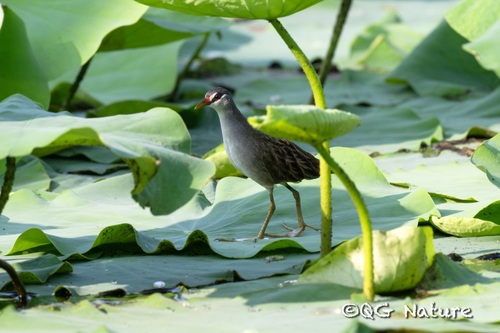 White-browed Crake
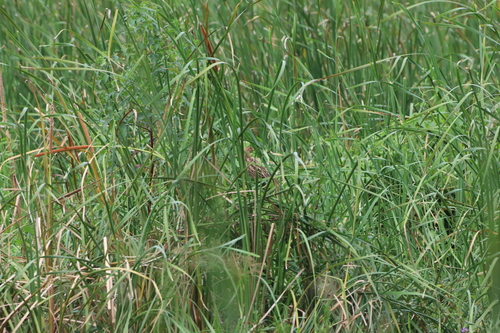 Watercock
In short
The most reliable way to separate White-browed Crake from Watercock is by size and structure: Watercock is much larger and bulkier, with a notably thick bill and long toes, while White-browed Crake is small and delicate. Adult male Watercocks are strikingly dark with red facial features, but females and immatures are streaky brown, which can cause confusion with crakes. However, the crake always shows a bold white eyebrow and is much daintier. In flight or on the ground, Watercock's size and heavy build stand out, while White-browed Crake is slim and quick. Habitat overlap is possible in wetlands, but Watercock prefers dense reeds, while White-browed Crake is more often in mangroves or open marsh edges.
Identification tips
- Size is the most immediate clue: Watercock is much larger and bulkier than White-browed Crake. Even at a distance, Watercock's heavy build and long neck stand out, while crake is small and dainty. This works for all ages and sexes.
- Bill and facial features: Adult male Watercock has a thick, red bill with an extended red frontal shield and horn—unique and unmistakable. Females and immatures have a yellow bill and green legs, but the bill is always thicker and heavier than the crake's fine bill.
- White eyebrow: White-browed Crake always shows a bold white supercilium (eyebrow) above the eye, which is never present on Watercock of any age or sex. This is a key field mark at all times.
- Plumage streaking: Female and immature Watercock are dark brown above, paler below, and heavily streaked and barred. White-browed Crake is much plainer, with less streaking and a more uniform appearance.
- Leg color: Male Watercock has red legs; females and immatures have green legs. White-browed Crake's leg color is not specified, but the contrast with the male Watercock's red legs is obvious.
- Body shape and gait: Watercock is laterally compressed (narrow when viewed head-on) and has very long toes for walking on floating vegetation. Its gait is heavy and deliberate. White-browed Crake is slim, with a quick, agile, almost mouse-like movement.
- Tail: Watercock has a short tail, often held low. No tail description for crake, but it is not a prominent feature.
- Habitat context: If the bird is deep in tall reeds, Watercock is more likely; in open mangrove or marsh edge, expect White-browed Crake.
- Vocalization: A loud, gulping call at dawn or dusk is diagnostic for Watercock. Crake is less vocal or not described as noisy in these sources.
- Sexual dimorphism in Watercock: Only males are black-grey with red facial features; females and immatures are brown and streaked, which can cause confusion with crake, but size and eyebrow remain reliable.
- Juvenile confusion: Young Watercock are buff and streaked, but never show a white eyebrow. Downy chicks are black, but this is not a confusion risk with crake.
- Feeding behavior: Watercock probes in mud or shallow water, often in dense cover; crake is more likely to be seen picking at the edge of open water.
- Flight views: No distinctive upperwing or flight pattern marks are described for either species, so rely on structure and size in flight.
- Abundance and range: Both can occur in Southeast Asia, but Watercock is generally less likely in open mangrove or marsh edge compared to crake.
- When in doubt: If you see a small, pale, white-browed rail, it's a White-browed Crake; if it's large, thick-billed, and especially if it has red facial features or is heavily streaked and brown, it's a Watercock.
Size
Watercock is dramatically larger and heavier than White-browed Crake. Adult Watercock males reach 43 cm in length and weigh 476–650 g, with females at 36 cm and 298–434 g [wikipedia]. The average body mass for Watercock is 403 g [wikidata]. White-browed Crake is much smaller and lighter, with a delicate build. This size difference is obvious in the field, even at a distance, and is the single most useful feature for separation.
Plumage
No detailed age-specific wing or flight pattern marks are described for either species in the sources. For adults, male Watercock is mostly black-grey with a vivid red bill, frontal shield, and horn, and red legs. Females and immatures are dark brown above and paler below, with heavy streaking and barring, yellow bill, and green legs. White-browed Crake, by contrast, always shows a prominent white supercilium (eyebrow), a pale face, and overall much plainer, paler plumage. Even young Watercocks are buffy and streaked, lacking any white eyebrow. Downy chicks of Watercock are black, but this is not a confusion risk with crake. In summary, Watercock (especially female/immature) can look superficially similar to crake in brownish tones, but the crake's white brow and more uniform, less streaked plumage are distinctive.
Behaviour
Watercock is secretive and prefers to move through dense reeds or undergrowth, using its laterally compressed body and long toes to slip through vegetation. It is occasionally seen in the open but is generally skulking. White-browed Crake is also shy but is more likely to be seen at the edge of water or in open marshy spots, moving quickly and lightly. Watercock tends to walk with a heavier, more deliberate gait, while crake is more agile and 'mouse-like' in its movements.
Habitat
Both species can be found in wetland habitats, but Watercock is more closely tied to dense reedbeds and tall marsh vegetation. White-browed Crake is most often found in mangrove forests and open marshes, sometimes venturing into rice paddies or grassy wetland edges. If seen in dense, tall reeds, Watercock is more likely; in open mangrove or marsh edge, White-browed Crake is the better bet.
Voice
Watercock is described as noisy at dawn and dusk, producing a loud, gulping call. No vocal description is provided for White-browed Crake in the sources. Thus, a loud, distinctive call at dawn or dusk points toward Watercock, but silence or unremarkable calls do not help separate the two.