

Motmot

White-backed Vulture vs Cape Griffon

Gyps africanus versus Gyps coprotheres

Play a quiz with White-backed Vulture and Cape Griffon
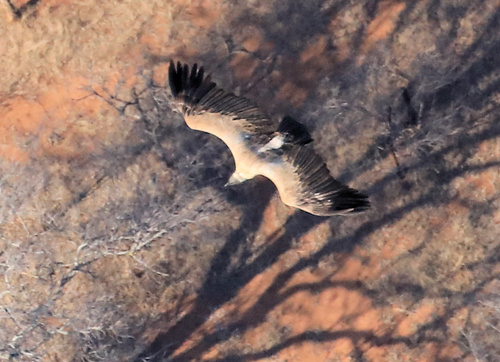
White-backed Vulture (Gyps africanus) White-backed Vulture
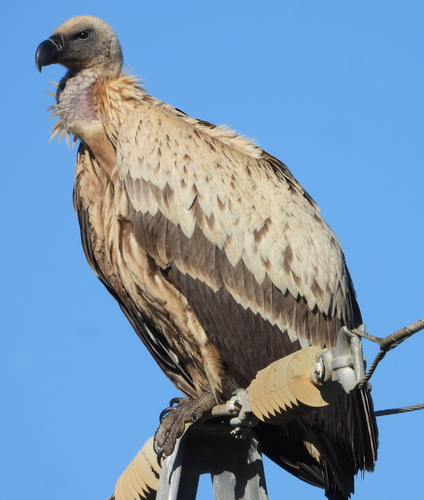
Cape Griffon (Gyps coprotheres) Cape Griffon

Media

Loading…

In short

Cape Griffon (Cape Vulture) and White-backed Vulture are both large, pale-headed Old World vultures, but Cape Griffon is noticeably larger and paler overall, especially in adults. The most reliable field mark is size and bulk: Cape Griffon dwarfs White-backed Vulture, with a heavier build and longer wingspan. In flight, adult Cape Griffon shows almost white underwing coverts and a creamy-buff body, while White-backed Vulture adults have a distinctive whitish back contrasting with otherwise dark plumage. Juveniles of both are darker and more similar, but Cape Griffon juveniles are still larger and show more streaking. Eye color (yellow in adult Cape Griffon, dark in White-backed) and iris color in immatures can help at close range. Both species can occur together at carcasses, so careful attention to size, wing pattern, and plumage is essential.

Identification tips

  1. Size and bulk: Cape Griffon is much larger and heavier than White-backed Vulture. Use this when birds are seen together or when perched near other raptors or vultures for scale. Size can be misleading at a distance or in flight without reference.
  2. Wingspan and structure: Cape Griffon has a broader wingspan (2.26–2.6 m vs. 1.96–2.25 m) and appears bulkier in flight. Look for longer, broader wings and a heavier, more imposing silhouette.
  3. Adult back color: White-backed Vulture adults have a distinctive whitish back that contrasts sharply with the rest of the dark body and wings. Cape Griffon lacks this, showing a creamy-buff body overall.
  4. Underwing coverts: Adult Cape Griffon shows almost white underwing coverts, especially striking in flight and at a distance. White-backed Vulture's underwing is darker overall.
  5. Head and neck: Both species have bare heads and necks, but Cape Griffon adults have yellowish eyes, while White-backed Vulture's eyes are dark. Juveniles of Cape Griffon may have brown to orange eyes and red necks, which can help separate them from White-backed juveniles.
  6. Juvenile/immature plumage: Both species' juveniles are darker than adults, but Cape Griffon juveniles are more streaked and still larger. White-backed juveniles lack the pale back and are more uniformly dark.
  7. Neck ruff: White-backed Vulture adults have a white neck ruff, which may be visible when perched. Cape Griffon does not have a contrasting ruff.
  8. Bill color: Cape Griffon has a black bill; White-backed Vulture's bill color is not specified as distinctive.
  9. Flight jizz: Cape Griffon appears heavier and steadier in flight, with broader wings and a more powerful glide. White-backed Vulture is more agile and slightly less imposing.
  10. Habitat context: Cape Griffon is more likely in mountainous or rocky areas, especially near cliffs, while White-backed Vulture is typical of wooded savannahs and open country with trees.
  11. Nesting sites: If seen at a nest, Cape Griffon nests on cliffs; White-backed Vulture nests in large trees.
  12. Group composition at carcasses: White-backed Vulture is usually the most numerous vulture at carcasses in much of Africa, while Cape Griffon is less common and more localized.
  13. Iris color in adults: At close range, adult Cape Griffon shows yellow irises, while White-backed Vulture remains dark-eyed.
  14. Overlap and pitfalls: Both species can be present at the same carcass, and juveniles are especially easy to confuse. Always check multiple features, not just one.
  15. Not by voice: No diagnostic vocalizations are described for separating these two species in the field.

Size

Cape Griffon is significantly larger than White-backed Vulture in all dimensions. Cape Griffon measures 96–115 cm in length, with a wingspan of 2.26–2.6 m and a body mass of 7–11 kg ([wikipedia]). White-backed Vulture is smaller, at 78–98 cm long, 1.96–2.25 m wingspan, and 4.2–7.2 kg ([wikipedia]). In the field, Cape Griffon appears bulkier, with broader wings and a heavier, more imposing presence, especially noticeable when both species are seen together. This size difference is diagnostic at close range or when perched side by side, but can be harder to judge in isolation or at a distance.

Plumage

Juvenile and immature birds of both species are generally darker than adults, but Cape Griffon juveniles are larger, more streaked, and often have brown to orange eyes and red necks ([wikipedia]). White-backed Vulture juveniles are largely dark overall, lacking the pale back of adults. Adult White-backed Vulture shows a striking whitish back that contrasts with otherwise dark plumage, a white neck ruff, and dark wings and tail. Cape Griffon adults are paler overall, with creamy-buff body plumage, almost white underwing coverts (especially obvious in flight), and contrasting dark flight and tail feathers. The head and neck are near-naked in both, but Cape Griffon has yellowish eyes as an adult, while White-backed Vulture's eyes remain dark. Both species have bare skin patches at the base of the neck, but these are not field marks. Bill color is black in Cape Griffon; not specified for White-backed but not noted as distinctive.

Behaviour

Both species are obligate scavengers specializing in carrion, often feeding in groups and arriving quickly at carcasses. White-backed Vulture is more social and is usually one of the first species to arrive at a carcass, relying on conspecifics to locate food. Cape Griffon also feeds in groups but is more likely to nest and roost on cliffs, while White-backed nests in trees. Both soar on thermals and can be seen circling high in the sky. No major behavioral differences are diagnostic in the field except for nesting and roosting preferences, which may be contextually useful.

Habitat

Cape Griffon is endemic to southern Africa, mainly in South Africa, Lesotho, Botswana, and parts of Namibia, and strongly prefers nesting and roosting on cliffs, often in mountainous terrain. White-backed Vulture is widespread across Africa and is the most common vulture on the continent, nesting in trees in wooded savannahs. Overlap can occur at carcasses, but Cape Griffon is more likely in rocky or mountainous areas, while White-backed is more typical of open savannah with scattered trees. Both may roost on pylons or trees, but only Cape Griffon regularly breeds on cliffs.

Submit a better description

Use the same sections as the comparison. Your text is published immediately.

Cape Griffon (Cape Vulture) and White-backed Vulture are both large, pale-headed Old World vultures, but Cape Griffon is noticeably larger and paler overall, especially in adults. The most reliable field mark is size and bulk: Cape Griffon dwarfs White-backed Vulture, with a heavier build and longer wingspan. In flight, adult Cape Griffon shows almost white underwing coverts and a creamy-buff body, while White-backed Vulture adults have a distinctive whitish back contrasting with otherwise dark plumage. Juveniles of both are darker and more similar, but Cape Griffon juveniles are still larger and show more streaking. Eye color (yellow in adult Cape Griffon, dark in White-backed) and iris color in immatures can help at close range. Both species can occur together at carcasses, so careful attention to size, wing pattern, and plumage is essential.

  1. Size and bulk: Cape Griffon is much larger and heavier than White-backed Vulture. Use this when birds are seen together or when perched near other raptors or vultures for scale. Size can be misleading at a distance or in flight without reference.
  2. Wingspan and structure: Cape Griffon has a broader wingspan (2.26–2.6 m vs. 1.96–2.25 m) and appears bulkier in flight. Look for longer, broader wings and a heavier, more imposing silhouette.
  3. Adult back color: White-backed Vulture adults have a distinctive whitish back that contrasts sharply with the rest of the dark body and wings. Cape Griffon lacks this, showing a creamy-buff body overall.
  4. Underwing coverts: Adult Cape Griffon shows almost white underwing coverts, especially striking in flight and at a distance. White-backed Vulture's underwing is darker overall.
  5. Head and neck: Both species have bare heads and necks, but Cape Griffon adults have yellowish eyes, while White-backed Vulture's eyes are dark. Juveniles of Cape Griffon may have brown to orange eyes and red necks, which can help separate them from White-backed juveniles.
  6. Juvenile/immature plumage: Both species' juveniles are darker than adults, but Cape Griffon juveniles are more streaked and still larger. White-backed juveniles lack the pale back and are more uniformly dark.
  7. Neck ruff: White-backed Vulture adults have a white neck ruff, which may be visible when perched. Cape Griffon does not have a contrasting ruff.
  8. Bill color: Cape Griffon has a black bill; White-backed Vulture's bill color is not specified as distinctive.
  9. Flight jizz: Cape Griffon appears heavier and steadier in flight, with broader wings and a more powerful glide. White-backed Vulture is more agile and slightly less imposing.
  10. Habitat context: Cape Griffon is more likely in mountainous or rocky areas, especially near cliffs, while White-backed Vulture is typical of wooded savannahs and open country with trees.
  11. Nesting sites: If seen at a nest, Cape Griffon nests on cliffs; White-backed Vulture nests in large trees.
  12. Group composition at carcasses: White-backed Vulture is usually the most numerous vulture at carcasses in much of Africa, while Cape Griffon is less common and more localized.
  13. Iris color in adults: At close range, adult Cape Griffon shows yellow irises, while White-backed Vulture remains dark-eyed.
  14. Overlap and pitfalls: Both species can be present at the same carcass, and juveniles are especially easy to confuse. Always check multiple features, not just one.
  15. Not by voice: No diagnostic vocalizations are described for separating these two species in the field.

Cape Griffon is significantly larger than White-backed Vulture in all dimensions. Cape Griffon measures 96–115 cm in length, with a wingspan of 2.26–2.6 m and a body mass of 7–11 kg ([wikipedia]). White-backed Vulture is smaller, at 78–98 cm long, 1.96–2.25 m wingspan, and 4.2–7.2 kg ([wikipedia]). In the field, Cape Griffon appears bulkier, with broader wings and a heavier, more imposing presence, especially noticeable when both species are seen together. This size difference is diagnostic at close range or when perched side by side, but can be harder to judge in isolation or at a distance.

Juvenile and immature birds of both species are generally darker than adults, but Cape Griffon juveniles are larger, more streaked, and often have brown to orange eyes and red necks ([wikipedia]). White-backed Vulture juveniles are largely dark overall, lacking the pale back of adults. Adult White-backed Vulture shows a striking whitish back that contrasts with otherwise dark plumage, a white neck ruff, and dark wings and tail. Cape Griffon adults are paler overall, with creamy-buff body plumage, almost white underwing coverts (especially obvious in flight), and contrasting dark flight and tail feathers. The head and neck are near-naked in both, but Cape Griffon has yellowish eyes as an adult, while White-backed Vulture's eyes remain dark. Both species have bare skin patches at the base of the neck, but these are not field marks. Bill color is black in Cape Griffon; not specified for White-backed but not noted as distinctive.

Both species are obligate scavengers specializing in carrion, often feeding in groups and arriving quickly at carcasses. White-backed Vulture is more social and is usually one of the first species to arrive at a carcass, relying on conspecifics to locate food. Cape Griffon also feeds in groups but is more likely to nest and roost on cliffs, while White-backed nests in trees. Both soar on thermals and can be seen circling high in the sky. No major behavioral differences are diagnostic in the field except for nesting and roosting preferences, which may be contextually useful.

Cape Griffon is endemic to southern Africa, mainly in South Africa, Lesotho, Botswana, and parts of Namibia, and strongly prefers nesting and roosting on cliffs, often in mountainous terrain. White-backed Vulture is widespread across Africa and is the most common vulture on the continent, nesting in trees in wooded savannahs. Overlap can occur at carcasses, but Cape Griffon is more likely in rocky or mountainous areas, while White-backed is more typical of open savannah with scattered trees. Both may roost on pylons or trees, but only Cape Griffon regularly breeds on cliffs.

Discard your changes?

You have unsaved edits. If you leave now, those changes will be lost.

White-backed Vulture · Cape Griffon · My Tricky Birds