

Motmot

Whimbrel vs Bar-tailed Godwit

Numenius phaeopus versus Limosa lapponica

Play a quiz with Whimbrel and Bar-tailed Godwit

Whimbrel (Numenius phaeopus) Whimbrel
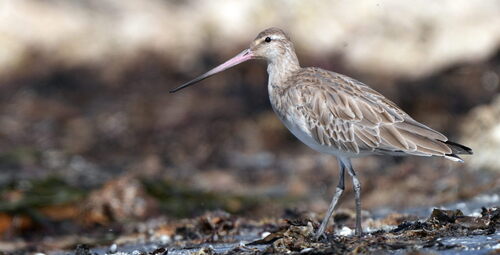
Bar-tailed Godwit (Limosa lapponica) Bar-tailed Godwit

Media

Loading…

In short

The most reliable field mark to separate Whimbrel from Bar-tailed Godwit is seen in flight: Eurasian Whimbrel shows a striking white lower back and rump (in most subspecies), while Bar-tailed Godwit has a brown rump and back matching the rest of its upperparts. This rump contrast is especially clear on immature and non-breeding birds, which are often confused in the field. Structurally, Whimbrel has a more obviously kinked, downcurved bill and slightly longer legs, while Bar-tailed Godwit’s bill is straighter and slightly upturned. Plumage differences are subtle outside breeding season, but Whimbrel is overall darker and more heavily streaked, whereas Bar-tailed Godwit is plainer and paler grey-brown in non-breeding plumage. Both species frequent similar coastal habitats, but careful attention to rump pattern, bill shape, and overall jizz will resolve most confusion.

Identification tips

  1. Rump pattern in flight (all ages): Whimbrel shows a bright white lower back and rump, sharply contrasting with the rest of the upperparts. Bar-tailed Godwit’s rump is brown and matches the back—no white flash. This is the single most reliable mark, especially on immatures and in non-breeding plumage.
  2. Bill shape: Whimbrel’s bill is long, strongly downcurved with a distinct kink (not a smooth curve). Bar-tailed Godwit’s bill is long but only slightly upturned, never as obviously curved as Whimbrel’s. Look for the kink when the bird is side-on.
  3. Bill color: Bar-tailed Godwit has a two-toned bill (pinkish at the base, black at the tip), especially obvious at close range. Whimbrel’s bill is uniformly dark.
  4. Head pattern: Whimbrel has a bold dark crown with a strong pale supercilium (eyebrow) and a central crown stripe, giving a distinctly striped head. Bar-tailed Godwit’s head is plainer, with less contrast and no strong crown stripes.
  5. Underparts in breeding plumage: Male Bar-tailed Godwits are bright brick red below in breeding plumage (females duller but still reddish). Whimbrel is never red below, always brownish and streaked.
  6. Underparts in non-breeding/juvenile plumage: Whimbrel is more heavily streaked below, especially on the breast and flanks. Bar-tailed Godwit is paler and plainer, with only faint streaks on the breast and flanks.
  7. Leg color and length: Both have blue-grey legs, but Whimbrel’s legs may appear slightly longer and bulkier in stance. Not a strong field mark.
  8. Overall structure/jizz: Whimbrel appears chunkier, longer-legged, and with a more angular profile. Bar-tailed Godwit is sleeker, with a more horizontal posture and shorter legs.
  9. Wing pattern: No distinctive upperwing marks are described for either species, but the rump contrast is visible from above and behind in flight.
  10. Feeding behavior: Whimbrel often picks at the surface or probes for crabs and insects, sometimes in grassy edges. Bar-tailed Godwit probes more deeply and rapidly in open mudflats.
  11. Habitat: Overlap is extensive, but Whimbrel may be slightly more likely in grassy or marshy edges; Bar-tailed Godwit prefers open tidal flats. Use with caution.
  12. Voice: Whimbrel’s rippling whistle or trill is distinctive if heard. Bar-tailed Godwit’s calls are not described here, but lack the Whimbrel’s song.
  13. Size: Both are similar in size and mass; do not rely on this unless birds are side by side.
  14. Pitfalls: Immature and non-breeding birds are most often confused; always try to see the rump in flight and the bill shape. Head pattern and underpart streaking are supporting marks but can be subtle at a distance.
  15. Season/sex: Bright red underparts in spring indicate male Bar-tailed Godwit; Whimbrel is never red below. In autumn and winter, rely on rump, bill, and head pattern.

Size

Both species are similar in overall length (Whimbrel: 37–47 cm; Bar-tailed Godwit: 37–41 cm) and wingspan (Whimbrel: 75–90 cm; Bar-tailed Godwit: 70–80 cm) [wikipedia]. Bar-tailed Godwit averages slightly heavier (mean adult mass 333.5 g [wikidata]), but this is not a reliable field mark. Whimbrel may appear longer-legged and a bit bulkier in stance, but size overlap is considerable and not diagnostic at a distance.

Plumage

The most diagnostic plumage mark is the rump and lower back in flight: Eurasian Whimbrel (all ages except some rare subspecies) shows a bright white rump and lower back, sharply contrasting with the brown upperparts, visible especially when the bird takes off or flies away. Bar-tailed Godwit (all ages) has a brown rump and back, concolorous with the rest of the upperparts, lacking any white flash. Juvenile and non-breeding Whimbrels are overall grey-brown with heavy streaking and a bold head pattern (dark crown with strong pale supercilium); Bar-tailed Godwits in non-breeding and juvenile plumage are plainer, paler grey-brown above with less streaking, and the underparts are whiter with only faint streaks on the breast and flanks. In breeding plumage, Bar-tailed Godwit males are bright brick red below and dark brown above, while Whimbrel remains brown and streaked. Female Bar-tailed Godwits in breeding plumage are duller reddish, but still much more colorful below than Whimbrel. Bill color also differs: Bar-tailed Godwit has a two-toned bill (pinkish at base, black at tip), while Whimbrel’s bill is uniformly dark.

Behaviour

Both species feed by probing mudflats and picking invertebrates, but Whimbrel often uses a more deliberate, methodical gait and is more likely to be seen picking at the surface for small crabs or insects. Bar-tailed Godwit tends to probe more deeply and rapidly. In flight, Whimbrel appears more angular and long-legged, with a slightly slower, more labored wingbeat, while Bar-tailed Godwit is sleeker and more direct. Ceremonial or display flights are not a useful field mark for separation between these two species.

Habitat

Both species frequent coastal mudflats, estuaries, and sandy shores during migration and winter. There is significant overlap in habitat, so location alone is not a reliable separator. Whimbrel may be found slightly more often in grassy or marshy edges, and Bar-tailed Godwit is more strictly tied to open tidal flats, but these are tendencies rather than rules.

Voice

Whimbrel gives a distinctive rippling whistle, often prolonged into a trill, which is quite different from the godwit’s calls. Bar-tailed Godwit’s voice is not described in the notes, but it lacks the Whimbrel’s characteristic call. Voice can be helpful if the Whimbrel’s song or call is heard, but silence is common when feeding.

Submit a better description

Use the same sections as the comparison. Your text is published immediately.

The most reliable field mark to separate Whimbrel from Bar-tailed Godwit is seen in flight: Eurasian Whimbrel shows a striking white lower back and rump (in most subspecies), while Bar-tailed Godwit has a brown rump and back matching the rest of its upperparts. This rump contrast is especially clear on immature and non-breeding birds, which are often confused in the field. Structurally, Whimbrel has a more obviously kinked, downcurved bill and slightly longer legs, while Bar-tailed Godwit’s bill is straighter and slightly upturned. Plumage differences are subtle outside breeding season, but Whimbrel is overall darker and more heavily streaked, whereas Bar-tailed Godwit is plainer and paler grey-brown in non-breeding plumage. Both species frequent similar coastal habitats, but careful attention to rump pattern, bill shape, and overall jizz will resolve most confusion.

  1. Rump pattern in flight (all ages): Whimbrel shows a bright white lower back and rump, sharply contrasting with the rest of the upperparts. Bar-tailed Godwit’s rump is brown and matches the back—no white flash. This is the single most reliable mark, especially on immatures and in non-breeding plumage.
  2. Bill shape: Whimbrel’s bill is long, strongly downcurved with a distinct kink (not a smooth curve). Bar-tailed Godwit’s bill is long but only slightly upturned, never as obviously curved as Whimbrel’s. Look for the kink when the bird is side-on.
  3. Bill color: Bar-tailed Godwit has a two-toned bill (pinkish at the base, black at the tip), especially obvious at close range. Whimbrel’s bill is uniformly dark.
  4. Head pattern: Whimbrel has a bold dark crown with a strong pale supercilium (eyebrow) and a central crown stripe, giving a distinctly striped head. Bar-tailed Godwit’s head is plainer, with less contrast and no strong crown stripes.
  5. Underparts in breeding plumage: Male Bar-tailed Godwits are bright brick red below in breeding plumage (females duller but still reddish). Whimbrel is never red below, always brownish and streaked.
  6. Underparts in non-breeding/juvenile plumage: Whimbrel is more heavily streaked below, especially on the breast and flanks. Bar-tailed Godwit is paler and plainer, with only faint streaks on the breast and flanks.
  7. Leg color and length: Both have blue-grey legs, but Whimbrel’s legs may appear slightly longer and bulkier in stance. Not a strong field mark.
  8. Overall structure/jizz: Whimbrel appears chunkier, longer-legged, and with a more angular profile. Bar-tailed Godwit is sleeker, with a more horizontal posture and shorter legs.
  9. Wing pattern: No distinctive upperwing marks are described for either species, but the rump contrast is visible from above and behind in flight.
  10. Feeding behavior: Whimbrel often picks at the surface or probes for crabs and insects, sometimes in grassy edges. Bar-tailed Godwit probes more deeply and rapidly in open mudflats.
  11. Habitat: Overlap is extensive, but Whimbrel may be slightly more likely in grassy or marshy edges; Bar-tailed Godwit prefers open tidal flats. Use with caution.
  12. Voice: Whimbrel’s rippling whistle or trill is distinctive if heard. Bar-tailed Godwit’s calls are not described here, but lack the Whimbrel’s song.
  13. Size: Both are similar in size and mass; do not rely on this unless birds are side by side.
  14. Pitfalls: Immature and non-breeding birds are most often confused; always try to see the rump in flight and the bill shape. Head pattern and underpart streaking are supporting marks but can be subtle at a distance.
  15. Season/sex: Bright red underparts in spring indicate male Bar-tailed Godwit; Whimbrel is never red below. In autumn and winter, rely on rump, bill, and head pattern.

Both species are similar in overall length (Whimbrel: 37–47 cm; Bar-tailed Godwit: 37–41 cm) and wingspan (Whimbrel: 75–90 cm; Bar-tailed Godwit: 70–80 cm) [wikipedia]. Bar-tailed Godwit averages slightly heavier (mean adult mass 333.5 g [wikidata]), but this is not a reliable field mark. Whimbrel may appear longer-legged and a bit bulkier in stance, but size overlap is considerable and not diagnostic at a distance.

The most diagnostic plumage mark is the rump and lower back in flight: Eurasian Whimbrel (all ages except some rare subspecies) shows a bright white rump and lower back, sharply contrasting with the brown upperparts, visible especially when the bird takes off or flies away. Bar-tailed Godwit (all ages) has a brown rump and back, concolorous with the rest of the upperparts, lacking any white flash. Juvenile and non-breeding Whimbrels are overall grey-brown with heavy streaking and a bold head pattern (dark crown with strong pale supercilium); Bar-tailed Godwits in non-breeding and juvenile plumage are plainer, paler grey-brown above with less streaking, and the underparts are whiter with only faint streaks on the breast and flanks. In breeding plumage, Bar-tailed Godwit males are bright brick red below and dark brown above, while Whimbrel remains brown and streaked. Female Bar-tailed Godwits in breeding plumage are duller reddish, but still much more colorful below than Whimbrel. Bill color also differs: Bar-tailed Godwit has a two-toned bill (pinkish at base, black at tip), while Whimbrel’s bill is uniformly dark.

Both species feed by probing mudflats and picking invertebrates, but Whimbrel often uses a more deliberate, methodical gait and is more likely to be seen picking at the surface for small crabs or insects. Bar-tailed Godwit tends to probe more deeply and rapidly. In flight, Whimbrel appears more angular and long-legged, with a slightly slower, more labored wingbeat, while Bar-tailed Godwit is sleeker and more direct. Ceremonial or display flights are not a useful field mark for separation between these two species.

Both species frequent coastal mudflats, estuaries, and sandy shores during migration and winter. There is significant overlap in habitat, so location alone is not a reliable separator. Whimbrel may be found slightly more often in grassy or marshy edges, and Bar-tailed Godwit is more strictly tied to open tidal flats, but these are tendencies rather than rules.

Whimbrel gives a distinctive rippling whistle, often prolonged into a trill, which is quite different from the godwit’s calls. Bar-tailed Godwit’s voice is not described in the notes, but it lacks the Whimbrel’s characteristic call. Voice can be helpful if the Whimbrel’s song or call is heard, but silence is common when feeding.

Discard your changes?

You have unsaved edits. If you leave now, those changes will be lost.

Whimbrel · Bar-tailed Godwit · My Tricky Birds