
Western Subalpine Warbler vs Eastern Subalpine Warbler
Curruca iberiae versus Curruca cantillans
Play a quiz with Western Subalpine Warbler and Eastern Subalpine Warbler
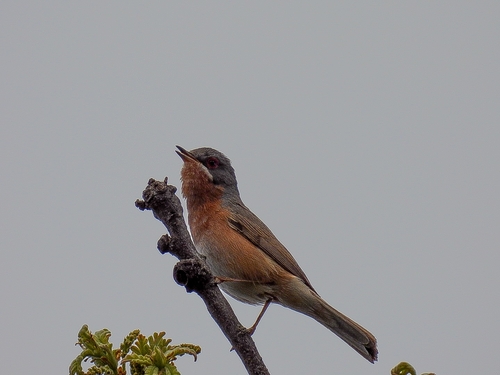 Western Subalpine Warbler
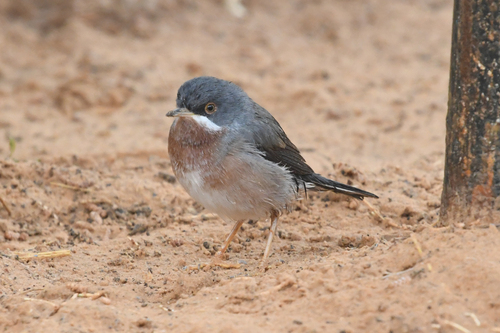 Eastern Subalpine Warbler
In short
The most reliable field mark between Western and Eastern Subalpine Warbler is the male's head and underpart pattern: Eastern males show a deeper blue-grey upperparts, a blackish mask on the lores and ear-coverts, and a sharply demarcated brick-red throat and breast, while Western males are paler grey above, lack a strong mask, and have brick-red extending further down the underparts. Females and immatures are much trickier, as both are brownish above and pale below with a pink flush, but Eastern tends to have a wider white submoustachial stripe and paler flanks. Both species share similar structure and size, so careful attention to subtle plumage details—especially in adult males—is key. Habitat and voice are not reliably separable in the field. Immature and female birds remain a significant identification challenge, and some individuals may not be safely assigned without close, prolonged views.
Identification tips
- Adult male head pattern: Eastern males have a deeper blue-grey head and back, with a distinct blackish mask (lores and ear-coverts). Western males are paler grey and lack a strong mask. This is the single most reliable mark in good light.
- Adult male underparts: Eastern males show brick-red confined to the throat and upper breast, sharply demarcated from a white belly and paler flanks. Western males have brick-red extending further down the belly, with a less abrupt transition to the paler areas.
- White malar (submoustachial) stripe: Eastern males have a broader, more striking white malar stripe than Western. This is most useful on close views of singing males.
- Female and immature plumage: Both are brownish above and pale below with a pink flush. Eastern females may show a broader white malar and paler flanks, but this is subtle and overlaps with Western. Most females and immatures are not safely identified without close, prolonged views.
- Absence of distinctive juvenile/first-winter wing pattern: Neither species shows a unique upperwing or flight pattern in immatures, so flight views of young birds are not diagnostic.
- Bill, tail, and primary projection: Structure is essentially identical and not useful for separation.
- Song and calls: Both species have a fast, rattling song similar to Lesser Whitethroat; vocal differences are not reliable in the field.
- Habitat: Both use dry, bushy habitats; range may help in some areas (Western extends to NW Africa, Eastern is southern Europe), but where overlap occurs, habitat is not diagnostic.
- Season and location: In some regions, only one species is expected, so local knowledge can help, but vagrancy and overlap zones mean this is not foolproof.
- Eye-ring and dark head: Both species have a naked eye-ring and dark head in adult males; this does not separate them.
- Subtlety of female/immature marks: Be cautious with females and immatures; most field marks are subtle and overlapping. Only assign to species with confidence if multiple features align.
- Plumage transition: The sharpness of the border between brick-red and white on the underparts is a key male mark—Eastern is sharply demarcated, Western is more blended.
- Mask strength: The presence and strength of the blackish mask is a critical separator in males; always check for this in good light.
- Flank color: Eastern males have paler flanks compared to Western, but this is a supporting, not primary, feature.
- Beware of worn or aberrant individuals: Some birds may not show classic features due to wear or individual variation—when in doubt, leave as 'Subalpine Warbler sp.'
Size
Both Western and Eastern Subalpine Warblers are small, slim warblers of essentially identical size and proportions. There are no consistent differences in length, wingspan, or mass that can be used for field identification between these two species. Structure—such as bill shape, tail length, and wing projection—is also very similar and not diagnostic.
Plumage
Adult males are the most separable: Eastern Subalpine Warbler males have deeper blue-grey upperparts, a distinct blackish mask across the lores and ear-coverts, and brick-red coloration sharply limited to the throat and breast, with a clear, abrupt border to a white belly and paler flanks. Their white submoustachial (malar) stripe is broader and more striking. Western males are paler grey above, lack a strong mask, and have brick-red underparts that extend further down the belly, with a less abrupt transition to the paler lower belly and flanks. Females and immatures of both species are brownish above with a greyer head, whitish below with a pink flush, and a white malar area; Eastern females may show a broader white malar and paler flanks, but this is subtle and overlaps. No distinctive juvenile or first-winter upperwing patterns are described for either species, so flight views of immatures are not reliably diagnostic.
Behaviour
Both species behave similarly: they are active, often skulking warblers, moving through low shrubs and bushes in search of insects. Flight and foraging behavior are not reliably different in the field. Both may occasionally perch up to sing but are more often seen flitting through dense vegetation.
Habitat
Habitat preferences are nearly identical: both breed in dry, open country with scattered bushes or low shrubs, often on hillsides. Western Subalpine Warbler's range extends into north-western Africa, while Eastern is restricted to southernmost Europe, but within overlap zones, habitat is not a reliable separator.
Voice
Both species have a fast, rattling song similar to Lesser Whitethroat, and their calls are not reliably separable in the field according to current sources. Vocal differences may exist but are subtle and not well described for field use.
Western Subalpine Warbler · Eastern Subalpine Warbler · My Tricky Birds