

Western Orphean Warbler vs Rüppell's Warbler
Curruca hortensis versus Curruca ruppeli
Play a quiz with Western Orphean Warbler and Rüppell's Warbler
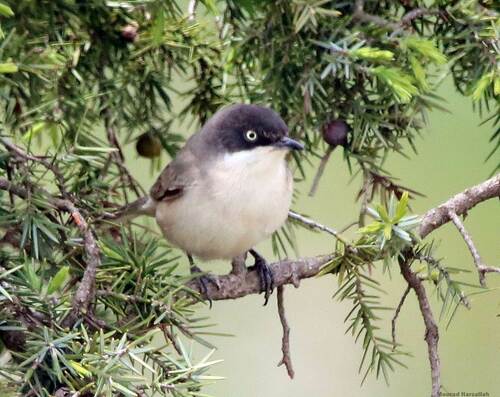 Western Orphean Warbler
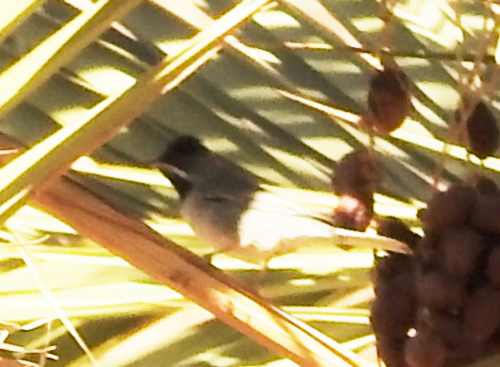 Rüppell's Warbler
In short
The most reliable field mark to separate Western Orphean Warbler from Rüppell's Warbler is the striking black head and throat of adult male Rüppell's, sharply divided by a white malar streak, which is never shown by Western Orphean. Female and immature Rüppell's are greyer-headed with a brownish tinge to the back and lack the bold black-and-white contrast. Both species are typical Curruca warblers, but Rüppell's is slimmer and has a finer, more pointed bill. When sexing or aging is uncertain, focus on head pattern and throat color, as well as overall structure and bill shape. Vocalizations and habitat can provide supporting clues, but are less reliable for quick field separation.
Identification tips
- Adult male Rüppell's Warbler shows a black head and throat, sharply divided by a white malar streak ('moustache')—this is the single best field mark and is never matched by Western Orphean Warbler.
- Female Rüppell's Warbler has a grey head (not black), pale throat, and a grey back with a brownish tinge; Western Orphean females are plainer and lack the brownish tinge.
- Both species have plain grey backs and paler grey underparts, so these features alone are not diagnostic.
- Bill shape is subtly different: Rüppell's has a finer, more pointed bill, which may be visible at close range.
- Eye color in Rüppell's is red; check for this if lighting allows, but be cautious as this can be hard to see in the field.
- Leg color in Rüppell's is brown; again, this is a subtle mark and not always visible.
- Structure: Rüppell's is slimmer than Western Orphean, with a more delicate build, especially compared to the slightly heavier Orphean.
- Juvenile and immature plumages are not well described for either species here; avoid relying on upperwing or flight pattern for separation in these ages based on current notes.
- Song: Rüppell's has a slower, deeper rattle than Sardinian Warbler, but no comparison is available for Western Orphean; use with caution.
- Habitat overlap is possible in southeastern Europe and the Mediterranean, so do not rely on location alone.
- If you see a bold black-and-white facial pattern (black head and throat, white malar), it is Rüppell's male—Western Orphean never shows this.
- If the bird is plainer grey with no sharp head/throat contrast, and especially if it appears heavier-billed and less slim, suspect Western Orphean.
- In mixed flocks or migration hotspots, check every 'Curruca' carefully for head pattern and bill shape—do not assume based on jizz alone.
- If you cannot see the head pattern well, use structure and bill as supporting clues, but beware overlap.
- If in doubt with a drab, plain Curruca in this region, prioritize head/throat contrast and bill shape over subtle color tones.
Size
Both species are typical Curruca warblers and broadly similar in size, but Rüppell's Warbler is noted as slimmer than the Sardinian Warbler, implying a more slender build than Western Orphean Warbler. No precise measurements are available here, but structure (slimmer, finer bill in Rüppell's) is a subtle but useful supporting clue.
Plumage
Adult male Rüppell's Warbler is unmistakable with its black head and throat, separated by a sharp white malar streak ('moustache'). This bold contrast is never matched by Western Orphean Warbler, which lacks the black-and-white facial pattern. Female Rüppell's has a grey head (not black), a pale throat, and a grey back with a brownish tinge, while Western Orphean females are generally plainer and lack the brownish tinge. Both species have plain grey backs and paler grey underparts, but only Rüppell's shows the distinctive head/throat contrast in males. Juvenile and immature plumages are not described in detail for either species, so caution is needed with non-adult birds.
Behaviour
No direct behavioral differences are described between these two species in the available notes. Both are typical warblers in their movements and foraging style.
Habitat
Rüppell's Warbler breeds in Greece, Turkey, and neighboring islands, and is migratory, wintering in northeast Africa. Western Orphean Warbler is also a Curruca warbler but is not described in detail here. Habitat overlap is possible in southeastern Europe and the Mediterranean, so habitat alone is not diagnostic.
Voice
Rüppell's Warbler's song is described as a slower, deeper rattle compared to Sardinian Warbler. There is no vocal description for Western Orphean Warbler here, so song is not a reliable separator between these two in the absence of direct comparison.
Western Orphean Warbler · Rüppell's Warbler · My Tricky Birds