

Western Marsh Harrier vs Pallid Harrier
Circus aeruginosus versus Circus macrourus
Play a quiz with Western Marsh Harrier and Pallid Harrier
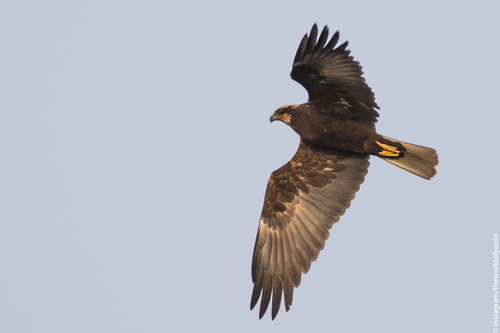 Western Marsh Harrier
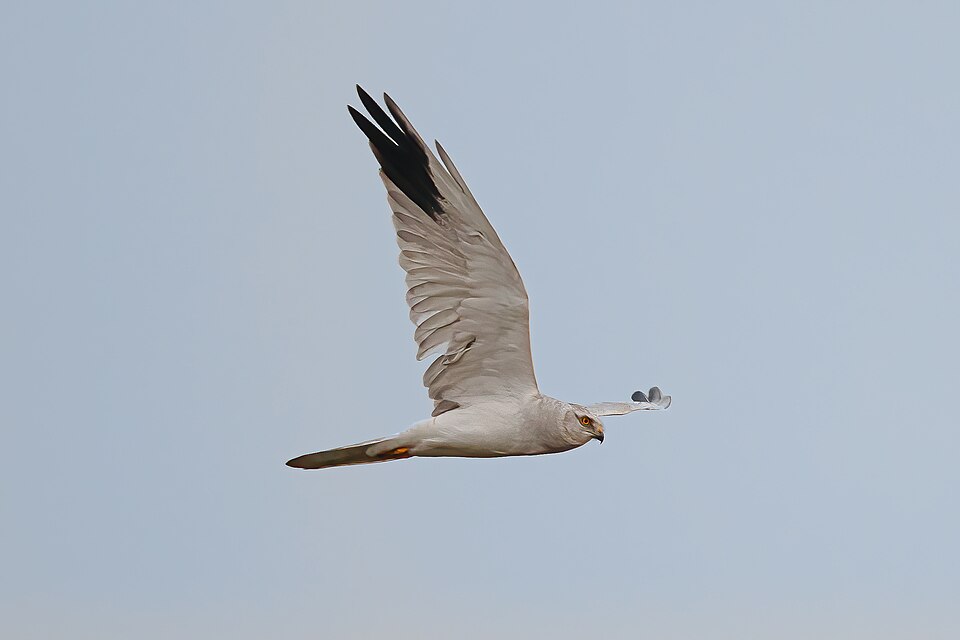 Pallid Harrier
In short
The most reliable field mark between Western Marsh Harrier and Pallid Harrier is overall structure and flight jizz: Western Marsh Harrier is bulkier with broader wings and a heavier build, while Pallid Harrier is noticeably slimmer and more graceful, with narrower wings and a lighter, more buoyant flight. Juvenile and female plumages can be especially confusing, but Western Marsh Harrier females and immatures show a more uniform dark brown with a contrasting pale head and shoulders, whereas Pallid Harrier females and juveniles ('ringtails') are browner above with a paler belly and a well-defined facial pattern. In adult males, Western Marsh Harrier is three-toned (brown, grey, black) with a reddish-brown body and grey secondaries, while Pallid Harrier males are much paler, almost white below with narrow black wingtips. Size and structure, especially in flight, are often more reliable than plumage alone.
Identification tips
- Structure in flight: Western Marsh Harrier is larger, bulkier, and broader-winged, with a heavier, more ponderous flight. Pallid Harrier is slimmer, with narrower wings and a more buoyant, agile flight. This is often the most reliable separator at distance or in poor light.
- Adult male plumage: Western Marsh Harrier males are reddish-brown with pale streaks, a pale head, grey secondaries and tail, and black primaries—giving a three-toned (brown-grey-black) wing. Pallid Harrier males are pale whitish-grey above, white below, with narrow black wingtips and no rufous tones.
- Female/juvenile head pattern: Female and juvenile Western Marsh Harrier have a pale yellowish head, throat, and shoulders contrasting with a dark brown body, and a dark eye area that makes the pale iris stand out. Pallid Harrier females/juveniles have a well-defined pale facial disk and collar, with a less contrasting head but a more striking facial pattern overall.
- Upper tail coverts ('ringtail'): Pallid Harrier females and juveniles show white upper tail coverts, forming a clear 'ringtail'—absent in Western Marsh Harrier of any age or sex.
- Underparts: Western Marsh Harrier females/juveniles are more uniformly dark brown below, sometimes with a paler throat, while Pallid Harrier females/juveniles have a paler, buff-streaked belly.
- Underwing: Western Marsh Harrier has a paler brown underwing with dark primaries, but the contrast is less sharp than in Pallid Harrier, which shows a much paler underwing with sharp black tips in adult males.
- Facial pattern: Pallid Harrier females/juveniles have a clear pale collar and facial disk, while Western Marsh Harrier's pale head is less sharply marked and often blends into the neck and shoulders.
- Legs and feet: Both species have yellow legs and feet, not a useful separator.
- Perched jizz: Western Marsh Harrier appears heavier and more upright when perched; Pallid Harrier is slimmer and more delicate.
- Flight jizz: Western Marsh Harrier often flies with legs dangling and appears more labored; Pallid Harrier is more buoyant and agile, rarely dangling legs.
- Habitat context: Western Marsh Harrier is almost always associated with wetlands and reedbeds, while Pallid Harrier prefers drier open country, steppes, and fields, especially as a vagrant in western Europe.
- Size in mixed flocks: If seen together, Western Marsh Harrier is noticeably larger and bulkier than Pallid Harrier.
- Rare morphs: Hypermelanic Western Marsh Harrier juveniles can appear all black, which is not matched by Pallid Harrier; beware of this rare pitfall.
- Seasonal context: Pallid Harrier is a rare vagrant in western Europe, so context and abundance may help, but do not rely solely on range.
- Voice: No diagnostic vocal differences are described in the sources; do not use voice for separation.
Size
Western Marsh Harrier is distinctly larger and bulkier than Pallid Harrier. While direct mass data is only available for Pallid Harrier (average adult body mass ~383.5 g [wikidata]), Western Marsh Harrier is described as 48–56 cm in length with a 115–130 cm wingspan, compared to Pallid Harrier's 40–48 cm length and 95–120 cm wingspan [wikipedia]. This translates to a noticeably heavier, broader-winged impression for Western Marsh Harrier, especially in females. Pallid Harrier is more slender and lighter, both in hand and in the field.
Plumage
Juvenile and female Western Marsh Harriers are mostly chocolate-brown with a conspicuously paler yellowish head, throat, and shoulders; this pale area can be sharply defined or more washed-out, but the dark eye area always makes the pale iris stand out. Juvenile Western Marsh Harriers have less yellow on the shoulders than females, and rare hypermelanic morphs can appear almost entirely black. By contrast, female and juvenile Pallid Harriers ('ringtails') are brown above with white upper tail coverts and a paler, buff-streaked belly. Their facial pattern is well-defined and more striking than in Western Marsh Harrier, with a clear pale collar and facial disk. Adult male Western Marsh Harrier is dark reddish-brown with pale streaks, a pale head, grey secondaries and tail, and black primaries, giving a three-toned upperwing; adult male Pallid Harrier is much paler, whitish-grey above and white below with narrow black wingtips and no rufous tones. The underwing of Western Marsh Harrier is similar to the upperwing but paler, while Pallid Harrier shows a much cleaner, paler underwing with sharp black tips. In all ages, Western Marsh Harrier lacks the white upper tail coverts ('ringtail') of Pallid Harrier females/juveniles.
Behaviour
Both species hunt by gliding low over open ground with wings held in a shallow V, but Western Marsh Harrier typically appears heavier and more labored, often with legs dangling. Pallid Harrier is more buoyant and agile, with a lighter, more graceful flight and less tendency to dangle legs. Perched, Western Marsh Harrier looks bulkier and more upright, while Pallid Harrier is slimmer and more delicate.
Habitat
Western Marsh Harrier is usually found in temperate and subtropical wetlands, reedbeds, and marshes across western Eurasia and adjacent Africa. Pallid Harrier breeds in southern parts of eastern Europe, central Asia, and Iran, favoring open fields, steppes, and moorland, and winters mainly in India and southeast Asia. In western Europe, Pallid Harrier is a rare vagrant, often seen in drier open country compared to the more wetland-associated Western Marsh Harrier.