

Western House Martin vs Siberian House Martin
Delichon urbicum versus Delichon lagopodum
Play a quiz with Western House Martin and Siberian House Martin
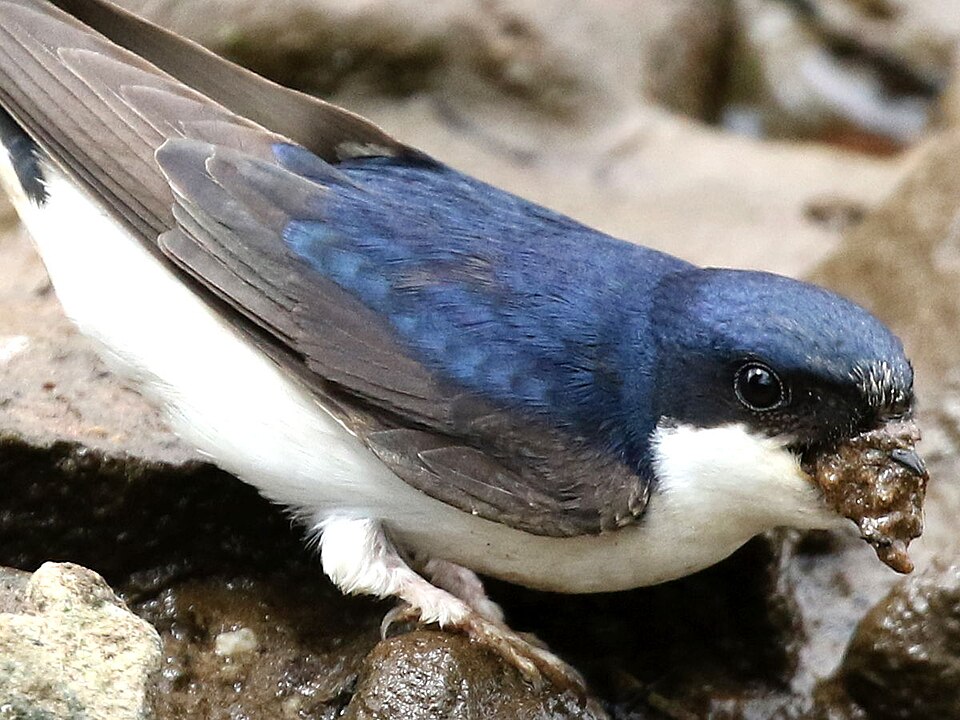 Western House Martin
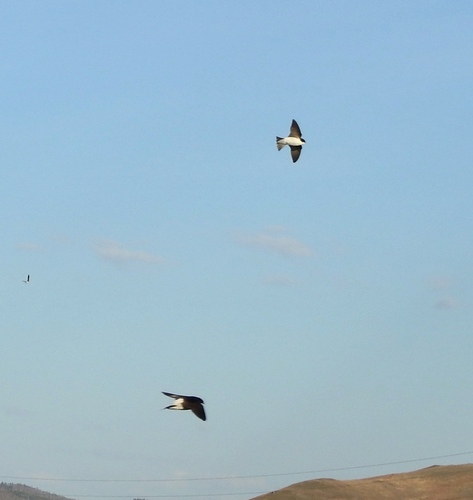 Siberian House Martin
In short
The most reliable field mark between Western House Martin and Siberian House Martin is the extent of the white rump: Siberian House Martin shows a much more extensive white rump, which can reach further onto the tail, while Western House Martin's white rump is more restricted. Both species are very similar in size, structure, and overall coloration, but subtle differences in rump pattern and tail fork depth are key, especially in flight. Juvenile Western House Martins can show white-tipped wing coverts and quills, which may help in some cases. Habitat and range are also helpful: Western House Martin breeds in Europe and western Asia, while Siberian House Martin is found in northeastern Asia.
Identification tips
- White rump extent: Siberian House Martin shows a much more extensive white rump, often reaching further onto the tail. Western House Martin's white rump is more restricted and does not extend as far. This is the most reliable field mark, especially in flight and from above.
- Tail fork depth: Siberian House Martin has a tail fork of intermediate depth between Western House Martin and Asian House Martin. Western House Martin's tail fork is shallower. This is subtle and best seen in direct comparison.
- Juvenile plumage: Juvenile Western House Martins are sooty black above with white tips and edgings to some wing coverts and quills. If you see a young bird with these marks, especially in late summer or early autumn, it is likely a Western House Martin. No specific juvenile details are given for Siberian House Martin, but expect the rump extent to remain a differentiator.
- Underparts and underwing: Both species have pure white underparts and underwings, so this is not a useful separation mark.
- Head and upperparts: Both have blue heads and upperparts; do not use this feature to separate them.
- Leg feathering: Western House Martin has white downy feathering on the short legs, but this is rarely visible in the field and likely similar in Siberian House Martin.
- Bill, eyes, and legs: Both have small black bills and brown eyes; exposed parts of the legs are pink in Western House Martin, but this is not a practical field mark.
- Flight style: Western House Martin is noted for a rapid wingbeat, but no comparative data for Siberian House Martin; do not rely on this for separation.
- Habitat and range: Western House Martin is found breeding in Europe, North Africa, and western/central Asia, often near human habitation. Siberian House Martin breeds in rocky, less urbanized areas of northeastern Asia. If you are in Europe or near buildings, Western House Martin is far more likely.
- Seasonal context: Consider the time of year and location. Western House Martin winters in sub-Saharan Africa and southwestern Asia, while Siberian House Martin winters in Southeast Asia.
- Colony size and nesting: Western House Martin often breeds in colonies, sometimes with thousands of nests, frequently attached to buildings. Siberian House Martin's colonial habits are not detailed but are likely similar; nesting substrate (rocky vs. man-made) may help in context.
- Sex differences: Both species are sexually monomorphic; do not use sex for identification.
- Confusion with other martins: Both can be confused with other Delichon martins, but within this pair, focus on rump extent and tail fork.
- Voice: No diagnostic vocal differences are described; do not use voice for separation.
- Pitfalls: Beware of relying on underpart color, head color, or size, as these are essentially identical between the two species. Focus on rump extent and, if visible, juvenile wing covert pattern.
Size
Both species are nearly identical in size, with Western House Martin averaging 13 cm in length and a wingspan of 26–29 cm. No specific size data is provided for Siberian House Martin, but as former conspecifics, they are expected to be extremely similar in mass and proportions. Size is not a reliable field mark for separating these two in the field.
Plumage
For adults, both species have steel-blue upperparts, white underparts, and a white rump, but the Siberian House Martin's white rump extends further onto the tail, making it appear larger and more obvious in flight. The tail fork in Siberian House Martin is intermediate in depth between Western House Martin and Asian House Martin, but this is subtle. Juvenile Western House Martins are sooty black above with white tips and edgings to some wing coverts and quills, which can be a useful mark if seen well; no such detail is given for Siberian House Martin juveniles, but expect them to be similar except for the rump extent. Underwing and underparts are pure white in both species, and both have blue heads and upperparts. Sexes are alike in both species.
Behaviour
Both species are aerial insectivores, feeding on insects caught in flight, and show similar flight styles typical of hirundines. Western House Martin is noted for a slightly faster wingbeat (5.3 beats/sec) compared to Barn Swallow, but no comparative data is given for Siberian House Martin. Both species are highly migratory and often travel in daylight. Western House Martin is known to breed colonially, sometimes in large colonies; Siberian House Martin's breeding behavior is not detailed but is likely similar.
Habitat
Western House Martin breeds in Europe, North Africa, and west-central Asia, often near human habitation as well as in open country. Siberian House Martin breeds in rocky areas of northeastern Russia, Mongolia, and northern China, and winters in Southeast Asia. While both are Delichon martins and may overlap on migration, their breeding habitats are distinct: Western House Martin is more associated with buildings and towns, while Siberian House Martin favors rocky, less urbanized breeding sites.
Western House Martin · Siberian House Martin · My Tricky Birds