
Western Bonelli's Warbler vs Common Chiffchaff
Phylloscopus bonelli versus Phylloscopus collybita
Play a quiz with Western Bonelli's Warbler and Common Chiffchaff
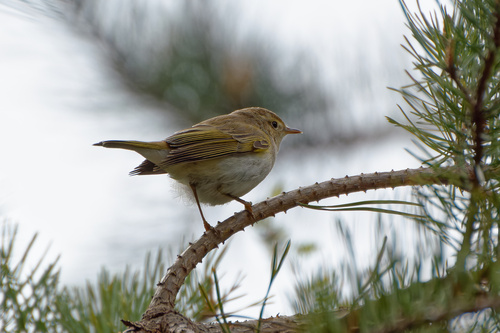 Western Bonelli's Warbler
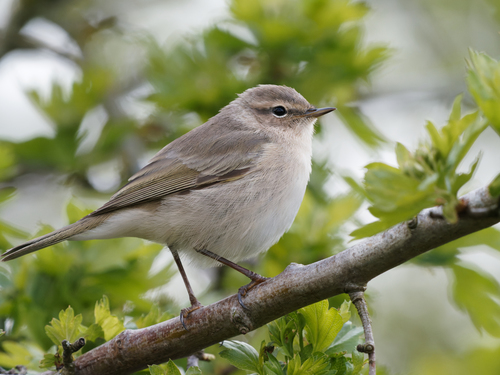 Common Chiffchaff
In short
The most reliable field mark to separate Western Bonelli's Warbler from Common Chiffchaff is overall plumage tone and facial pattern: Bonelli's shows a plain, clean face with a grey-green back and whitish underparts, while Chiffchaff is more greenish-brown above with a short pale supercilium and yellowish flanks. Both are small leaf warblers, but Bonelli's is cleaner and brighter, lacking the Chiffchaff's yellow wash and obvious supercilium. Their calls are also distinctly different: Bonelli's gives a sharp disyllabic 'hu-it', while Chiffchaff has a softer 'hweet'. Structure and jizz can help, but beware overlap in dull or worn birds, especially juveniles.
Identification tips
- Face pattern: Bonelli's Warbler has a plain, clean face with no strong supercilium, while Chiffchaff shows a short pale supercilium, especially after post-juvenile moult. This is a key separator in all plumages.
- Plumage tone: Bonelli's is grey-green (sometimes browner) above with greenish wings and rump, and always has whitish underparts. Chiffchaff is greenish-brown above, with off-white underparts and yellowish flanks (especially in fresh plumage). Duller, browner Chiffchaffs can approach Bonelli's, but usually retain some yellowish wash or supercilium.
- Underparts: Bonelli's underparts are clean white, while Chiffchaff often shows a yellowish wash on the flanks and sometimes breast, especially in fresh plumage or juveniles.
- Wing pattern: Neither species shows a strong wing bar or panel; Chiffchaff has a short primary projection and rounded wings, but this is subtle and not always reliable in the field.
- Tail movement: Chiffchaff frequently dips and wags its tail side-to-side; Bonelli's does not. If you see this behavior, it strongly points to Chiffchaff.
- Leg color: Both have dark or brown legs; this is not a separator between these two.
- Bill: Both have small, fine, pointed bills typical of Phylloscopus warblers; not a separator.
- Song: Bonelli's gives a fast, monotone trill; Chiffchaff sings a repetitive 'chiff-chaff'. Song is distinctive, but beware confusion with other Phylloscopus warblers.
- Call: Bonelli's call is a sharp, disyllabic 'hu-it'; Chiffchaff's is a soft, less disyllabic 'hweet'. Calls are the most reliable vocal separator, especially in migration or winter.
- Habitat and range: In northern and temperate Europe, Chiffchaff is vastly more likely. Bonelli's is restricted to southwest Europe and North Africa in breeding season, and is rare elsewhere.
- Season: Outside the breeding season, Chiffchaff is much more widespread and abundant. Bonelli's is a rare vagrant outside its core range.
- Juvenile confusion: Fresh juvenile Chiffchaffs are browner above and yellower below, but moult quickly to a greener, paler look. Bonelli's juveniles are not well described but are likely to resemble adults, i.e., plain and clean.
- Supercilium: If you see a clear pale supercilium, especially behind the eye, favor Chiffchaff. Bonelli's is always plain-faced.
- General jizz: Chiffchaff is dumpier and often appears more active, especially with its tail wagging. Bonelli's tends to look cleaner and more delicate, but this is subtle.
- Pitfalls: Worn or dull Chiffchaffs can look surprisingly plain, but usually retain some yellow on the flanks or a hint of supercilium. Always try to combine face pattern, underparts, and call for a confident ID.
Size
Both species are very similar in size and structure, being small, compact leaf warblers. Chiffchaff is described as 'dumpy', about 10–12 cm long and weighing 6–8 grams depending on sex [wikipedia]. Bonelli's Warbler is similar in length and mass, with no significant size difference noted in the sources. In the field, size is not a reliable separator between these two.
Plumage
- Juvenile/First-year birds: Chiffchaff juveniles are browner above than adults, with yellow-white underparts, but after their first moult (about 10 weeks post-fledging) they become brighter and greener above with a paler supercilium. Bonelli's Warbler juveniles are not described in detail, but adults and immatures share a plain grey-green back, green-toned rump and wings, and whitish underparts, with no mention of a strong supercilium or yellow wash.
- Adults: Bonelli's Warbler has a plain, clean face with no strong supercilium, a grey-green (sometimes browner) back, greenish wings and rump, and clear white underparts. Chiffchaff adults are greenish-brown above, off-white below but with yellowish flanks, and show a short pale supercilium. Chiffchaff's plumage gets duller and browner with wear, and the yellow on the flanks fades after breeding. Bonelli's always looks cleaner and plainer, especially on the face and underparts.
- Wings in flight: Chiffchaff has rounded wings and a short primary projection; Bonelli's is not specifically described, but no distinctive wing pattern is noted for either species. Thus, wing pattern is not a strong separator here.
- Leg color: Both have dark or brown legs, not a reliable field mark between them.
Behaviour
Chiffchaff is well known for its constant tail dipping and side-to-side wagging, a behavior so distinctive it is called the 'tailwagger' in India. Bonelli's Warbler does not show this tail movement. Both forage actively in foliage for insects, but Chiffchaff's tail action is a strong behavioral clue. In flight, Chiffchaff's wings appear rounded, but this is subtle and best judged with experience.
Habitat
Bonelli's Warbler breeds in southwest Europe and North Africa, preferring forest and woodland, and is a rare vagrant further north. Chiffchaff is much more widespread, breeding throughout northern and temperate Europe and the Palearctic in open woodlands, and winters in southern and western Europe, southern Asia, and North Africa. In areas of overlap (e.g., southern Europe in migration), Chiffchaff is much more likely, especially outside Bonelli's core breeding range.
Voice
Bonelli's Warbler has a fast, monotone trill for its song (very similar to Eastern Bonelli's and somewhat like Wood Warbler), but its call is a sharp, disyllabic 'hu-it'. Chiffchaff's song is the familiar repetitive 'chiff-chaff', and its call is a soft 'hweet', less disyllabic than Bonelli's. The calls are the most reliable vocal separator: Bonelli's 'hu-it' is sharper and more abrupt, while Chiffchaff's 'hweet' is softer and more drawn out.
Western Bonelli's Warbler · Common Chiffchaff · My Tricky Birds