

Wattled Starling vs Fan-tailed Widowbird
Creatophora cinerea versus Euplectes axillaris
Play a quiz with Wattled Starling and Fan-tailed Widowbird
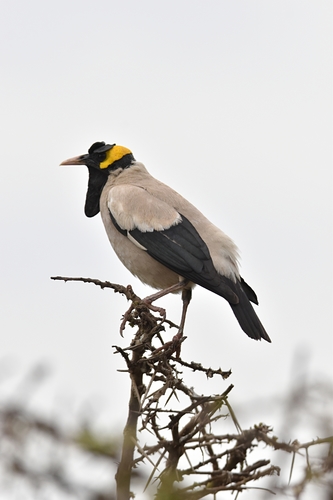 Wattled Starling
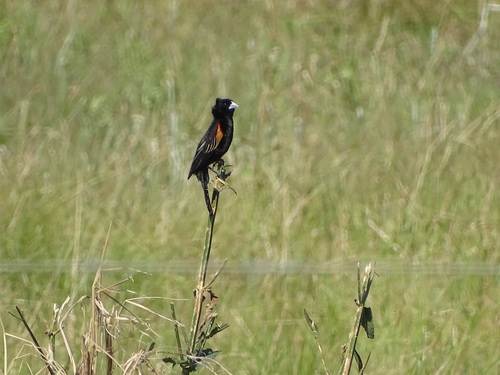 Fan-tailed Widowbird
In short
The most reliable separation in the field is the Wattled Starling’s distinctive white rump and black flight feathers and tail, which are obvious in flight for all ages and sexes—features the Fan-tailed Widowbird never shows. Immature and non-breeding Wattled Starlings can be confused with widowbirds when perched, but widowbirds are much smaller, with a slimmer build and a very different tail shape. Breeding male Wattled Starlings have unique facial wattles and bare yellow skin, while Fan-tailed Widowbirds never show any facial bare parts. In flight, the widowbird’s tail is long and rounded, while the starling’s tail is short and squared. Both species may occur in open country, but their structure, size, and flight patterns are quite different.
Identification tips
- White rump in flight (all ages, Wattled Starling): Look for a bold white rump contrasting with black flight feathers and tail when the bird takes off or flies overhead. Fan-tailed Widowbird never shows a white rump.
- Tail shape and length: Wattled Starling has a short, squared tail; Fan-tailed Widowbird has a long, rounded tail (especially in breeding males, but even females/immatures have a longer tail than the starling).
- Bare yellow facial skin and wattles (breeding male Wattled Starling): Only breeding male starlings show bare yellow skin and black wattles on the head—never seen in widowbirds.
- White shoulder patch (breeding male Wattled Starling): A clear white patch on the shoulder is visible in breeding males, sometimes faint in old females; widowbirds never show this.
- Facial pattern (non-breeding/immature Wattled Starling): Non-breeding males, females, and juveniles may show a small yellow patch behind the eye and a black moustachial stripe, but never the red shoulder or all-black plumage of a male widowbird.
- Red shoulder patch (breeding male Fan-tailed Widowbird): Only breeding male widowbirds show a red shoulder on otherwise black plumage; starlings never have a red shoulder.
- Plumage color (non-breeding/immature Fan-tailed Widowbird): Non-breeding males, females, and juveniles are streaky brown and buff, lacking any white rump or shoulder, and have a longish, rounded tail. Starlings are more uniform grey with a white rump and dark wings/tail.
- Size and structure: Wattled Starling is much larger and bulkier, with a thicker bill and short tail. Widowbird is small, slim, and long-tailed.
- Flight style: Starlings fly directly and rapidly; widowbirds (especially males) have a fluttery, undulating display flight with trailing tail.
- Perching behavior: Wattled Starlings often perch on livestock or in large noisy flocks; widowbirds are more likely to perch on grass stems or low bushes, often in smaller groups.
- Habitat context: If seen in cultivated fields, on livestock, or in large mixed flocks, suspect Wattled Starling. In tall grass or marsh, especially with displaying long-tailed males, suspect Fan-tailed Widowbird.
- Voice: If you hear a harsh, wheezing 'ssreeeeo', it's likely a Wattled Starling. Widowbird calls are not described here.
- Confusion risk (immature birds): Immature and non-breeding Wattled Starlings can look quite plain and may be mistaken for female/immature widowbirds at a distance, but the white rump in flight and heavier build are reliable clues.
- Seasonal marks: Only breeding male starlings show facial wattles and bare skin; only breeding male widowbirds have the long tail and red shoulder. Outside the breeding season, rely more on size, structure, and rump color.
- Mixed flocks: If you see both species together, the size difference is striking—starlings dwarf widowbirds.
Size
Wattled Starling is substantially larger and heavier (73.0g vs 25.75g) than Fan-tailed Widowbird. The starling is about three times the mass of the widowbird, with a more robust, stocky appearance and a short tail. Widowbirds are small, slender, and light, with a proportionally longer tail, especially in males during the breeding season. Size alone can be a strong clue if both are seen together or with familiar species for scale.
Plumage
Juvenile and non-breeding Wattled Starlings have mostly greyish plumage with brownish flight feathers and tail, but always show a white rump and contrasting dark wings and tail in flight—this is true for all ages and sexes. Breeding males develop striking bare yellow facial skin and black wattles, plus a white shoulder patch, making them unmistakable. Non-breeding males, females, and juveniles lack wattles but may show a faint yellow patch behind the eye and a black moustachial stripe. Fan-tailed Widowbirds, by contrast, never show bare facial skin or wattles. Males in breeding plumage are mostly black with a red shoulder patch and a very long, rounded tail; non-breeding males, females, and juveniles are streaky brown and buff, with no white rump or shoulder, and have a longish, rounded tail. In flight, widowbirds lack any white rump or strong black-and-white contrast on the wings and tail.
Behaviour
Wattled Starlings are highly gregarious, often forming large, noisy flocks, sometimes mixing with other starlings and weavers. They are frequently seen perching on livestock or foraging on the ground in open areas, and their flight is direct and strong with rapid wingbeats. Fan-tailed Widowbirds are also social but tend to form smaller flocks, often in grassy or marshy areas. Males display by fluttering over grasslands with slow, exaggerated wingbeats and trailing their long tails. Widowbirds are less likely to perch on livestock or scavenge, and their flight is more buoyant and undulating, especially during display.
Habitat
Both species occur in open country, but Wattled Starlings favor grasslands, open woodlands, and cultivated areas, often near livestock or human habitation. They are nomadic and may be found in a wide range of open habitats, sometimes roosting in huge reedbed flocks. Fan-tailed Widowbirds are more closely tied to grassy and swampy areas, especially in wetter regions, and are less likely to be found in cultivated fields or among livestock. Their presence is a good indicator of marshy or tall grass habitat.
Voice
Wattled Starlings have a variety of wheezing or grating calls, with the most familiar being a harsh 'ssreeeeo', reminiscent of the European Starling. Fan-tailed Widowbird vocalizations are not described in the provided notes, so calls are not a reliable field separation here.