

Water Rail vs Sora
Rallus aquaticus versus Porzana carolina
Play a quiz with Water Rail and Sora
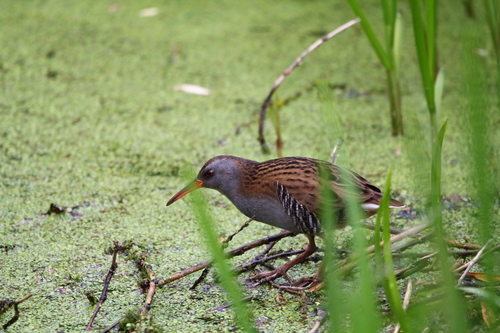 Water Rail
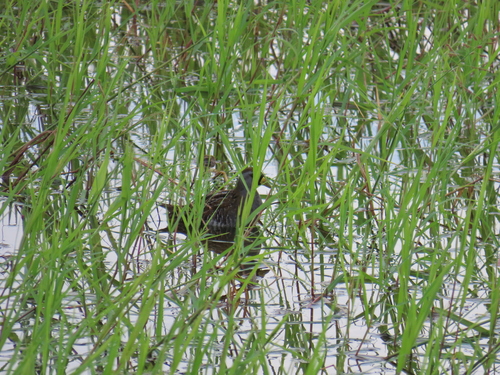 Sora
In short
The most reliable field mark to separate Water Rail from Sora is the bill: Water Rail has a long, slender, and distinctly red bill, while Sora shows a short, thick, yellow bill. In adults, Water Rail also has blue-grey underparts and a white undertail, whereas Sora adults have a blue-grey face and underparts but with a black-and-white barred flank and a black face patch at the base of the bill. Juvenile birds are trickier, as both can show buffier underparts, but the bill color and undertail remain helpful. Both species are secretive marsh dwellers, but their structure and face patterns are quite different if seen well.
Identification tips
- Bill shape and color: Water Rail has a long, slender, slightly down-curved red bill (longer than the rest of the rail's head), while Sora has a short, thick, yellow bill. This is the most reliable mark for all ages and seasons.
- Face pattern (adult): Water Rail adults have a dark slate-blue face and underparts, with a blackish area between the bill and eye; Sora adults have a blue-grey face but with a distinctive black patch at the base of the bill and on the throat.
- Undertail color: Water Rail's undertail is white with some dark streaks (unique to each bird), while Sora's undertail is not as distinctly white and is less prominent in the field.
- Flank barring: Both species show black-and-white barred flanks in adults, but Water Rail's barring is bolder and more sharply defined, while Sora's can appear finer.
- Juvenile plumage: Juvenile Water Rail has a blackish crown, white chin and throat, buff or white underparts with dark bars, and brown/buff flanks; Sora juveniles lack the black facial markings, have a whitish face, and a buff breast. Bill color remains a key separator in juveniles (Water Rail: duller, but still long and slender; Sora: short and yellowish).
- Upperparts: Water Rail upperparts are olive-brown with black streaks, especially on the shoulders; Sora's are dark-marked brown, more mottled than streaked.
- Leg color: Water Rail has flesh-brown legs; Sora's leg color is not a prominent field mark in the notes.
- Body shape: Water Rail appears more laterally compressed (flatter side-to-side), aiding its movement through reeds; Sora is more compact and rounded.
- Tail: Both have short tails, but Water Rail's is often cocked, showing the white undertail; Sora's tail is less often held up and less conspicuous.
- Behavior: Water Rail is more likely to be seen slipping through dense reeds, often briefly; Sora may be seen walking near open water or swimming, especially when responding to playback.
- Flight: No distinctive upperwing or flight pattern marks are described for either species in the notes; separation in flight relies on structure and bill color if seen.
- Voice: Water Rail gives a pig-like squeal; Sora gives a slow whistled 'ker-whee' or descending whinny. Voice is diagnostic if heard.
- Habitat: Water Rail is Eurasian/African, Sora is North American; vagrancy is rare but possible. In Europe, a Sora is exceptional and should be scrutinized for these marks.
- Sex differences: Both species are sexually similar; sex is not a useful field mark.
- Pitfalls: Juvenile Water Rails can show buff undertails and less blue-grey below, but the bill remains long and slender. Sora juveniles lack the black face patch but always have the short, thick yellow bill. Never rely on size alone due to overlap.
Size
Water Rail is slightly heavier on average (body mass ~111.5 g) than Sora (49–112 g), but their length and wingspan overlap: Water Rail is 23–28 cm long with a 38–45 cm wingspan, while Sora is 19–30 cm long with a 35–40 cm wingspan. In the field, Water Rail often appears slimmer and more elongated due to its longer bill and body shape, while Sora looks more compact and short-billed. However, size alone is not a reliable separator due to overlap.
Plumage
Juvenile Water Rails have a blackish crown, white chin and throat, buff or white underparts with darker bars, brown and buff flank markings, and a buff undertail; their bill and legs are duller than adults. Juvenile Soras lack the black facial markings of adults, have a whitish face, and a buff breast, but still show the short, thick yellowish bill. In adults, Water Rail shows olive-brown upperparts with black streaks, dark slate-blue face and underparts, black-and-white barred flanks, and a white undertail with some dark streaks. Sora adults have dark-marked brown upperparts, blue-grey face and underparts, black-and-white barred flanks, a black face patch at the base of the bill and on the throat, and a short, thick yellow bill. The undertail of Water Rail is white (sometimes with dark streaks), while Sora's undertail is less distinctly white and not a prominent field mark. Both species have brown upperparts, but Water Rail's are more olive and streaked, while Sora's are more mottled. Sexes are similar in both species.
Behaviour
Both species are secretive and prefer to skulk in dense wetland vegetation, but Water Rail is more likely to be seen slipping through reeds, often with its body compressed laterally. Sora may be seen walking near open water or swimming, and is sometimes more approachable when responding to call broadcasts. Water Rail can be flightless after breeding due to molt. Both are more often heard than seen, but Sora is especially known for responding to playback.
Habitat
Water Rail breeds in well-vegetated wetlands across Europe, Asia, and North Africa, favoring dense reedbeds. Sora is found throughout much of North America in marshes and wetlands, and is a rare vagrant to Europe. Habitat overlap is unlikely except in rare vagrancy situations, but both prefer dense, reedy, or marshy environments.
Voice
Water Rail gives a pig-like squeal, which is very different from Sora's slow, whistled 'ker-whee' or descending whinny. Sora's call is distinctive and often used to detect their presence, especially during migration. If you hear a descending whinny, it's Sora; a pig-like squeal points to Water Rail.