

Versicoloured Emerald vs Gilded Hummingbird
Chrysuronia versicolor versus Hylocharis chrysura
Play a quiz with Versicoloured Emerald and Gilded Hummingbird
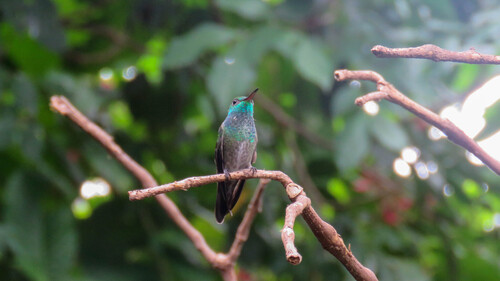 Versicoloured Emerald
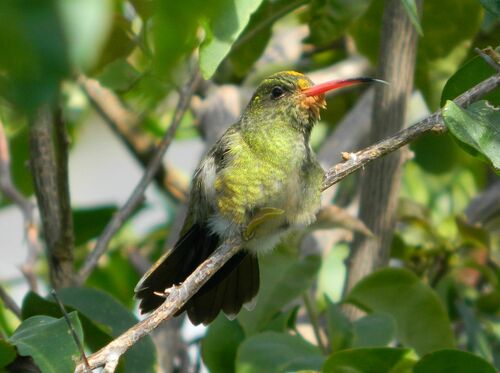 Gilded Hummingbird
In short
The most reliable field mark between Versicoloured Emerald and Gilded Hummingbird is the bill color: Versicoloured Emerald has a mostly black bill with a flesh-colored or orange base to the lower mandible, while Gilded Hummingbird shows a straight, coral red bill with a black tip. Tail color is also key: Versicoloured Emerald’s tail is coppery-green with a dark subterminal band, whereas Gilded Hummingbird’s tail is glittering golden-bronze. Both species are similar in size and structure, so focus on bill and tail color, and check for subtle plumage differences on the throat and underparts, especially in females and immatures. Be aware that throat and crown color in Versicoloured Emerald is variable by subspecies and can overlap with the golden-green tones of Gilded Hummingbird, so structural and tail features are more reliable.
Identification tips
- Bill color is the fastest field check: Versicoloured Emerald has a mostly black bill with a flesh- or orange-colored base to the lower mandible; Gilded Hummingbird’s bill is coral red with a black tip. This is visible in good light, even at a distance, and works for all ages and sexes.
- Tail color and pattern: Versicoloured Emerald shows a coppery-green tail with a dark subterminal band, while Gilded Hummingbird’s tail is a glittering golden-bronze with no strong dark band. This is best seen when the bird fans or flicks its tail.
- Underparts contrast: Versicoloured Emerald has white central underparts and crissum, contrasting with coppery-green flanks. Gilded Hummingbird is more uniform below, with adult females and juveniles showing a grayish lower belly (not white), and males sometimes a pale rufous chin.
- Throat and crown color (variable in Versicoloured Emerald): Versicoloured Emerald’s throat can be greenish, turquoise, bluish, or even white depending on subspecies and sex, sometimes edged white in females. Gilded Hummingbird males have a pale rufous chin, but otherwise throat color is less variable. Use this mark with caution due to overlap and subspecies variation.
- Face and crown: Versicoloured Emerald often shows green or blue tones on the face and crown, especially in some subspecies; Gilded Hummingbird is more uniformly golden-green.
- Juvenile marks: Gilded Hummingbird juveniles have buff fringes on head feathers, while Versicoloured Emerald juveniles resemble adults but with less intense coloration. If you see buffy head feather edges, favor Gilded Hummingbird.
- Bill shape: Both species have medium to long bills, but Versicoloured Emerald’s is slightly decurved, while Gilded Hummingbird’s is straight. This is subtle and less reliable than color.
- Sex differences: Female Versicoloured Emeralds may have a white-edged greenish throat, while female Gilded Hummingbirds are duller overall with a grayish lower belly.
- Tail shape: Both species have similar tail shapes, but color and banding are more useful than shape.
- Upperwing pattern: No distinctive age-specific upperwing marks are described for either species; do not rely on wing pattern in flight.
- Size: Both species are the same size (8–10 cm); do not use size for separation.
- Habitat and range: Both species overlap in much of their range; do not use location alone to separate them.
- Voice: No vocal differences are described; do not use song/call for separation.
- Beware of subspecies variation: Versicoloured Emerald’s throat and crown color can vary greatly by subspecies, so always check bill and tail color before relying on plumage hues.
- Lighting and wear: Iridescent colors can change with lighting and feather wear; always confirm with structural marks (bill and tail) if plumage appears ambiguous.
Size
Both species are closely matched in size, with adults measuring 8–10 cm (3.1–3.9 in) in length [wikipedia]. Gilded Hummingbird is slightly heavier (4–5 g) than Versicoloured Emerald (weight not specified), but this difference is not field-diagnostic. Structure is similar: both have medium to long bills and proportionate tails. Size alone will not reliably separate these species in the field.
Plumage
Juvenile and female Gilded Hummingbirds are duller than males and have a grayish lower belly, with juveniles showing buff fringes on head feathers. Versicoloured Emerald, regardless of age, has white central underparts and crissum, with flanks and upperparts coppery-green. The throat and crown in Versicoloured Emerald vary by subspecies: greenish/turquoise (often edged white in females) or blue/azure in some forms, while Gilded Hummingbird males have a pale rufous chin and golden-green iridescence. The tail is a strong separator: Versicoloured Emerald’s is coppery-green with a dark subterminal band, while Gilded Hummingbird’s is glittering golden-bronze. Bill color is also diagnostic: Versicoloured Emerald’s is mostly black with a pale or orange base, Gilded Hummingbird’s is coral red with a black tip. There are no distinctive age-specific upperwing patterns described for either species.
Behaviour
No behavioral differences are described that would reliably separate these two species in the field. Both are typical small hummingbirds with similar flight and foraging behavior.
Habitat
Both species occur in overlapping regions of central and eastern South America, including Brazil, Paraguay, and Argentina. Habitat preferences are not detailed in the notes, so context is not a reliable separator.
Versicoloured Emerald · Gilded Hummingbird · My Tricky Birds