

Motmot

Veraguan Mango vs Green Thorntail

Anthracothorax veraguensis versus Discosura conversii

Play a quiz with Veraguan Mango and Green Thorntail
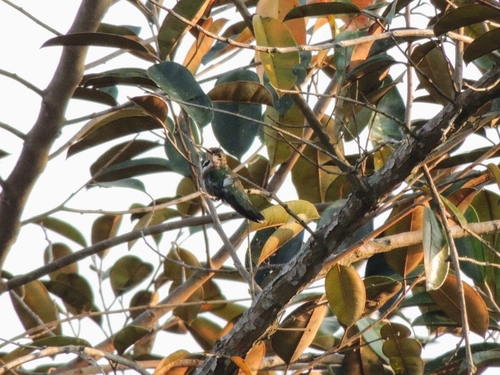
Veraguan Mango (Anthracothorax veraguensis) Veraguan Mango
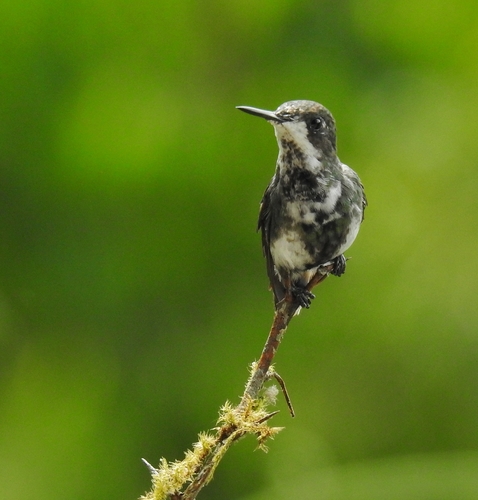
Green Thorntail (Discosura conversii) Green Thorntail

Media

Loading…

In short

The most reliable field mark to separate Veraguan Mango from Green Thorntail is the tail shape and length: Green Thorntail males have a dramatically long, deeply forked tail, while Veraguan Mango has a shorter, less deeply notched tail. For perched birds, note the Veraguan Mango's metallic green body with a blueish or teal ventral stripe (not black), versus the Green Thorntail's metallic green with a white rump band (male) or white cheek patch (female). Females and immatures are easily confused, but the Green Thorntail female always shows a broad white cheek patch and white-spotted tail, which are absent in Veraguan Mango. Both species occur in overlapping regions of Panama and Costa Rica, but Green Thorntail prefers higher, humid forest canopies, while Veraguan Mango is more often found in lower elevations. Size and overall structure also differ, with Veraguan Mango being noticeably larger and heavier.

Identification tips

  1. Tail shape and length (all ages/sexes): Male Green Thorntail has a spectacularly long, deeply forked tail with very narrow outer feathers, creating a 'swallowtail' look in flight or when perched. Veraguan Mango's tail is shorter, broader, and less deeply notched, with no extreme narrowing.
  2. White rump band (adult male Green Thorntail): Only Green Thorntail males show a bright white band across the coppery bronze rump. Veraguan Mango never shows this feature.
  3. White cheek patch (female/immature Green Thorntail): Female and immature Green Thorntails have a bold white cheek patch, easily seen from the side. Veraguan Mango females lack this entirely.
  4. Tail pattern (female Green Thorntail): Female Green Thorntail's tail is notched, not elongated, with white bases and tips on the outer feathers, creating a two-toned effect. Veraguan Mango females have uniformly dark tails with a red circle on each feather, lacking white.
  5. Ventral stripe color (female Veraguan Mango): Female Veraguan Mango has a white-cream belly with a dark teal (not black) stripe down the center. Green Thorntail females have a dull black breast and belly, not a clean stripe.
  6. Throat color (all ages): Veraguan Mango lacks black on the throat; Green Thorntail males have a bright metallic green throat, while females have a dull black chin with white spots.
  7. Size and structure: Veraguan Mango is noticeably larger and heavier, with a stouter body and thicker, slightly decurved bill. Green Thorntail is dainty, especially the female, and the male appears elongated due to the tail.
  8. Bill shape: Both have dark bills, but Veraguan Mango's is slightly thicker and more decurved; Green Thorntail's is finer and straighter.
  9. Flight style: Green Thorntail often cocks its long tail at a right angle while feeding and perches high in the canopy. Veraguan Mango has steadier, more direct flight and is less likely to display its tail dramatically.
  10. Habitat context: In humid forest canopy above 600 m, especially at flowering trees, Green Thorntail is more likely. In gardens, open woodlands, or lower elevations, expect Veraguan Mango.
  11. Male breast color: Veraguan Mango males have a blueish breast and belly; Green Thorntail males have a metallic greenish-blue center to the breast, but the overall impression is more uniformly metallic green.
  12. Tail color (Veraguan Mango): All tail feathers are black with a red circle central to each feather, a subtle but unique mark if seen well.
  13. Juvenile Green Thorntail: Like adults but with a grayish white chin; still shows the white cheek patch and tail pattern.
  14. No black ventral stripe (Veraguan Mango): Unlike Green-breasted Mango, Veraguan Mango's ventral stripe is teal, not black, which can help in confusion with other Anthracothorax.
  15. Pitfalls: Immature or female Green Thorntail can be mistaken for Veraguan Mango female, but always check for the white cheek patch and tail pattern in the Thorntail.

Size

Veraguan Mango is a medium-sized hummingbird, reaching 11–12 cm in length, while Green Thorntail males are smaller at 9.5–10.2 cm and females even smaller at 6.6–7.5 cm. The Mango is bulkier and heavier, with a stouter appearance and a thicker, slightly decurved bill. Green Thorntail is much more delicate, especially the male, whose long, narrow, deeply forked tail adds to its slender look. The female Green Thorntail is tiny and dainty compared to the Mango, and even the male, despite his tail, is lighter and more streamlined overall. These size differences are most apparent when both species are seen together or with familiar hummingbirds for scale.

Plumage

No distinctive age-specific upperwing or flight pattern marks are described for either species, so focus on body and tail plumage. Adult male Veraguan Mango has a metallic green body with a blueish breast and belly, and black tail feathers with a red circle central to each feather. Females have a white-cream belly with a dark teal (not black) stripe down the breast. Critically, Veraguan Mango lacks any black plumage on the throat, which is a key difference from Green-breasted Mango but also helps separate it from the darker-throated Green Thorntail.

Male Green Thorntail is metallic green with a bright white band across the coppery bronze rump, a deeply forked bluish-black tail, and a metallic greenish-blue center to the breast. The female Green Thorntail has a broad white cheek patch, dull black chin with white spots, dull green flanks with a white spot, and a notched but not elongated tail with white bases and tips on the outer feathers. Juvenile Green Thorntails resemble adults but have a grayish white chin. Veraguan Mango females never show the white cheek patch or the white-spotted tail pattern of Green Thorntail females.

In summary: look for the white rump band (male Green Thorntail), white cheek patch and white-spotted tail (female/immature Green Thorntail), and the blueish or teal ventral stripe (Veraguan Mango, especially female).

Behaviour

Green Thorntail males often perch on high, exposed twigs and display with their long tails, sometimes cocking the tail at a right angle while hovering at flowers. They forage mostly at the tops of flowering trees, often in the forest canopy, and can appear more active and acrobatic than the relatively heavier Veraguan Mango. Veraguan Mango is more likely to be seen at lower elevations, feeding at flowers in gardens, edges, or open areas, and tends to have a steadier, less erratic flight. The Mango's feeding behavior is more typical of medium-sized hummingbirds, while the Thorntail's tail movements and canopy preference are distinctive.

Habitat

Both species overlap in Panama and Costa Rica, but their preferred habitats differ. Veraguan Mango is typically found in lower elevations, including gardens, open woodlands, and edges. Green Thorntail is a canopy specialist, favoring the upper levels of humid montane and lowland evergreen forests, usually between 600–1,400 m depending on the country. If you see a hummingbird in the high canopy of a humid forest, especially above 700 m, Green Thorntail is more likely. In open, lower, or disturbed habitats, Veraguan Mango is the better bet.

Submit a better description

Use the same sections as the comparison. Your text is published immediately.

The most reliable field mark to separate Veraguan Mango from Green Thorntail is the tail shape and length: Green Thorntail males have a dramatically long, deeply forked tail, while Veraguan Mango has a shorter, less deeply notched tail. For perched birds, note the Veraguan Mango's metallic green body with a blueish or teal ventral stripe (not black), versus the Green Thorntail's metallic green with a white rump band (male) or white cheek patch (female). Females and immatures are easily confused, but the Green Thorntail female always shows a broad white cheek patch and white-spotted tail, which are absent in Veraguan Mango. Both species occur in overlapping regions of Panama and Costa Rica, but Green Thorntail prefers higher, humid forest canopies, while Veraguan Mango is more often found in lower elevations. Size and overall structure also differ, with Veraguan Mango being noticeably larger and heavier.

  1. Tail shape and length (all ages/sexes): Male Green Thorntail has a spectacularly long, deeply forked tail with very narrow outer feathers, creating a 'swallowtail' look in flight or when perched. Veraguan Mango's tail is shorter, broader, and less deeply notched, with no extreme narrowing.
  2. White rump band (adult male Green Thorntail): Only Green Thorntail males show a bright white band across the coppery bronze rump. Veraguan Mango never shows this feature.
  3. White cheek patch (female/immature Green Thorntail): Female and immature Green Thorntails have a bold white cheek patch, easily seen from the side. Veraguan Mango females lack this entirely.
  4. Tail pattern (female Green Thorntail): Female Green Thorntail's tail is notched, not elongated, with white bases and tips on the outer feathers, creating a two-toned effect. Veraguan Mango females have uniformly dark tails with a red circle on each feather, lacking white.
  5. Ventral stripe color (female Veraguan Mango): Female Veraguan Mango has a white-cream belly with a dark teal (not black) stripe down the center. Green Thorntail females have a dull black breast and belly, not a clean stripe.
  6. Throat color (all ages): Veraguan Mango lacks black on the throat; Green Thorntail males have a bright metallic green throat, while females have a dull black chin with white spots.
  7. Size and structure: Veraguan Mango is noticeably larger and heavier, with a stouter body and thicker, slightly decurved bill. Green Thorntail is dainty, especially the female, and the male appears elongated due to the tail.
  8. Bill shape: Both have dark bills, but Veraguan Mango's is slightly thicker and more decurved; Green Thorntail's is finer and straighter.
  9. Flight style: Green Thorntail often cocks its long tail at a right angle while feeding and perches high in the canopy. Veraguan Mango has steadier, more direct flight and is less likely to display its tail dramatically.
  10. Habitat context: In humid forest canopy above 600 m, especially at flowering trees, Green Thorntail is more likely. In gardens, open woodlands, or lower elevations, expect Veraguan Mango.
  11. Male breast color: Veraguan Mango males have a blueish breast and belly; Green Thorntail males have a metallic greenish-blue center to the breast, but the overall impression is more uniformly metallic green.
  12. Tail color (Veraguan Mango): All tail feathers are black with a red circle central to each feather, a subtle but unique mark if seen well.
  13. Juvenile Green Thorntail: Like adults but with a grayish white chin; still shows the white cheek patch and tail pattern.
  14. No black ventral stripe (Veraguan Mango): Unlike Green-breasted Mango, Veraguan Mango's ventral stripe is teal, not black, which can help in confusion with other Anthracothorax.
  15. Pitfalls: Immature or female Green Thorntail can be mistaken for Veraguan Mango female, but always check for the white cheek patch and tail pattern in the Thorntail.

Veraguan Mango is a medium-sized hummingbird, reaching 11–12 cm in length, while Green Thorntail males are smaller at 9.5–10.2 cm and females even smaller at 6.6–7.5 cm. The Mango is bulkier and heavier, with a stouter appearance and a thicker, slightly decurved bill. Green Thorntail is much more delicate, especially the male, whose long, narrow, deeply forked tail adds to its slender look. The female Green Thorntail is tiny and dainty compared to the Mango, and even the male, despite his tail, is lighter and more streamlined overall. These size differences are most apparent when both species are seen together or with familiar hummingbirds for scale.

No distinctive age-specific upperwing or flight pattern marks are described for either species, so focus on body and tail plumage. Adult male Veraguan Mango has a metallic green body with a blueish breast and belly, and black tail feathers with a red circle central to each feather. Females have a white-cream belly with a dark teal (not black) stripe down the breast. Critically, Veraguan Mango lacks any black plumage on the throat, which is a key difference from Green-breasted Mango but also helps separate it from the darker-throated Green Thorntail.

Male Green Thorntail is metallic green with a bright white band across the coppery bronze rump, a deeply forked bluish-black tail, and a metallic greenish-blue center to the breast. The female Green Thorntail has a broad white cheek patch, dull black chin with white spots, dull green flanks with a white spot, and a notched but not elongated tail with white bases and tips on the outer feathers. Juvenile Green Thorntails resemble adults but have a grayish white chin. Veraguan Mango females never show the white cheek patch or the white-spotted tail pattern of Green Thorntail females.

In summary: look for the white rump band (male Green Thorntail), white cheek patch and white-spotted tail (female/immature Green Thorntail), and the blueish or teal ventral stripe (Veraguan Mango, especially female).

Green Thorntail males often perch on high, exposed twigs and display with their long tails, sometimes cocking the tail at a right angle while hovering at flowers. They forage mostly at the tops of flowering trees, often in the forest canopy, and can appear more active and acrobatic than the relatively heavier Veraguan Mango. Veraguan Mango is more likely to be seen at lower elevations, feeding at flowers in gardens, edges, or open areas, and tends to have a steadier, less erratic flight. The Mango's feeding behavior is more typical of medium-sized hummingbirds, while the Thorntail's tail movements and canopy preference are distinctive.

Both species overlap in Panama and Costa Rica, but their preferred habitats differ. Veraguan Mango is typically found in lower elevations, including gardens, open woodlands, and edges. Green Thorntail is a canopy specialist, favoring the upper levels of humid montane and lowland evergreen forests, usually between 600–1,400 m depending on the country. If you see a hummingbird in the high canopy of a humid forest, especially above 700 m, Green Thorntail is more likely. In open, lower, or disturbed habitats, Veraguan Mango is the better bet.

Discard your changes?

You have unsaved edits. If you leave now, those changes will be lost.

Veraguan Mango · Green Thorntail · My Tricky Birds