

Motmot

Variable Hawk vs White Hawk

Geranoaetus polyosoma versus Pseudastur albicollis

Play a quiz with Variable Hawk and White Hawk
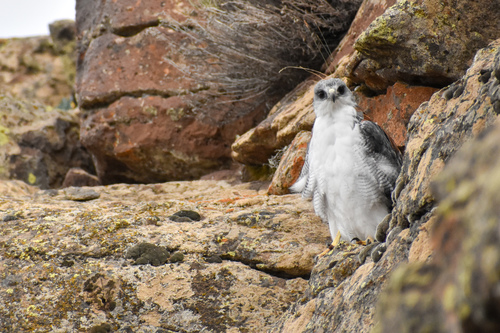
Variable Hawk (Geranoaetus polyosoma) Variable Hawk
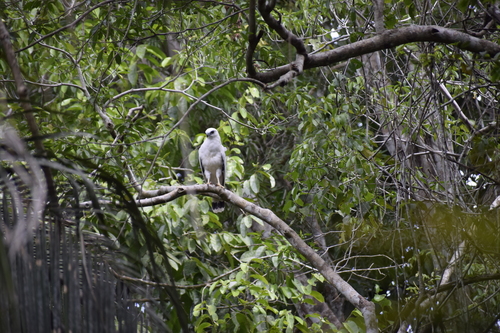
White Hawk (Pseudastur albicollis) White Hawk

Media

Loading…

In short

The most reliable field mark to separate Variable Hawk from White Hawk is the upperwing and tail pattern in flight: adult Variable Hawks always show a white tail with a bold black subterminal band and grey wings with fine barring and a broad black tip, while adult White Hawks are strikingly white below with black upperwings and a short tail that is black with a broad white band. Immature White Hawks show heavy black spotting above and streaked whitish underparts, which never occurs in Variable Hawk. Size overlaps, but Variable Hawk is generally bulkier and longer-winged. Habitat is also a strong clue: Variable Hawk favors open country at all elevations, while White Hawk is a forest raptor of tropical lowlands.

Identification tips

  1. Tail pattern in flight (all ages): Variable Hawk always shows a white tail with a bold black subterminal band; White Hawk has a short black tail with a broad white band (the reverse pattern). This is the single most reliable mark when seen well.
  2. Upperwing pattern (adults): Variable Hawk has grey wings barred dark, with remiges appearing whitish and finely barred from below, plus a broad black tip. White Hawk's upperwings are black, contrasting sharply with the white body and underwings.
  3. Immature plumage: Immature White Hawks have extensive black spotting above and dark-streaked whitish underparts—never matched by Variable Hawk, which may be variable but does not show this pattern.
  4. Underparts color: Adult White Hawks are pure white below; Variable Hawks range from white to grey to reddish, sometimes with dark or rufous underparts, but never pure white throughout.
  5. Back color (adults, especially females): Female Variable Hawks often have a reddish-brown back, a feature never seen in White Hawk.
  6. Tail length and shape: Variable Hawk has a longer, broader tail; White Hawk's tail is notably short and squared-off.
  7. Overall structure: Variable Hawk is bulkier and longer-winged, especially in the largest highland forms; White Hawk is more compact with broader wings and a short tail.
  8. Perched posture: Variable Hawk often perches in exposed, open sites; White Hawk usually perches within or at the edge of forest, often partially concealed.
  9. Habitat: Variable Hawk is found in open country (steppe, puna, agricultural land, high Andes); White Hawk is restricted to lowland and foothill forests.
  10. Geographic range: If seen in the Amazon basin, Central America, or Trinidad, White Hawk is likely; in southern South America or high Andes, Variable Hawk is expected.
  11. Flight style: Both soar, but Variable Hawk is more likely to be seen soaring high over open terrain; White Hawk may soar above forest but is often seen gliding between trees.
  12. Sexual dimorphism: Both species show little plumage difference between sexes, but female Variable Hawks may be slightly more rufous above.
  13. Subspecific variation: Variable Hawk is extremely variable in plumage, but the tail and wing pattern in flight remain constant. White Hawk subspecies differ mainly in the amount of black on wings and tail, but all are white below.
  14. Voice: White Hawk's 'kerwee' call may be heard in forest, but Variable Hawk's voice is not distinctive in the field.
  15. Confusion risk: Beware of pale morph Variable Hawks, which can appear mostly white below but always show the diagnostic tail and wing pattern; White Hawk never shows grey or rufous tones.

Size

Variable Hawk is a large buteo with considerable size variation: adults range from 45–62 cm in length and 113–151 cm in wingspan, with weights from 800–1800 g depending on subspecies [wikipedia]. White Hawk is slightly smaller and more compact, at 46–56 cm long, with females averaging 840 g and males 650 g [wikipedia]. Both are broad-winged, but Variable Hawk typically appears longer-winged and bulkier, especially in the largest Andean forms. White Hawk has a notably short tail compared to Variable Hawk's proportionally longer tail.

Plumage

Juvenile and immature plumage is a key separation point. Immature White Hawks are heavily marked above with black spotting and have dark-streaked whitish underparts—this strong contrast is never shown by Variable Hawk of any age. Adult White Hawks are almost entirely white below, with black upperwings and a short black tail with a broad white band; from below, they look mostly white with some black on the outer primaries and a black subterminal tail bar. Variable Hawk, regardless of morph, always shows a white tail with a bold black subterminal band and grey wings barred dark; in flight from below, remiges appear whitish with fine barring and a broad black tip. The rest of the plumage is highly variable: some Variable Hawks are dark grey, others whitish, and some have reddish-brown underparts or backs (especially females). No White Hawk shows reddish or grey plumage. Sexes are similar in both, but female Variable Hawks often have a reddish-brown back. Subspecific variation in White Hawk affects the amount of black on wings and tail, but all are mainly white below. Variable Hawk can show up to 27 adult plumages, but the tail and wing pattern in flight remain consistent.

Behaviour

Variable Hawk is most often seen soaring over open country or perched on exposed posts and trees, hunting mainly small mammals by scanning from the air. White Hawk also soars but is more often found perched quietly within or at the edge of forest, hunting by sallying from a perch for reptiles and small mammals. White Hawk sometimes follows monkeys or coatis to catch prey flushed by these mammals—a behavior not seen in Variable Hawk. Both build large stick nests, but White Hawk always nests in trees, while Variable Hawk may use any elevated structure.

Habitat

Habitat is a strong separator. Variable Hawk is widespread in open habitats of western and southern South America, from high Andean puna and páramo (up to 5,000 m) to Patagonian steppe, agricultural land, and even lowland edges of forest. It avoids dense forest. White Hawk, in contrast, is a bird of tropical lowland forests and woodlands, ranging from southern Mexico through Central America and the Amazon basin to northern South America. It is rarely found outside forested areas and never in the high Andes or open steppe. Thus, context is often decisive: a soaring raptor over open grassland or high mountains is almost certainly Variable Hawk; in dense lowland forest, White Hawk is far more likely.

Voice

White Hawk gives a plaintive 'kerwee' call, but vocalizations are not a reliable field mark for separating these two species, as Variable Hawk's calls are not described in the provided notes.

Submit a better description

Use the same sections as the comparison. Your text is published immediately.

The most reliable field mark to separate Variable Hawk from White Hawk is the upperwing and tail pattern in flight: adult Variable Hawks always show a white tail with a bold black subterminal band and grey wings with fine barring and a broad black tip, while adult White Hawks are strikingly white below with black upperwings and a short tail that is black with a broad white band. Immature White Hawks show heavy black spotting above and streaked whitish underparts, which never occurs in Variable Hawk. Size overlaps, but Variable Hawk is generally bulkier and longer-winged. Habitat is also a strong clue: Variable Hawk favors open country at all elevations, while White Hawk is a forest raptor of tropical lowlands.

  1. Tail pattern in flight (all ages): Variable Hawk always shows a white tail with a bold black subterminal band; White Hawk has a short black tail with a broad white band (the reverse pattern). This is the single most reliable mark when seen well.
  2. Upperwing pattern (adults): Variable Hawk has grey wings barred dark, with remiges appearing whitish and finely barred from below, plus a broad black tip. White Hawk's upperwings are black, contrasting sharply with the white body and underwings.
  3. Immature plumage: Immature White Hawks have extensive black spotting above and dark-streaked whitish underparts—never matched by Variable Hawk, which may be variable but does not show this pattern.
  4. Underparts color: Adult White Hawks are pure white below; Variable Hawks range from white to grey to reddish, sometimes with dark or rufous underparts, but never pure white throughout.
  5. Back color (adults, especially females): Female Variable Hawks often have a reddish-brown back, a feature never seen in White Hawk.
  6. Tail length and shape: Variable Hawk has a longer, broader tail; White Hawk's tail is notably short and squared-off.
  7. Overall structure: Variable Hawk is bulkier and longer-winged, especially in the largest highland forms; White Hawk is more compact with broader wings and a short tail.
  8. Perched posture: Variable Hawk often perches in exposed, open sites; White Hawk usually perches within or at the edge of forest, often partially concealed.
  9. Habitat: Variable Hawk is found in open country (steppe, puna, agricultural land, high Andes); White Hawk is restricted to lowland and foothill forests.
  10. Geographic range: If seen in the Amazon basin, Central America, or Trinidad, White Hawk is likely; in southern South America or high Andes, Variable Hawk is expected.
  11. Flight style: Both soar, but Variable Hawk is more likely to be seen soaring high over open terrain; White Hawk may soar above forest but is often seen gliding between trees.
  12. Sexual dimorphism: Both species show little plumage difference between sexes, but female Variable Hawks may be slightly more rufous above.
  13. Subspecific variation: Variable Hawk is extremely variable in plumage, but the tail and wing pattern in flight remain constant. White Hawk subspecies differ mainly in the amount of black on wings and tail, but all are white below.
  14. Voice: White Hawk's 'kerwee' call may be heard in forest, but Variable Hawk's voice is not distinctive in the field.
  15. Confusion risk: Beware of pale morph Variable Hawks, which can appear mostly white below but always show the diagnostic tail and wing pattern; White Hawk never shows grey or rufous tones.

Variable Hawk is a large buteo with considerable size variation: adults range from 45–62 cm in length and 113–151 cm in wingspan, with weights from 800–1800 g depending on subspecies [wikipedia]. White Hawk is slightly smaller and more compact, at 46–56 cm long, with females averaging 840 g and males 650 g [wikipedia]. Both are broad-winged, but Variable Hawk typically appears longer-winged and bulkier, especially in the largest Andean forms. White Hawk has a notably short tail compared to Variable Hawk's proportionally longer tail.

Juvenile and immature plumage is a key separation point. Immature White Hawks are heavily marked above with black spotting and have dark-streaked whitish underparts—this strong contrast is never shown by Variable Hawk of any age. Adult White Hawks are almost entirely white below, with black upperwings and a short black tail with a broad white band; from below, they look mostly white with some black on the outer primaries and a black subterminal tail bar. Variable Hawk, regardless of morph, always shows a white tail with a bold black subterminal band and grey wings barred dark; in flight from below, remiges appear whitish with fine barring and a broad black tip. The rest of the plumage is highly variable: some Variable Hawks are dark grey, others whitish, and some have reddish-brown underparts or backs (especially females). No White Hawk shows reddish or grey plumage. Sexes are similar in both, but female Variable Hawks often have a reddish-brown back. Subspecific variation in White Hawk affects the amount of black on wings and tail, but all are mainly white below. Variable Hawk can show up to 27 adult plumages, but the tail and wing pattern in flight remain consistent.

Variable Hawk is most often seen soaring over open country or perched on exposed posts and trees, hunting mainly small mammals by scanning from the air. White Hawk also soars but is more often found perched quietly within or at the edge of forest, hunting by sallying from a perch for reptiles and small mammals. White Hawk sometimes follows monkeys or coatis to catch prey flushed by these mammals—a behavior not seen in Variable Hawk. Both build large stick nests, but White Hawk always nests in trees, while Variable Hawk may use any elevated structure.

Habitat is a strong separator. Variable Hawk is widespread in open habitats of western and southern South America, from high Andean puna and páramo (up to 5,000 m) to Patagonian steppe, agricultural land, and even lowland edges of forest. It avoids dense forest. White Hawk, in contrast, is a bird of tropical lowland forests and woodlands, ranging from southern Mexico through Central America and the Amazon basin to northern South America. It is rarely found outside forested areas and never in the high Andes or open steppe. Thus, context is often decisive: a soaring raptor over open grassland or high mountains is almost certainly Variable Hawk; in dense lowland forest, White Hawk is far more likely.

White Hawk gives a plaintive 'kerwee' call, but vocalizations are not a reliable field mark for separating these two species, as Variable Hawk's calls are not described in the provided notes.

Discard your changes?

You have unsaved edits. If you leave now, those changes will be lost.

Variable Hawk · White Hawk · My Tricky Birds