

Upcher's Warbler vs Melodious Warbler
Hippolais languida versus Hippolais polyglotta
Play a quiz with Upcher's Warbler and Melodious Warbler
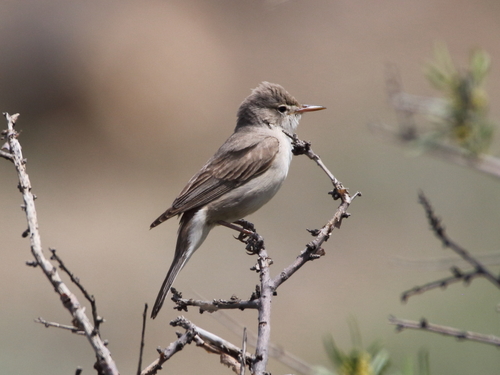 Upcher's Warbler
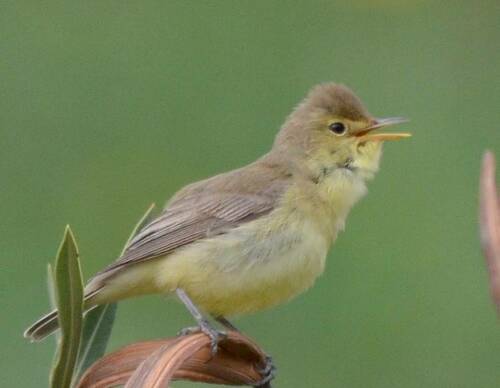 Melodious Warbler
In short
The most reliable field mark to separate Upcher's Warbler from Melodious Warbler is behavior: Upcher’s Warbler frequently flicks and fans its long tail, a habit not shared by Melodious. Structurally, Upcher’s has a longer tail, slightly longer bill, and shorter wings, giving it a lankier, more elongated look compared to the more compact Melodious. In plumage, Upcher’s is overall greyer, while Melodious is warmer brown above and distinctly yellowish below. Both are medium-sized Hippolais warblers and can be confused in poor light, but careful attention to tail action and overall tone is key. Vocalizations are also quite different, but these are not always available in the field.
Identification tips
- Tail action is diagnostic: Upcher’s Warbler frequently flicks and fans its long tail, a behavior not shown by Melodious Warbler. If you see this tail movement, strongly favor Upcher’s.
- Tail length and structure: Upcher’s has a noticeably longer tail and slightly longer bill, with shorter wings, giving it a more elongated, lanky look. Melodious is more compact and balanced.
- Overall color tone: Upcher’s is rather grey above and below, lacking strong yellow or brown tones. Melodious is warmer brown above and distinctly yellowish below, especially in adults.
- Underpart color: Melodious Warbler shows yellowish underparts, while Upcher’s is much less colorful and more neutral greyish.
- Upperpart color: Melodious is brownish above; Upcher’s is more greyish, sometimes compared to Olivaceous Warbler.
- Bill shape: Both have strong, pointed bills, but Upcher’s is slightly longer. This is subtle and best used in combination with other marks.
- Leg color: Both have brown legs; not a strong separator.
- Juvenile/immature plumage: No distinctive upperwing or flight pattern marks are described for either species, so do not rely on wing panels or covert patterns.
- Song and calls: If singing, Melodious gives a pleasant, fluent babbling without mimicry; Upcher’s song is distinctive within Hippolais but not described in detail here. Calls may be more useful for Melodious (rattling 'trrrr', 'tuk', 'chret-chet').
- Range and context: In breeding season, Upcher’s is found from Turkey to Pakistan; Melodious in southwest Europe and northwest Africa. On migration or in Africa, use structure and behavior over range.
- Sex and season: Sexes are identical in both species. Young Melodious are paler on the belly but still warmer than Upcher’s.
- Feeding behavior: Both feed on invertebrates, but Upcher’s may appear more active due to its tail movements.
- Confusion with other species: Upcher’s is sometimes mistaken for Olivaceous Warbler due to its greyish tones, but tail action separates it from both Melodious and Olivaceous.
- When marks fail: In poor light or brief views, focus on tail action and overall structure; color tone can be misleading in shadow.
- Summary tip: If you see a medium-sized Hippolais warbler with a long, flicking tail and greyish plumage, it is Upcher’s. If the bird is compact, brown above, yellowish below, and not flicking its tail, it is Melodious.
Size
Both species are medium-sized Hippolais warblers, similar in size to Icterine Warbler. Melodious Warbler is 12–13 cm in length and weighs about 13.2 g [wikidata]. Upcher’s Warbler is described as similar in size but with a slightly longer bill, shorter wings, and a longer tail, giving it a more elongated appearance. In hand or with prolonged views, Upcher’s should look a bit more stretched, especially in the tail and bill, but overall size is not a strong separator.
Plumage
No age-specific wing or flight pattern marks are described for either species, so focus is on general plumage and structure. Upcher’s Warbler is rather grey overall, lacking strong yellow tones, and is similar to Olivaceous Warbler in color. Melodious Warbler is browner above and distinctly yellowish below, especially in adults; young birds are paler on the belly but still show a warmer tone than Upcher’s. Both have plain backs and wings, but Melodious is warmer and more colorful, while Upcher’s is colder and greyer. Bill and leg color are not strongly contrasting, but Melodious has a strong, pointed bill and brown legs. Sexes are identical in both, and there is no mention of seasonal variation.
Behaviour
Upcher’s Warbler is highly active with its tail, frequently flicking and fanning it in a manner reminiscent of Sylvia warblers or chats. This tail action is diagnostic and should be looked for whenever the bird is visible. Melodious Warbler does not show this behavior and is generally less animated in tail movement. Both feed on invertebrates and can be seen foraging in similar ways, but the tail action of Upcher’s is a standout behavioral clue.
Habitat
Upcher’s Warbler breeds from Turkey east to Pakistan, while Melodious Warbler breeds in southwest Europe and northwest Africa. Their breeding ranges do not overlap, but both are migratory and winter in Africa (Upcher’s in eastern Africa, Melodious in sub-Saharan Africa). In the field, range and habitat may help, but are not diagnostic in isolation, especially on migration.
Voice
Upcher’s Warbler’s song is distinctive within Hippolais, but entirely different from Olivaceous Warbler; unfortunately, there is no direct comparison to Melodious in the notes. Melodious Warbler’s song is a fluent, pleasant babbling, less varied than Icterine Warbler and lacking mimicry. Its rattling 'trrrr' call can resemble a House Sparrow. If heard well, the songs are quite different, but both are typical Hippolais warbler songs and can be overlooked in brief encounters.