

Motmot

Tundra Bean Goose vs Fieldfare

Anser serrirostris versus Turdus pilaris

Play a quiz with Tundra Bean Goose and Fieldfare
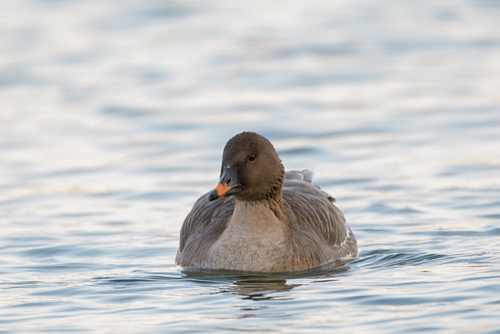
Tundra Bean Goose (Anser serrirostris) Tundra Bean Goose
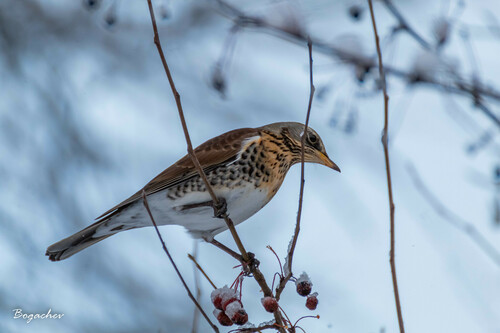
Fieldfare (Turdus pilaris) Fieldfare

Media

Loading…

In short

Tundra Bean Goose and Fieldfare are extremely unlikely to be confused by experienced observers, but distant flight views or poor light can cause confusion, especially with juveniles. The most reliable separation is overall structure and size: Tundra Bean Goose is a massive, heavy-bodied waterfowl with broad wings and a large orange-banded bill, while Fieldfare is a medium-sized thrush with a slim bill, long tail, and distinctive slate-grey and chestnut plumage. In flight, Fieldfare shows striking white underwing coverts and a dark tail, while Tundra Bean Goose has uniformly dark upperwings with narrow white feather fringes. Vocalizations are also completely different: Fieldfare gives a harsh 'tsak-tsak' call, while Tundra Bean Goose honks. Habitat is a strong clue—geese are found on open water or fields, fieldfares in trees or open country.

Identification tips

  1. Size and structure: Tundra Bean Goose is enormous compared to Fieldfare; if you can see both together, the goose dwarfs the thrush. Even singly, note the long neck, heavy body, and broad wings of the goose versus the compact, upright stance and long tail of the Fieldfare.
  2. Bill shape and color: Goose has a large, triangular bill with a black base and tip and an orange band; Fieldfare has a slim, pointed bill, yellowish or orange-yellow depending on season and sex.
  3. Leg color: Goose legs and feet are bright orange; Fieldfare's are brown.
  4. Flight pattern: Goose flies with steady, powerful wingbeats, neck outstretched; Fieldfare has bounding, thrush-like flight with bursts of flapping and gliding, often calling.
  5. Upperwing in flight: Fieldfare (all ages) shows white underwing coverts and axillaries, contrasting with dark wings and tail; Tundra Bean Goose has uniformly dark upperwings with only narrow white fringes—never shows white underwing.
  6. Breast pattern: Fieldfare has a boldly spotted breast and creamy-white belly; goose is plain brownish-grey below with no bold markings.
  7. Head and rump color: Fieldfare shows slate-grey head, nape, and rump, with chestnut back; goose is plain brownish-grey overall.
  8. Tail shape: Fieldfare has a rounded, dark tail with subtle grey fringes; goose has a broad, square tail, not as obviously marked.
  9. Perching behavior: Fieldfare often perches in trees and hedges; geese are never seen in trees.
  10. Habitat: If the bird is on open water or grazing in a field with other geese, it's almost certainly a Tundra Bean Goose; if in a tree, hedgerow, or feeding on berries, it's a Fieldfare.
  11. Vocalization: Fieldfare gives a harsh 'tsak-tsak' call, especially in flight; goose gives deep honking calls.
  12. Seasonal context: Both species are migratory, but Fieldfare is more likely in woodlands and hedgerows in winter, while Tundra Bean Goose is restricted to wetlands and fields.
  13. Flock composition: Geese are usually in large, tight flocks; Fieldfares in looser groups, often mixed with other thrushes.
  14. Juvenile confusion: Juvenile Fieldfare is duller but still shows pale streaks and white underwing; no age of Tundra Bean Goose shows a white underwing or bold breast spots.
  15. Pitfalls: At extreme distance, a Fieldfare flock in flight may look dark and goose-like, but look for the white underwing and listen for the call. Conversely, a lone goose on land may seem plain, but its size, bill, and structure are diagnostic.

Size

Tundra Bean Goose is vastly larger, with a length of 68–90 cm and a wingspan of 140–174 cm, weighing 1.7–4 kg ([wikipedia]). Fieldfare is much smaller, at 25 cm long, wingspan 39–42 cm, and body mass around 105 g ([wikidata]). Even at a distance, the goose's bulk, long neck, and broad wings are unmistakable compared to the compact, short-necked, long-tailed Fieldfare.

Plumage

Juvenile and adult Fieldfare both show a bold contrast in flight: white underwing coverts and axillaries stand out against otherwise dark wings and tail ([wikipedia]). This is never shown by Tundra Bean Goose, which has uniformly dark brown upperwing coverts with only narrow white fringes on the feather edges. Fieldfare perched shows a slate-grey head, nape, and rump, chestnut back, and heavily spotted breast, while Tundra Bean Goose is overall brownish-grey with no bold patterning. The goose's bill is black with an orange band, and legs are bright orange; Fieldfare has a slim, yellowish bill (orange-yellow in winter, yellow in summer males) and brown legs. Juvenile Fieldfare is duller than adults but still shows pale streaks and the white underwing in flight. No age of Tundra Bean Goose shows a white underwing or bold breast spotting.

Behaviour

Tundra Bean Goose is typically seen in flocks on open water, lakes, or grazing in fields, often walking slowly and feeding on grasses. Flight is strong and direct, with steady wingbeats and outstretched neck. Fieldfare is usually seen in loose flocks perched in trees or flying between trees and fields, often dropping to the ground to feed on berries or invertebrates. Flight is bounding and thrush-like, with bursts of flapping and gliding, and the bird often calls in flight. Fieldfare perches upright and alert, while geese are rarely seen perched except on the ground or water.

Habitat

Tundra Bean Goose breeds in northern Siberian tundra and winters further south, always associated with open wetlands, lakes, and agricultural fields ([wikipedia]). Fieldfare breeds in woodland and scrub across northern Europe and the Palearctic, and winters in open country, hedgerows, and fields, often near trees. If the bird is in a tree or hedgerow, it is almost certainly a Fieldfare; geese are never arboreal.

Voice

Fieldfare gives a harsh, repeated 'tsak tsak' call, especially in flight or when alarmed ([wikipedia]). The song is weak and rarely heard except in the breeding season. Tundra Bean Goose gives typical goose honking calls, deep and resonant, never resembling a thrush's call. If you hear a harsh, chattering call, it's a Fieldfare; if you hear honking, it's a goose.

Submit a better description

Use the same sections as the comparison. Your text is published immediately.

Tundra Bean Goose and Fieldfare are extremely unlikely to be confused by experienced observers, but distant flight views or poor light can cause confusion, especially with juveniles. The most reliable separation is overall structure and size: Tundra Bean Goose is a massive, heavy-bodied waterfowl with broad wings and a large orange-banded bill, while Fieldfare is a medium-sized thrush with a slim bill, long tail, and distinctive slate-grey and chestnut plumage. In flight, Fieldfare shows striking white underwing coverts and a dark tail, while Tundra Bean Goose has uniformly dark upperwings with narrow white feather fringes. Vocalizations are also completely different: Fieldfare gives a harsh 'tsak-tsak' call, while Tundra Bean Goose honks. Habitat is a strong clue—geese are found on open water or fields, fieldfares in trees or open country.

  1. Size and structure: Tundra Bean Goose is enormous compared to Fieldfare; if you can see both together, the goose dwarfs the thrush. Even singly, note the long neck, heavy body, and broad wings of the goose versus the compact, upright stance and long tail of the Fieldfare.
  2. Bill shape and color: Goose has a large, triangular bill with a black base and tip and an orange band; Fieldfare has a slim, pointed bill, yellowish or orange-yellow depending on season and sex.
  3. Leg color: Goose legs and feet are bright orange; Fieldfare's are brown.
  4. Flight pattern: Goose flies with steady, powerful wingbeats, neck outstretched; Fieldfare has bounding, thrush-like flight with bursts of flapping and gliding, often calling.
  5. Upperwing in flight: Fieldfare (all ages) shows white underwing coverts and axillaries, contrasting with dark wings and tail; Tundra Bean Goose has uniformly dark upperwings with only narrow white fringes—never shows white underwing.
  6. Breast pattern: Fieldfare has a boldly spotted breast and creamy-white belly; goose is plain brownish-grey below with no bold markings.
  7. Head and rump color: Fieldfare shows slate-grey head, nape, and rump, with chestnut back; goose is plain brownish-grey overall.
  8. Tail shape: Fieldfare has a rounded, dark tail with subtle grey fringes; goose has a broad, square tail, not as obviously marked.
  9. Perching behavior: Fieldfare often perches in trees and hedges; geese are never seen in trees.
  10. Habitat: If the bird is on open water or grazing in a field with other geese, it's almost certainly a Tundra Bean Goose; if in a tree, hedgerow, or feeding on berries, it's a Fieldfare.
  11. Vocalization: Fieldfare gives a harsh 'tsak-tsak' call, especially in flight; goose gives deep honking calls.
  12. Seasonal context: Both species are migratory, but Fieldfare is more likely in woodlands and hedgerows in winter, while Tundra Bean Goose is restricted to wetlands and fields.
  13. Flock composition: Geese are usually in large, tight flocks; Fieldfares in looser groups, often mixed with other thrushes.
  14. Juvenile confusion: Juvenile Fieldfare is duller but still shows pale streaks and white underwing; no age of Tundra Bean Goose shows a white underwing or bold breast spots.
  15. Pitfalls: At extreme distance, a Fieldfare flock in flight may look dark and goose-like, but look for the white underwing and listen for the call. Conversely, a lone goose on land may seem plain, but its size, bill, and structure are diagnostic.

Tundra Bean Goose is vastly larger, with a length of 68–90 cm and a wingspan of 140–174 cm, weighing 1.7–4 kg ([wikipedia]). Fieldfare is much smaller, at 25 cm long, wingspan 39–42 cm, and body mass around 105 g ([wikidata]). Even at a distance, the goose's bulk, long neck, and broad wings are unmistakable compared to the compact, short-necked, long-tailed Fieldfare.

Juvenile and adult Fieldfare both show a bold contrast in flight: white underwing coverts and axillaries stand out against otherwise dark wings and tail ([wikipedia]). This is never shown by Tundra Bean Goose, which has uniformly dark brown upperwing coverts with only narrow white fringes on the feather edges. Fieldfare perched shows a slate-grey head, nape, and rump, chestnut back, and heavily spotted breast, while Tundra Bean Goose is overall brownish-grey with no bold patterning. The goose's bill is black with an orange band, and legs are bright orange; Fieldfare has a slim, yellowish bill (orange-yellow in winter, yellow in summer males) and brown legs. Juvenile Fieldfare is duller than adults but still shows pale streaks and the white underwing in flight. No age of Tundra Bean Goose shows a white underwing or bold breast spotting.

Tundra Bean Goose is typically seen in flocks on open water, lakes, or grazing in fields, often walking slowly and feeding on grasses. Flight is strong and direct, with steady wingbeats and outstretched neck. Fieldfare is usually seen in loose flocks perched in trees or flying between trees and fields, often dropping to the ground to feed on berries or invertebrates. Flight is bounding and thrush-like, with bursts of flapping and gliding, and the bird often calls in flight. Fieldfare perches upright and alert, while geese are rarely seen perched except on the ground or water.

Tundra Bean Goose breeds in northern Siberian tundra and winters further south, always associated with open wetlands, lakes, and agricultural fields ([wikipedia]). Fieldfare breeds in woodland and scrub across northern Europe and the Palearctic, and winters in open country, hedgerows, and fields, often near trees. If the bird is in a tree or hedgerow, it is almost certainly a Fieldfare; geese are never arboreal.

Fieldfare gives a harsh, repeated 'tsak tsak' call, especially in flight or when alarmed ([wikipedia]). The song is weak and rarely heard except in the breeding season. Tundra Bean Goose gives typical goose honking calls, deep and resonant, never resembling a thrush's call. If you hear a harsh, chattering call, it's a Fieldfare; if you hear honking, it's a goose.

Discard your changes?

You have unsaved edits. If you leave now, those changes will be lost.

Tundra Bean Goose · Fieldfare · My Tricky Birds