

Tibetan Sand Plover vs Kittlitz's Plover
Anarhynchus atrifrons versus Anarhynchus pecuarius
Play a quiz with Tibetan Sand Plover and Kittlitz's Plover
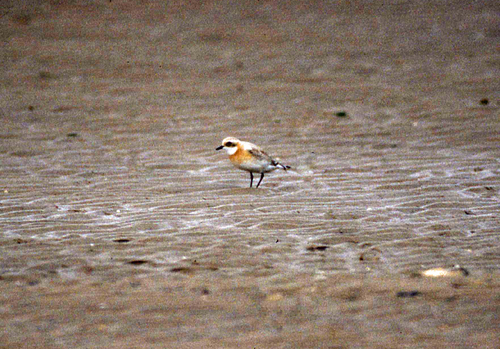 Tibetan Sand Plover
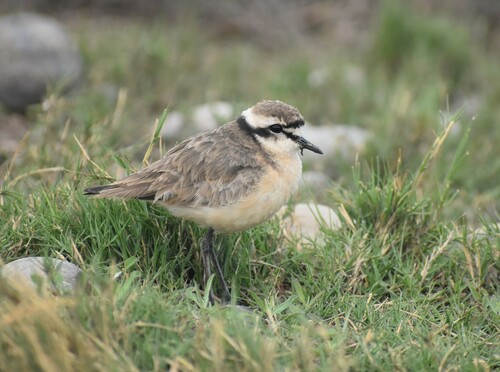 Kittlitz's Plover
In short
The most reliable field mark between Tibetan Sand Plover and Kittlitz's Plover is the facial pattern and breast color in breeding adults: Tibetan Sand Plover shows a black mask with a pale orange chest, while Kittlitz's Plover has a striking white forehead, black eye-stripe, and a yellowish (not orange) wash to the underparts. Juveniles and non-breeding birds are trickier, but Kittlitz's Plover always shows a white supercilium and a dark collar extending onto the upper mantle, which Tibetan Sand Plover lacks. Structure is similar, but Kittlitz's Plover is slightly smaller and more delicate overall. Habitat and range overlap in Africa and Asia during migration, so careful attention to plumage is essential.
Identification tips
- Breeding adult face pattern: Tibetan Sand Plover shows a black mask and pale orange chest/neck; Kittlitz's Plover has a white forehead, blackish bar on the forecrown, and a black eye-stripe extending to a collar on the neck. This is the most obvious difference in breeding plumage.
- Supercilium: Kittlitz's Plover always has a strong white supercilium (eyebrow), even in non-breeding and juvenile plumage. Tibetan Sand Plover lacks a strong supercilium at all ages.
- Neck collar: Kittlitz's Plover shows a dark collar across the upper mantle (neck sides) in all plumages except juvenile, where it is buff. Tibetan Sand Plover never shows this collar.
- Breast color: Tibetan Sand Plover (breeding) has a pale orange chest and neck; Kittlitz's Plover has yellowish underparts but never orange. Non-breeding and juvenile Tibetan Sand Plovers have white underparts.
- Juvenile upperparts: Kittlitz's Plover juveniles have brown upperparts, buff hindneck collar, and white underparts. Tibetan Sand Plover juveniles are plainer brown above, white below, lacking the buff collar.
- Tail pattern: Kittlitz's Plover has blackish central tail feathers with white outer pairs, visible in flight or when tail is spread. No tail pattern is described for Tibetan Sand Plover, so this may help if seen well.
- Leg color: Kittlitz's Plover has black legs, sometimes appearing greenish or grey. Leg color is not described for Tibetan Sand Plover, so use with caution.
- Bill: Both have black bills, but Kittlitz's Plover's is proportionally shorter and finer (15–23 mm). This is subtle and best used alongside other marks.
- Sexual dimorphism: Kittlitz's Plover is monomorphic (males and females look alike). Tibetan Sand Plover males are paler than females in breeding plumage, but this is subtle and not always reliable.
- Seasonal change: Kittlitz's Plover changes little between seasons; the eye-stripe becomes browner and the frontal bar is lost in non-breeding plumage. Tibetan Sand Plover loses the black mask and orange chest in non-breeding plumage, becoming much plainer.
- Structure: Kittlitz's Plover is slightly smaller and more delicate, with a shorter bill and legs. This is subtle and best used with direct comparison.
- Habitat: In Africa, both can occur together in wetlands, but Kittlitz's Plover is resident and more likely in inland alkaline grasslands and riverbanks. Tibetan Sand Plover is a migrant, more likely on coasts or large wetlands in winter.
- Flight views: No distinctive upperwing or flight pattern is described for either species in the sources, so rely on face and collar pattern even in flight.
- Pitfalls: Non-breeding and juvenile Tibetan Sand Plovers can appear very plain and may be confused with Kittlitz's Plover juveniles, but lack the buff collar and strong supercilium. Always check for the white eyebrow and neck collar in Kittlitz's.
- Voice: No vocal differences are described in the sources, so do not rely on calls for separation.
Size
Kittlitz's Plover is slightly smaller and lighter, weighing 35–40 g [wikipedia]. Tibetan Sand Plover is described as medium-sized, but no precise weight is given. Kittlitz's Plover has a wing length of 100–110 mm, bill 15–23 mm, and tarsus 26–33 mm. Both species are small, slim plovers, but Kittlitz's Plover may appear more delicate and fine-billed in direct comparison.
Plumage
- Juveniles and non-breeding birds: Kittlitz's Plover juveniles lack black facial marks, have brown upperparts, a buff hindneck collar, and white underparts. Tibetan Sand Plover juveniles and winter adults are plainer, with light brown upperparts and white underparts, but without the buff collar or strong supercilium of Kittlitz's.
- Breeding adults: Tibetan Sand Plover males (and to a lesser extent females) show a black mask and a light orange chest and neck, with a pale throat and white underparts. Kittlitz's Plover (both sexes) has a white forehead, blackish bar on the forecrown, black eye-stripe extending to the neck forming a collar, and yellowish underparts.
- Face pattern: Kittlitz's Plover always shows a strong white supercilium and dark eye-stripe, even in non-breeding plumage (though the stripe is browner and the frontal bar is absent). Tibetan Sand Plover lacks this supercilium and has a more uniform face in non-breeding/juvenile plumage.
- Tail: Kittlitz's Plover has blackish central tail feathers with white outer pairs; this is not described for Tibetan Sand Plover.
Behaviour
Both species are typical small plovers, feeding by running and pausing on open ground. Kittlitz's Plover is noted for active parental defense behaviors (injury-feigning, false brooding), but these are not field marks for separation. No major behavioral differences are described for field separation.
Habitat
Tibetan Sand Plover breeds in high-altitude Central Asian regions (Pamir, Tian Shan, Tibetan Plateau, south Mongolia) and winters widely in Africa and Asia, including coastal and inland wetlands. Kittlitz's Plover is resident and widespread in sub-Saharan Africa, Madagascar, and the Nile Delta, breeding near saltmarshes, sandy or muddy riverbanks, and alkaline grasslands. In Africa, both can occur in similar wetland habitats during the non-breeding season, so habitat alone is not diagnostic where ranges overlap.