
Swainson's Hawk vs Rough-legged Buzzard
Buteo swainsoni versus Buteo lagopus
Play a quiz with Swainson's Hawk and Rough-legged Buzzard
 Swainson's Hawk
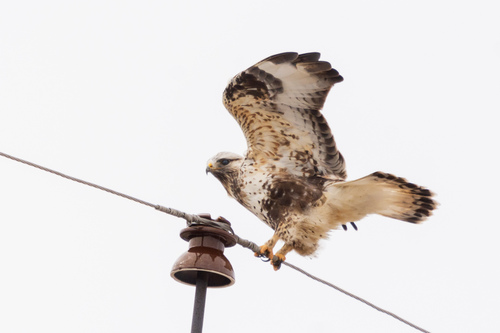 Rough-legged Buzzard
In short
The most reliable field mark between Swainson's Hawk and Rough-legged Buzzard is the underwing pattern in flight: Swainson's Hawk (especially light-morph adults and immatures) shows pale underwing coverts with a sharp contrast against dark flight feathers along the trailing edge, while Rough-legged Buzzard (light morphs) displays a bold dark carpal (wrist) patch on otherwise pale underwings. Juvenile and immature plumages can be confusing, but the presence or absence of these underwing contrasts is key. Structurally, Rough-legged Buzzard has longer wings and a longer tail, with wings that often reach or extend past the tail when perched. Both species are similar in size and can appear variable in plumage, so careful attention to wing and tail pattern is essential, especially in flight.
Identification tips
- Underwing pattern in flight (all ages): Swainson's Hawk shows pale underwing coverts with a dark trailing edge (flight feathers), while Rough-legged Buzzard has a bold dark carpal (wrist) patch on otherwise pale underwings. This is the most reliable mark, especially in light morphs.
- Tail pattern (all ages): Swainson's Hawk has a gray-brown tail with several narrow dark bands and a broader subterminal band (less distinct in juveniles). Rough-legged Buzzard's tail is white with one or more dark subterminal bands, often appearing whiter overall, especially at the base.
- Chest and bib (adults and immatures): Swainson's Hawk (light morph) shows a reddish or brownish bib on the chest and a white throat/face. Rough-legged Buzzard typically has a broad brown chest band, but not a sharply defined bib or white throat.
- Facial pattern (adults and immatures): Swainson's Hawk often has a noticeable white face and throat, sometimes with a pale head in worn immatures. Rough-legged Buzzard lacks this clear facial contrast.
- Dark morph confusion: Both species have dark morphs. Rough-legged dark morphs retain the pale tail base and carpal patch, while Swainson's dark morphs are more uniformly dark with a light patch under the tail.
- Wing length and structure: Rough-legged Buzzard has longer wings and a longer tail, with wing tips that reach or extend past the tail when perched. Swainson's Hawk appears more compact, with shorter wings relative to tail.
- Perched jizz: When perched, Rough-legged Buzzard's wings often reach or extend past the tail, giving a rangy look. Swainson's Hawk's wings are shorter relative to the tail.
- Leg feathering: Rough-legged Buzzard has feathered legs down to the toes (not always visible in the field), an adaptation to cold climates. Swainson's Hawk has unfeathered lower legs.
- Flight style: Rough-legged Buzzard frequently hovers over open ground, a behavior rarely seen in Swainson's Hawk, which prefers soaring or still-hunting from perches.
- Habitat context: In open tundra or northern fields in winter, especially in cold climates, Rough-legged Buzzard is more likely. Swainson's Hawk is more typical of grasslands, prairies, and agricultural areas, especially in warmer seasons.
- Seasonal occurrence: Rough-legged Buzzard is a winter visitor in temperate North America and Eurasia, while Swainson's Hawk is present during the breeding season and migration, rarely in winter.
- Plumage variability: Both species are variable, but the underwing pattern (carpal patch vs. dark trailing edge) and tail color (white vs. gray-brown) are more reliable than overall color.
- Juvenile confusion: Juvenile Swainson's can show more mottling and less distinct tail bands, but still lack the carpal patch of Rough-legged. Juvenile Rough-legged always shows the carpal patch and white tail base.
- Group behavior: Swainson's Hawk may be seen in flocks, especially at food sources or during migration; Rough-legged Buzzard is usually solitary.
- Voice: Not diagnostic in the field for separation; both are generally silent or give high-pitched calls that are not distinctive at distance.
Size
Both species are large Buteos with overlapping mass (Swainson's Hawk: ~958.5g; Rough-legged Buzzard: ~925.8g) [wikidata]. Rough-legged Buzzard can appear slightly bulkier in some contexts, but this is not a reliable field mark. Structurally, Rough-legged Buzzard has longer wings and a longer tail, and its wing tips often reach or extend past the tail when perched, giving it a more eagle-like or rangy appearance compared to the more compact Swainson's Hawk.
Plumage
Juvenile and immature Swainson's Hawks show pale underparts with a reddish or brownish bib on the chest, a white throat and face, and underwings with pale linings and a dark trailing edge. The tail is gray-brown with several narrow dark bands and a broader subterminal band, though this is less obvious in juveniles. Immatures may have paler heads due to feather wear. In contrast, Rough-legged Buzzard (light morphs, all ages) shows a broad dark carpal patch on the otherwise white underwing, a feature not present in Swainson's. The tail of Rough-legged is white with one or more dark subterminal bands, and the underparts often have a broad brown chest band. Dark morphs of both species are mostly dark brown, but Rough-legged retains the carpal patch and white tail base, while Swainson's dark morphs show a light patch under the tail. Both species are variable, but the underwing pattern is the most consistent difference.
Behaviour
Both species hunt by soaring, but Rough-legged Buzzard is unique among large Buteos for its frequent hovering, especially when searching for prey over open ground. Swainson's Hawk may occasionally hover but is more likely to soar in a dihedral or still-hunt from a perch. Swainson's is also known for following tractors and feeding on insects on the ground, sometimes gathering in flocks during migration or at food sources. Rough-legged Buzzard is more solitary and is adapted to colder environments, often seen hunting over tundra or open fields.
Habitat
Swainson's Hawk is typically found in open country, grasslands, and agricultural areas, especially during migration and on wintering grounds. It often follows farming activity and is attracted to recently ploughed fields. Rough-legged Buzzard breeds in arctic and subarctic tundra and moves south to open fields and marshes in winter. In North America, it is a winter visitor to open country, often farther north or in colder regions than Swainson's. Overlap can occur in migration or winter, but Swainson's is more associated with warmer, drier grasslands and agricultural landscapes.