

Motmot

Spotted Redshank vs Red Knot

Tringa erythropus versus Calidris canutus

Play a quiz with Spotted Redshank and Red Knot
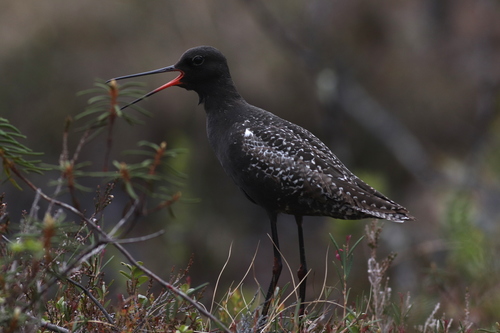
Spotted Redshank (Tringa erythropus) Spotted Redshank
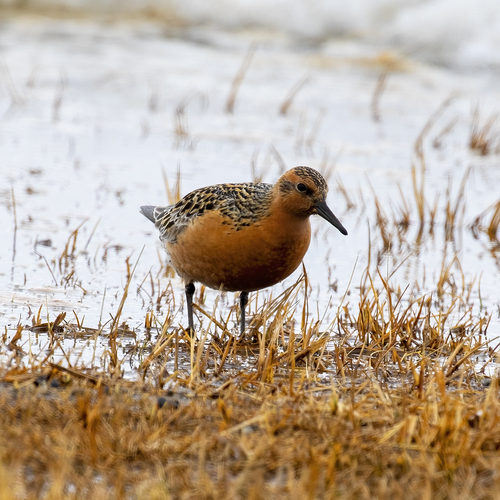
Red Knot (Calidris canutus) Red Knot

Media

Loading…

In short

The most reliable field mark to separate Spotted Redshank from Red Knot is the leg color: Spotted Redshank shows red legs (sometimes darkening in breeding plumage), while Red Knot always has short, dark greenish legs. In flight, Spotted Redshank reveals a distinctive white oval on its back, whereas Red Knot shows a white wing bar and a grey rump and tail. Juvenile and non-breeding birds can be especially confusing, but the Spotted Redshank’s longer, slightly upturned bill and more elegant, taller stance also help distinguish it from the stockier, shorter-billed Red Knot. Both species can appear pale grey in winter, so careful attention to structure and flight pattern is essential.

Identification tips

  1. Leg color: Spotted Redshank always shows red or reddish legs (darkening in breeding plumage), while Red Knot’s legs are short and dark greenish to black. This is reliable at all ages and seasons if legs are visible.
  2. Bill shape and length: Spotted Redshank has a longer, slightly upturned bill with a red base, while Red Knot’s bill is shorter, straight, and dark. This is especially helpful in side views.
  3. Flight pattern (all ages): Spotted Redshank shows a white oval on the back in flight, while Red Knot shows a white wing bar and a grey rump and tail. Use this when birds flush or fly past.
  4. Juvenile upperparts: Juvenile Spotted Redshank is grey-brown with fine white speckling, while juvenile Red Knot has brown coverts with submarginal lines, giving a scaly look. The Spotted Redshank’s upperparts are plainer and less patterned.
  5. Winter plumage: Both species become pale grey above and below, but Spotted Redshank is paler and maintains red legs, while Red Knot is more evenly grey and always has dark legs.
  6. Breeding plumage: Spotted Redshank is black to dark grey with white spots, while Red Knot is mottled grey above with a rich cinnamon face, throat, and breast. Red Knot never becomes all-black.
  7. Structure and jizz: Spotted Redshank is taller, more elegant, and longer-legged, often standing upright. Red Knot is compact, with a small head, short neck, and a 'low-slung' feeding posture.
  8. Feeding behavior: Spotted Redshank often wades in deeper water, while Red Knot feeds on mudflats or beaches, rarely wading deeply.
  9. Group size: Red Knot is often in tight flocks, especially in migration or winter, while Spotted Redshank is more solitary or loosely grouped.
  10. Habitat: Spotted Redshank prefers freshwater wetlands, while Red Knot is mostly coastal outside the breeding season. If you’re inland, Spotted Redshank is more likely.
  11. Vocalizations: Spotted Redshank’s 'teu-it' and 'kyip-kyip-kyip' are higher-pitched and more musical than Red Knot’s low 'knutt' or 'knuup-knuup'.
  12. Bill base color: The red base to the bill is visible in Spotted Redshank, especially outside breeding plumage; Red Knot’s bill is uniformly dark.
  13. Sex differences: Not reliably separable in the field for either species, but female Red Knot is slightly paler and has a less distinct eye-line in breeding plumage.
  14. Moult timing: Both species moult from breeding to winter plumage during migration, but Spotted Redshank adults moult completely between July and October, with body plumage changing in spring (March–May). Juvenile Spotted Redshank has a partial moult between August and February.
  15. Pitfalls: In poor light or at distance, both can appear similar in winter plumage. Focus on leg color, bill shape, and flight pattern for the most reliable separation.

Size

Spotted Redshank is the larger of the two, with an average mass of 151.5 g compared to Red Knot’s 137 g [wikidata]. Spotted Redshank measures 29–31 cm in length with a 61–67 cm wingspan, while Red Knot is smaller at 23–26 cm long and a 47–53 cm wingspan [wikipedia]. In the field, Spotted Redshank often appears taller and more elongated, while Red Knot is compact and 'low-slung', with a small head and short neck.

Plumage

Juvenile Spotted Redshank is grey-brown above, finely speckled with white, and has pale, finely barred underparts. In flight, all ages show a white oval on the back, which is absent in Red Knot. Juvenile Red Knot has brown coverts with submarginal lines, giving a scaly look to the upperparts, but lacks the Spotted Redshank’s white back patch. In non-breeding (winter) plumage, both species are pale grey above and below, but Spotted Redshank is paler overall and maintains red (or dark reddish) legs, while Red Knot’s legs are always dark. In breeding plumage, Spotted Redshank is strikingly black to dark grey with white spots, and Red Knot is mottled grey above with a cinnamon face, throat, and breast. In flight, Red Knot shows a strong white wing bar and a grey rump and tail, while Spotted Redshank’s flight is marked by the white oval on the back. Adult Spotted Redshank legs darken in breeding plumage but never become as short or dark as Red Knot’s.

Behaviour

Spotted Redshank tends to be more elegant and upright, often wading in deeper water, and is more likely to be seen singly or in loose groups. Red Knot is stockier, feeds in a 'low-slung' posture, and is often seen in tight flocks, especially on mudflats or sandy shores. When feeding, Red Knot uses shallow probing and is less likely to wade deeply. In flight, Red Knot flocks are tight and fast-moving, while Spotted Redshank may appear more solitary and graceful.

Habitat

Spotted Redshank breeds in boggy taiga and winters in a variety of wetlands, including shallow lakes, marshes, and flooded fields. Red Knot breeds in Arctic tundra and is most often seen on coastal mudflats, estuaries, and sandy beaches during migration and winter. Overlap may occur on migration, but Red Knot is more strictly coastal outside the breeding season, while Spotted Redshank is more likely inland or in freshwater habitats.

Voice

Spotted Redshank gives a creaking whistle 'teu-it' and an alarm call 'kyip-kyip-kyip', which is higher-pitched and more musical than Red Knot. Red Knot is generally quiet when feeding alone but in flight flocks gives a low monosyllabic 'knutt' or a disyllabic 'knuup-knuup'. Their calls are less sharp and less musical than Spotted Redshank.

Submit a better description

Use the same sections as the comparison. Your text is published immediately.

The most reliable field mark to separate Spotted Redshank from Red Knot is the leg color: Spotted Redshank shows red legs (sometimes darkening in breeding plumage), while Red Knot always has short, dark greenish legs. In flight, Spotted Redshank reveals a distinctive white oval on its back, whereas Red Knot shows a white wing bar and a grey rump and tail. Juvenile and non-breeding birds can be especially confusing, but the Spotted Redshank’s longer, slightly upturned bill and more elegant, taller stance also help distinguish it from the stockier, shorter-billed Red Knot. Both species can appear pale grey in winter, so careful attention to structure and flight pattern is essential.

  1. Leg color: Spotted Redshank always shows red or reddish legs (darkening in breeding plumage), while Red Knot’s legs are short and dark greenish to black. This is reliable at all ages and seasons if legs are visible.
  2. Bill shape and length: Spotted Redshank has a longer, slightly upturned bill with a red base, while Red Knot’s bill is shorter, straight, and dark. This is especially helpful in side views.
  3. Flight pattern (all ages): Spotted Redshank shows a white oval on the back in flight, while Red Knot shows a white wing bar and a grey rump and tail. Use this when birds flush or fly past.
  4. Juvenile upperparts: Juvenile Spotted Redshank is grey-brown with fine white speckling, while juvenile Red Knot has brown coverts with submarginal lines, giving a scaly look. The Spotted Redshank’s upperparts are plainer and less patterned.
  5. Winter plumage: Both species become pale grey above and below, but Spotted Redshank is paler and maintains red legs, while Red Knot is more evenly grey and always has dark legs.
  6. Breeding plumage: Spotted Redshank is black to dark grey with white spots, while Red Knot is mottled grey above with a rich cinnamon face, throat, and breast. Red Knot never becomes all-black.
  7. Structure and jizz: Spotted Redshank is taller, more elegant, and longer-legged, often standing upright. Red Knot is compact, with a small head, short neck, and a 'low-slung' feeding posture.
  8. Feeding behavior: Spotted Redshank often wades in deeper water, while Red Knot feeds on mudflats or beaches, rarely wading deeply.
  9. Group size: Red Knot is often in tight flocks, especially in migration or winter, while Spotted Redshank is more solitary or loosely grouped.
  10. Habitat: Spotted Redshank prefers freshwater wetlands, while Red Knot is mostly coastal outside the breeding season. If you’re inland, Spotted Redshank is more likely.
  11. Vocalizations: Spotted Redshank’s 'teu-it' and 'kyip-kyip-kyip' are higher-pitched and more musical than Red Knot’s low 'knutt' or 'knuup-knuup'.
  12. Bill base color: The red base to the bill is visible in Spotted Redshank, especially outside breeding plumage; Red Knot’s bill is uniformly dark.
  13. Sex differences: Not reliably separable in the field for either species, but female Red Knot is slightly paler and has a less distinct eye-line in breeding plumage.
  14. Moult timing: Both species moult from breeding to winter plumage during migration, but Spotted Redshank adults moult completely between July and October, with body plumage changing in spring (March–May). Juvenile Spotted Redshank has a partial moult between August and February.
  15. Pitfalls: In poor light or at distance, both can appear similar in winter plumage. Focus on leg color, bill shape, and flight pattern for the most reliable separation.

Spotted Redshank is the larger of the two, with an average mass of 151.5 g compared to Red Knot’s 137 g [wikidata]. Spotted Redshank measures 29–31 cm in length with a 61–67 cm wingspan, while Red Knot is smaller at 23–26 cm long and a 47–53 cm wingspan [wikipedia]. In the field, Spotted Redshank often appears taller and more elongated, while Red Knot is compact and 'low-slung', with a small head and short neck.

Juvenile Spotted Redshank is grey-brown above, finely speckled with white, and has pale, finely barred underparts. In flight, all ages show a white oval on the back, which is absent in Red Knot. Juvenile Red Knot has brown coverts with submarginal lines, giving a scaly look to the upperparts, but lacks the Spotted Redshank’s white back patch. In non-breeding (winter) plumage, both species are pale grey above and below, but Spotted Redshank is paler overall and maintains red (or dark reddish) legs, while Red Knot’s legs are always dark. In breeding plumage, Spotted Redshank is strikingly black to dark grey with white spots, and Red Knot is mottled grey above with a cinnamon face, throat, and breast. In flight, Red Knot shows a strong white wing bar and a grey rump and tail, while Spotted Redshank’s flight is marked by the white oval on the back. Adult Spotted Redshank legs darken in breeding plumage but never become as short or dark as Red Knot’s.

Spotted Redshank tends to be more elegant and upright, often wading in deeper water, and is more likely to be seen singly or in loose groups. Red Knot is stockier, feeds in a 'low-slung' posture, and is often seen in tight flocks, especially on mudflats or sandy shores. When feeding, Red Knot uses shallow probing and is less likely to wade deeply. In flight, Red Knot flocks are tight and fast-moving, while Spotted Redshank may appear more solitary and graceful.

Spotted Redshank breeds in boggy taiga and winters in a variety of wetlands, including shallow lakes, marshes, and flooded fields. Red Knot breeds in Arctic tundra and is most often seen on coastal mudflats, estuaries, and sandy beaches during migration and winter. Overlap may occur on migration, but Red Knot is more strictly coastal outside the breeding season, while Spotted Redshank is more likely inland or in freshwater habitats.

Spotted Redshank gives a creaking whistle 'teu-it' and an alarm call 'kyip-kyip-kyip', which is higher-pitched and more musical than Red Knot. Red Knot is generally quiet when feeding alone but in flight flocks gives a low monosyllabic 'knutt' or a disyllabic 'knuup-knuup'. Their calls are less sharp and less musical than Spotted Redshank.

Discard your changes?

You have unsaved edits. If you leave now, those changes will be lost.

Spotted Redshank · Red Knot · My Tricky Birds