
Spotted Crake vs Little Crake
Porzana porzana versus Zapornia parva
Play a quiz with Spotted Crake and Little Crake
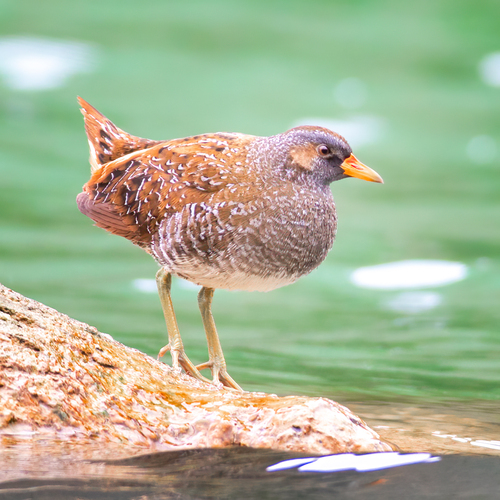 Spotted Crake
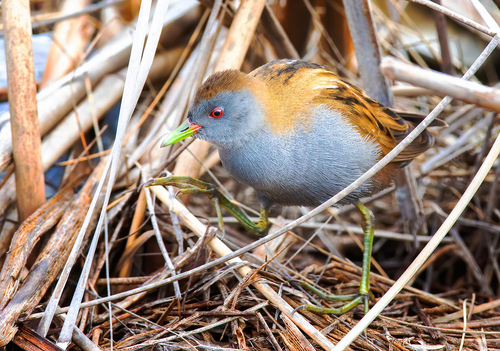 Little Crake
In short
The most reliable field mark to separate Spotted Crake from Little Crake is the presence or absence of bold white spots and dark barring on the flanks: Spotted Crake shows both, while Little Crake lacks them entirely. Adult male Little Crakes have a blue-grey face and underparts, but females and immatures are buff below and can resemble Spotted Crake, making the flank pattern crucial. Both species have short, straight yellow bills with a red base and green legs with long toes, but Little Crake is slightly smaller and has a shorter tail with distinctive black-and-white barring underneath. Immature plumages are similar in both, but the face and breast coloration differs subtly. In the field, focus first on the flanks and then check under-tail and face color for confirmation.
Identification tips
- Check the flanks first: Spotted Crake always shows bold white spots and dark barring on the flanks; Little Crake's flanks are plain, with no spots or barring. This is the most reliable mark for all ages and sexes.
- Tail pattern in raised or fanned tail: Spotted Crake has buff undertail coverts; Little Crake shows black-and-white barring under the tail. Look for this when the bird flicks or raises its tail.
- Adult male face and underparts: Adult male Little Crake has a blue-grey face and unmarked blue-grey underparts, contrasting with Spotted Crake's blue-grey breast and spotted/banded flanks. Female and immature Little Crake are buff below, with only the face grey (female) or white (immature).
- Bill color and shape: Both have short, straight yellow bills with a red base, so this is not a strong separator. Do not rely on bill color alone.
- Legs and toes: Both have green legs and long toes, so leg color is not diagnostic.
- Size and structure: Little Crake is slightly smaller and more delicate, but size overlap is significant and not reliable in the field unless both species are present.
- Upperparts: Both species have mainly brown upperparts; this is not useful for separation.
- Juvenile/immature underparts: Immature Spotted Crake lacks blue-grey on the breast, being brown below, but still shows the flank spots and barring. Immature Little Crake is similar to the female but with a white face and breast and plain flanks.
- Sexual dimorphism in Little Crake: Only Little Crake shows strong sexual dimorphism; males are blue-grey below, females are buff below with grey only on the face. Spotted Crake sexes are similar.
- Flight views: If flushed, focus on flank pattern and undertail color. Spotted Crake shows spotted/banded flanks and buff undertail; Little Crake shows plain flanks and black-and-white barred undertail.
- Behavior: Both are secretive and creep through dense vegetation; behavior is not a reliable separator.
- Habitat: Both use similar wetland habitats; do not rely on habitat for separation in overlapping range.
- Voice: If you hear a yapping 'kua' call, suspect Little Crake, especially on migration. Spotted Crake's call is not described here.
- Pitfalls: Female and immature Little Crake can resemble Spotted Crake in general coloration, but will never show flank spots or barring. Always check the flanks carefully.
- Chicks: Both species' chicks are black and downy; not separable at this age.
Size
Spotted Crake is slightly larger, at 19–22.5 cm in length and about 80 g in mass, compared to Little Crake's 17–19 cm length (mass not specified, but consistently described as smaller) [wikipedia][wikidata]. The difference is subtle and may not be obvious unless both species are seen side by side, but Spotted Crake generally appears a touch bulkier and longer-bodied. Both have similar proportions, with short tails and long toes, but Little Crake's overall jizz is more delicate.
Plumage
Flank pattern is the most diagnostic: Spotted Crake (all ages) has bold white spots and dark barring on the flanks, while Little Crake (all ages and sexes) lacks both, showing plain flanks. Adult Spotted Crake has brown upperparts, blue-grey breast, and a short tail with buff underneath. Adult male Little Crake has brown upperparts and blue-grey face and underparts, but the underparts are unmarked and the tail is barred black and white underneath. Female Little Crake is buff below with grey only on the face, and immatures are similar to females but with a white face and breast. Spotted Crake immatures are brown below (not blue-grey), but still show the flank spots and barring. Both species' chicks are black and downy. In flight or when the tail is raised, Spotted Crake shows buff undertail, Little Crake shows black-and-white barring.
Behaviour
Both species are secretive, probing in mud or shallow water for insects and aquatic animals. Little Crake is especially elusive during the breeding season and more likely to be heard than seen, but can be more visible and vocal on migration. Spotted Crake is similarly skulking but may be slightly more likely to be seen in open marshy areas. Neither species is likely to flush far; both creep through dense vegetation.
Habitat
Both species breed in marshes and reedbeds in Europe and western Asia, but Little Crake is more common in eastern Europe and winters in Africa. Spotted Crake is more widespread across temperate Europe. Both favor dense, wet vegetation, but Little Crake may nest in slightly drier reedbeds. Habitat overlap is substantial, so context is not a strong separator.
Voice
Little Crake is noted for a yapping 'kua' call, especially on migration. Spotted Crake's call is not described in the notes, so vocalization is only useful if Little Crake's distinctive call is heard. Both are more often detected by voice than by sight in the breeding season.