
Motmot

Spotless Crake vs Brown Booby

Zapornia tabuensis versus Sula leucogaster

Play a quiz with Spotless Crake and Brown Booby
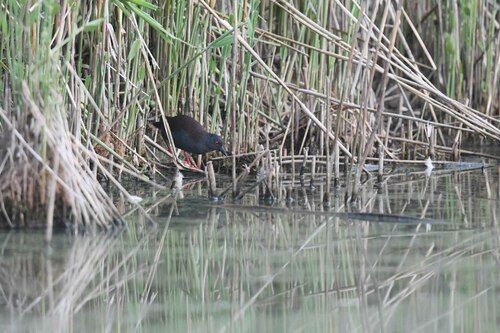
Spotless Crake (Zapornia tabuensis) Spotless Crake
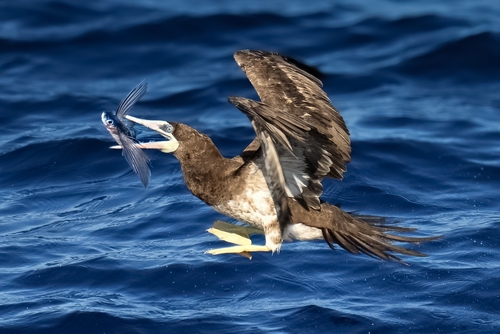
Brown Booby (Sula leucogaster) Brown Booby

Media

Loading…

In short

The most reliable field mark separating Spotless Crake from Brown Booby is overall structure and size: Spotless Crake is a tiny, secretive rail with a short bill and legs, while Brown Booby is a massive, long-winged seabird with a sharply contrasting brown-and-white plumage. Juvenile plumages are not easily confused, as young crakes are dull brownish-grey and small, while juvenile boobies are already large and show brown upperparts with white underparts flecked brown. In flight or at rest, the crake is a small, round-bodied bird of dense wetlands, whereas the booby is a powerful flier of open coasts and ocean. Even at a distance, the booby's long wings, pointed tail, and bold color contrast are diagnostic.

Identification tips

  1. Size is decisive: Spotless Crake is tiny (sparrow-sized), while Brown Booby is huge (goose-sized). Use binoculars for scale if both are distant.
  2. Habitat is a strong clue: Crake in dense freshwater marshes; booby over open sea or rocky coasts. Never expect a crake at sea or a booby in a reedbed.
  3. Body shape and structure: Crake is round-bodied, short-necked, with a short, fine bill and short tail; booby is long-necked, long-winged, with a strong, pointed bill and long, tapered tail.
  4. Flight style: Crake flies weakly and low, only when flushed; booby soars, glides, and dives powerfully over water.
  5. Adult plumage: Crake is mostly bluish-grey and dark brown, with no sharp color contrast; booby is sharply two-toned, brown above and white below.
  6. Juvenile plumage: Young crake is dull brown and greyish, with a white chin/throat; juvenile booby is brown above, white below with brown flecks—still showing strong contrast.
  7. Bill color and shape: Crake's bill is short and black; booby's is long, pale, and sharply pointed.
  8. Leg color: Adult crake has reddish-pink legs; juvenile legs are brownish-olive. Booby's leg color is not described here, but is not reddish.
  9. Eye color: Adult crake has deep red eyes; juvenile's eyes are brownish-orange. Booby's orbital ring is blue (male) or yellow (female), but eye color is not a strong field mark at distance.
  10. Sexual dimorphism: Crake sexes look alike; booby sexes differ in orbital ring color (blue in males, yellow in females).
  11. Vocalizations: Crake may be heard giving rapid, high-pitched calls in marshes; booby is mostly silent, with rare grunting or quacking.
  12. Behavior: Crake is secretive, rarely seen in the open; booby is conspicuous, often in groups, and perches openly.
  13. Contextual clues: If you see a bird walking on floating vegetation or among reeds, it's a crake; if you see a bird plunge-diving or flying high over the sea, it's a booby.
  14. Pitfalls: At extreme distance, a perched booby may look dark above and pale below, but the size and setting are always different from a crake.
  15. When marks fail: If only a fleeting view is obtained, rely on size, habitat, and overall jizz; these two species are never truly similar in any direct field situation.

Size

Spotless Crake is dramatically smaller than Brown Booby. The crake reaches only 17–20 cm in length and weighs 40–50g (about the size of a sparrow or small thrush), with a wingspan of 26–29 cm. In contrast, Brown Booby is a large seabird: females up to 80 cm in length, 150 cm wingspan, and 1,300g; males slightly smaller but still enormous compared to any rail. Even a distant silhouette or a quick view is enough to separate them by size alone.

Plumage

Juvenile Spotless Crake is dull brown above and dull grey-brown below, with a white chin and throat patch; the adult is bluish-grey on head and underparts, with a dark reddish-brown back and wings, and blackish tail. There is no strong contrast between upper and underparts, and the bird appears mostly dark and uniform at a distance. Juvenile Brown Booby already shows the species' signature pattern: brown head, back, and upperwings, with white lower breast and belly, the latter flecked brown. Adults are even more striking, with a sharp brown-and-white division. The booby's bill is pale and strong, while the crake's is short and black. Eye color is deep red in adult crake (brownish-orange in juveniles), while booby's orbital ring color varies by sex (blue in males, yellow in females). The crake's legs are reddish-pink (adults) or brownish-olive (juveniles); booby's bare parts are not described in detail here, but are not reddish.

Behaviour

Spotless Crake is extremely shy, skulking in dense reeds, sedges, and grasses, rarely seen in the open, and walking or running rather than flying. Brown Booby is gregarious, often seen flying over open water, diving for fish, or perched conspicuously on rocks or boats. The crake is almost never seen in flight except when flushed, and then flies weakly and low. The booby is a strong, direct flier with rapid wingbeats and long glides, often seen soaring or commuting over the sea.

Habitat

Spotless Crake is strictly a freshwater wetland bird, inhabiting dense marshes, reedbeds, and sedge swamps, always near or over water with thick vegetation. Brown Booby is a marine species, found over open ocean, along coasts, and on offshore islands, never in dense vegetation or freshwater marshes. If seen in a wetland or reedbed, it is almost certainly a crake; if seen at sea or on a rocky coast, it is a booby.

Voice

Spotless Crake has a variety of calls, including a rapid, high-pitched 'purr', 'pit-pit', and bubbling or 'mook' sounds, but is generally quiet and secretive. Brown Booby is usually silent, but may give grunting or quacking sounds. Vocalizations are not likely to be a primary field mark for separating these species, but if you hear a rapid series of high-pitched notes in a marsh, it is likely a crake.

Submit a better description

Use the same sections as the comparison. Your text is published immediately.

The most reliable field mark separating Spotless Crake from Brown Booby is overall structure and size: Spotless Crake is a tiny, secretive rail with a short bill and legs, while Brown Booby is a massive, long-winged seabird with a sharply contrasting brown-and-white plumage. Juvenile plumages are not easily confused, as young crakes are dull brownish-grey and small, while juvenile boobies are already large and show brown upperparts with white underparts flecked brown. In flight or at rest, the crake is a small, round-bodied bird of dense wetlands, whereas the booby is a powerful flier of open coasts and ocean. Even at a distance, the booby's long wings, pointed tail, and bold color contrast are diagnostic.

  1. Size is decisive: Spotless Crake is tiny (sparrow-sized), while Brown Booby is huge (goose-sized). Use binoculars for scale if both are distant.
  2. Habitat is a strong clue: Crake in dense freshwater marshes; booby over open sea or rocky coasts. Never expect a crake at sea or a booby in a reedbed.
  3. Body shape and structure: Crake is round-bodied, short-necked, with a short, fine bill and short tail; booby is long-necked, long-winged, with a strong, pointed bill and long, tapered tail.
  4. Flight style: Crake flies weakly and low, only when flushed; booby soars, glides, and dives powerfully over water.
  5. Adult plumage: Crake is mostly bluish-grey and dark brown, with no sharp color contrast; booby is sharply two-toned, brown above and white below.
  6. Juvenile plumage: Young crake is dull brown and greyish, with a white chin/throat; juvenile booby is brown above, white below with brown flecks—still showing strong contrast.
  7. Bill color and shape: Crake's bill is short and black; booby's is long, pale, and sharply pointed.
  8. Leg color: Adult crake has reddish-pink legs; juvenile legs are brownish-olive. Booby's leg color is not described here, but is not reddish.
  9. Eye color: Adult crake has deep red eyes; juvenile's eyes are brownish-orange. Booby's orbital ring is blue (male) or yellow (female), but eye color is not a strong field mark at distance.
  10. Sexual dimorphism: Crake sexes look alike; booby sexes differ in orbital ring color (blue in males, yellow in females).
  11. Vocalizations: Crake may be heard giving rapid, high-pitched calls in marshes; booby is mostly silent, with rare grunting or quacking.
  12. Behavior: Crake is secretive, rarely seen in the open; booby is conspicuous, often in groups, and perches openly.
  13. Contextual clues: If you see a bird walking on floating vegetation or among reeds, it's a crake; if you see a bird plunge-diving or flying high over the sea, it's a booby.
  14. Pitfalls: At extreme distance, a perched booby may look dark above and pale below, but the size and setting are always different from a crake.
  15. When marks fail: If only a fleeting view is obtained, rely on size, habitat, and overall jizz; these two species are never truly similar in any direct field situation.

Spotless Crake is dramatically smaller than Brown Booby. The crake reaches only 17–20 cm in length and weighs 40–50g (about the size of a sparrow or small thrush), with a wingspan of 26–29 cm. In contrast, Brown Booby is a large seabird: females up to 80 cm in length, 150 cm wingspan, and 1,300g; males slightly smaller but still enormous compared to any rail. Even a distant silhouette or a quick view is enough to separate them by size alone.

Juvenile Spotless Crake is dull brown above and dull grey-brown below, with a white chin and throat patch; the adult is bluish-grey on head and underparts, with a dark reddish-brown back and wings, and blackish tail. There is no strong contrast between upper and underparts, and the bird appears mostly dark and uniform at a distance. Juvenile Brown Booby already shows the species' signature pattern: brown head, back, and upperwings, with white lower breast and belly, the latter flecked brown. Adults are even more striking, with a sharp brown-and-white division. The booby's bill is pale and strong, while the crake's is short and black. Eye color is deep red in adult crake (brownish-orange in juveniles), while booby's orbital ring color varies by sex (blue in males, yellow in females). The crake's legs are reddish-pink (adults) or brownish-olive (juveniles); booby's bare parts are not described in detail here, but are not reddish.

Spotless Crake is extremely shy, skulking in dense reeds, sedges, and grasses, rarely seen in the open, and walking or running rather than flying. Brown Booby is gregarious, often seen flying over open water, diving for fish, or perched conspicuously on rocks or boats. The crake is almost never seen in flight except when flushed, and then flies weakly and low. The booby is a strong, direct flier with rapid wingbeats and long glides, often seen soaring or commuting over the sea.

Spotless Crake is strictly a freshwater wetland bird, inhabiting dense marshes, reedbeds, and sedge swamps, always near or over water with thick vegetation. Brown Booby is a marine species, found over open ocean, along coasts, and on offshore islands, never in dense vegetation or freshwater marshes. If seen in a wetland or reedbed, it is almost certainly a crake; if seen at sea or on a rocky coast, it is a booby.

Spotless Crake has a variety of calls, including a rapid, high-pitched 'purr', 'pit-pit', and bubbling or 'mook' sounds, but is generally quiet and secretive. Brown Booby is usually silent, but may give grunting or quacking sounds. Vocalizations are not likely to be a primary field mark for separating these species, but if you hear a rapid series of high-pitched notes in a marsh, it is likely a crake.

Discard your changes?

You have unsaved edits. If you leave now, those changes will be lost.

Spotless Crake · Brown Booby · My Tricky Birds