
Motmot

Southern Giant-Petrel vs Northern Giant-Petrel

Macronectes giganteus versus Macronectes halli

Play a quiz with Southern Giant-Petrel and Northern Giant-Petrel
Southern Giant-Petrel (Macronectes giganteus) Southern Giant-Petrel
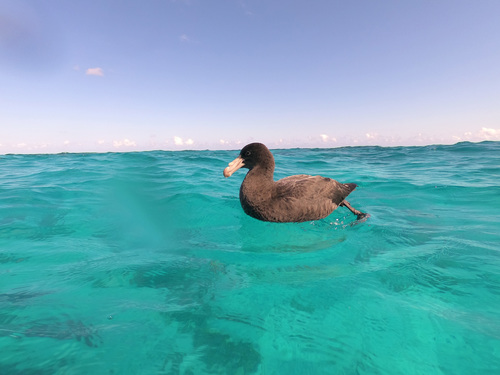
Northern Giant-Petrel (Macronectes halli) Northern Giant-Petrel

Media

Loading…

In short

The most reliable field mark to separate Southern and Northern Giant-Petrels is the color of the bill tip: Southern Giant-Petrel shows a greenish bill tip, while Northern Giant-Petrel has a reddish-brown tip. Both species are very similar in size, structure, and overall dark morph plumage, but subtle differences in head and face coloration, as well as the presence of a rare white morph in Southern, can help. Juvenile birds are particularly tricky, as both start out dark and gradually pale with age, so bill color remains the best clue at all ages. In flight and on the ground, both can look nearly identical except for these details.

Identification tips

  1. Bill tip color is the single most reliable field mark: Southern Giant-Petrel always shows a greenish bill tip, while Northern Giant-Petrel's is reddish-brown. This works for adults and immatures, but can be hard to see at distance or in poor light.
  2. White morph only in Southern: If you see a giant petrel that is nearly all white with sparse black speckles, it is a Southern Giant-Petrel (light morph). Northern does not have a white morph.
  3. Head and neck contrast in adults: Adult Southern (dark morph) tends to have a paler head, neck, and upper breast compared to the rest of the body, while Northern's head and face are only slightly paler than the body, mostly on the forehead, sides of face, and chin.
  4. Juvenile confusion: Both species' juveniles are entirely dark brown and lighten with age. In these ages, bill tip color is the only reliable mark; plumage is not diagnostic.
  5. Wing pattern in flight: There are no strong, age-specific upperwing or underwing pattern differences described between the two; both show similar mottled brown wings, but Southern may show a slightly lighter leading edge and base of inner primaries on the underside, especially in adults.
  6. Size is not reliable: Both species overlap in size and mass, and colony/sex variation makes size-based separation impossible in the field.
  7. Bill structure: Northern's bill is slightly longer on average, but this is not a reliable field mark without direct comparison.
  8. Leg color: Southern is described as having greyish-brown legs, but this is not contrasted for Northern and is not a primary field mark.
  9. Habitat overlap: Both species occur together throughout much of the southern oceans; only at the extremes of their ranges (far south for Southern, slightly north for Northern) does location help.
  10. Behavioral overlap: Both are aggressive scavengers, often seen walking on land and following ships; behavior does not separate them.
  11. Sexual/seasonal differences: Males of both species are larger, but this does not help with species ID. No clear seasonal plumage differences are described that aid separation.
  12. In poor light or at distance: If you cannot see the bill tip color, be very cautious—most field marks are subtle and unreliable without close views.
  13. When in doubt: If you cannot confirm bill tip color or see a white morph, it is often safest to leave the bird unidentified to species, especially for juveniles and immatures.

Size

Both species are among the largest petrels, with considerable overlap in size and mass. Southern Giant-Petrel averages slightly heavier (mean adult mass ~4395g) than Northern (~4185g), but this difference is not reliable in the field due to wide variation by sex and colony. Length and wingspan ranges also overlap extensively, with Southern sometimes having slightly longer wings on average, and Northern a marginally longer bill and tarsus. In practice, size is not a safe field mark for separation.

Plumage

Juvenile and immature birds of both species are initially dark brown and gradually become paler with age, making them very difficult to separate by plumage alone. For adults, Southern Giant-Petrel (dark morph) shows a paler head, neck, and upper breast compared to the rest of the body, and the leading edge of the wing and base of the inner primaries (on the underside) are lighter. The rare light morph Southern is almost entirely white with sparse black speckles, a look not found in Northern. Northern Giant-Petrel adults have a grey-brown body with a lighter forehead, sides of face, and chin, but lack the distinctly pale upper breast and neck of Southern. The most consistent difference at all ages is the bill tip color: greenish in Southern, reddish-brown in Northern.

Behaviour

Both species are strong, aggressive scavengers, often seen walking on land and feeding on carrion, and both follow ships for food. In flight, both have a hunchbacked, heavy look typical of giant petrels. There are no reliable behavioral differences for field separation, though Northern may be slightly more aggressive and is noted for sometimes killing other seabirds.

Habitat

Ranges overlap broadly, but Southern Giant-Petrel is generally found further south, while Northern is slightly more northerly. Both occur together around subantarctic islands and southern oceans, so location alone is not diagnostic unless at the extreme ends of their ranges.

Submit a better description

Use the same sections as the comparison. Your text is published immediately.

The most reliable field mark to separate Southern and Northern Giant-Petrels is the color of the bill tip: Southern Giant-Petrel shows a greenish bill tip, while Northern Giant-Petrel has a reddish-brown tip. Both species are very similar in size, structure, and overall dark morph plumage, but subtle differences in head and face coloration, as well as the presence of a rare white morph in Southern, can help. Juvenile birds are particularly tricky, as both start out dark and gradually pale with age, so bill color remains the best clue at all ages. In flight and on the ground, both can look nearly identical except for these details.

  1. Bill tip color is the single most reliable field mark: Southern Giant-Petrel always shows a greenish bill tip, while Northern Giant-Petrel's is reddish-brown. This works for adults and immatures, but can be hard to see at distance or in poor light.
  2. White morph only in Southern: If you see a giant petrel that is nearly all white with sparse black speckles, it is a Southern Giant-Petrel (light morph). Northern does not have a white morph.
  3. Head and neck contrast in adults: Adult Southern (dark morph) tends to have a paler head, neck, and upper breast compared to the rest of the body, while Northern's head and face are only slightly paler than the body, mostly on the forehead, sides of face, and chin.
  4. Juvenile confusion: Both species' juveniles are entirely dark brown and lighten with age. In these ages, bill tip color is the only reliable mark; plumage is not diagnostic.
  5. Wing pattern in flight: There are no strong, age-specific upperwing or underwing pattern differences described between the two; both show similar mottled brown wings, but Southern may show a slightly lighter leading edge and base of inner primaries on the underside, especially in adults.
  6. Size is not reliable: Both species overlap in size and mass, and colony/sex variation makes size-based separation impossible in the field.
  7. Bill structure: Northern's bill is slightly longer on average, but this is not a reliable field mark without direct comparison.
  8. Leg color: Southern is described as having greyish-brown legs, but this is not contrasted for Northern and is not a primary field mark.
  9. Habitat overlap: Both species occur together throughout much of the southern oceans; only at the extremes of their ranges (far south for Southern, slightly north for Northern) does location help.
  10. Behavioral overlap: Both are aggressive scavengers, often seen walking on land and following ships; behavior does not separate them.
  11. Sexual/seasonal differences: Males of both species are larger, but this does not help with species ID. No clear seasonal plumage differences are described that aid separation.
  12. In poor light or at distance: If you cannot see the bill tip color, be very cautious—most field marks are subtle and unreliable without close views.
  13. When in doubt: If you cannot confirm bill tip color or see a white morph, it is often safest to leave the bird unidentified to species, especially for juveniles and immatures.

Both species are among the largest petrels, with considerable overlap in size and mass. Southern Giant-Petrel averages slightly heavier (mean adult mass ~4395g) than Northern (~4185g), but this difference is not reliable in the field due to wide variation by sex and colony. Length and wingspan ranges also overlap extensively, with Southern sometimes having slightly longer wings on average, and Northern a marginally longer bill and tarsus. In practice, size is not a safe field mark for separation.

Juvenile and immature birds of both species are initially dark brown and gradually become paler with age, making them very difficult to separate by plumage alone. For adults, Southern Giant-Petrel (dark morph) shows a paler head, neck, and upper breast compared to the rest of the body, and the leading edge of the wing and base of the inner primaries (on the underside) are lighter. The rare light morph Southern is almost entirely white with sparse black speckles, a look not found in Northern. Northern Giant-Petrel adults have a grey-brown body with a lighter forehead, sides of face, and chin, but lack the distinctly pale upper breast and neck of Southern. The most consistent difference at all ages is the bill tip color: greenish in Southern, reddish-brown in Northern.

Both species are strong, aggressive scavengers, often seen walking on land and feeding on carrion, and both follow ships for food. In flight, both have a hunchbacked, heavy look typical of giant petrels. There are no reliable behavioral differences for field separation, though Northern may be slightly more aggressive and is noted for sometimes killing other seabirds.

Ranges overlap broadly, but Southern Giant-Petrel is generally found further south, while Northern is slightly more northerly. Both occur together around subantarctic islands and southern oceans, so location alone is not diagnostic unless at the extreme ends of their ranges.

Discard your changes?

You have unsaved edits. If you leave now, those changes will be lost.

Southern Giant-Petrel · Northern Giant-Petrel · My Tricky Birds