
Motmot

Sora vs Spotted Crake

Porzana carolina versus Porzana porzana

Play a quiz with Sora and Spotted Crake
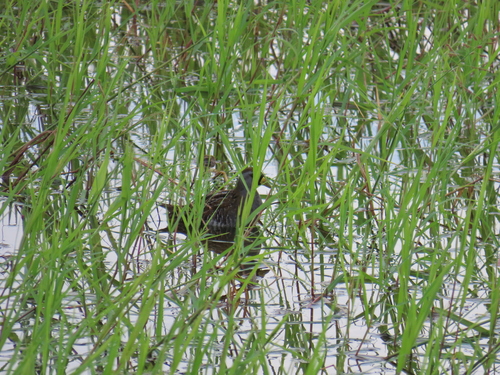
Sora (Porzana carolina) Sora
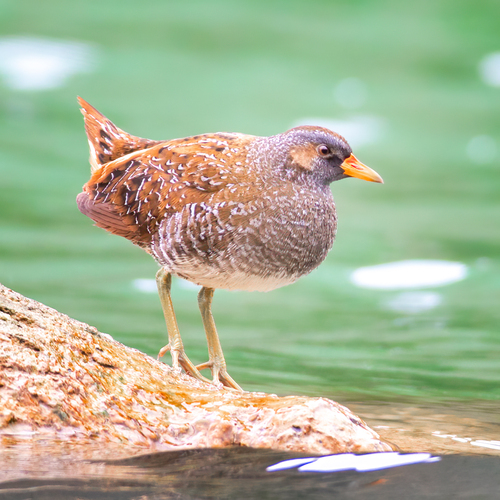
Spotted Crake (Porzana porzana) Spotted Crake

Media

Loading…

In short

The most reliable way to separate Sora from Spotted Crake is by looking for breast spots and crown streaking: Spotted Crake always shows white spots on the breast and a streaked crown stripe, while Sora lacks both, instead showing a plain face and crown. Adult Sora has a distinctive black face and throat patch, which Spotted Crake never shows. Juvenile Sora has a pale, buffy face and breast, but still lacks the breast spotting of Spotted Crake. Bill color is also helpful: Sora’s bill is short, thick, and yellow, while Spotted Crake’s is yellow with a red base. Both species are small, short-tailed rails, but Sora is slightly larger and bulkier. When in doubt, focus on the breast pattern and face details, as these are consistently diagnostic across ages.

Identification tips

  1. Breast spotting (all ages): Spotted Crake always shows white spots on the breast and flanks; Sora never does. If you see any spots on the breast, it is not a Sora.
  2. Crown stripe (all ages): Spotted Crake has a streaked crown stripe, visible even on immatures; Sora’s crown is plain.
  3. Face and throat (adults): Adult Sora has a bold black face and throat patch, with a blue-grey face. Spotted Crake never shows a black face or throat.
  4. Face and breast (juveniles): Juvenile Sora has a whitish face and buff breast, lacking black or blue-grey tones, but still lacks any breast spotting or crown streaking. Juvenile Spotted Crake is brown-faced and brown-breasted, but always with white breast spots.
  5. Bill color: Sora’s bill is short, thick, and yellow. Spotted Crake’s bill is yellow with a red base, and is a bit straighter. Bill color can be subtle in poor light but is helpful at close range.
  6. Flank pattern: Both species show barring on the flanks, but only Spotted Crake combines this with white spots; Sora’s flanks are barred black and white, without spots.
  7. Upperparts: Both have brown upperparts, but Sora’s are more dark-marked. This is not a strong separator.
  8. Tail and undertail: Spotted Crake has a short tail with buff underneath; this is subtle and not always visible. Sora’s tail is also short.
  9. Leg color: Spotted Crake has green legs with long toes; Sora’s leg color is not specified in the notes and is not a primary field mark.
  10. Size and structure: Sora is slightly larger and bulkier, but this is only apparent in direct comparison and is not reliable for lone birds.
  11. Behavior: Both species are secretive, but Sora may be seen more often near open water and is more likely to approach call broadcasts.
  12. Habitat and range: In Europe, Sora is a rare vagrant; in North America, Spotted Crake is the rarity. Use local abundance as a clue, but always confirm with plumage.
  13. Voice: Sora’s descending whinny is distinctive, but Spotted Crake’s call is not described here. Use voice for detection, not separation.
  14. Immature confusion: If you see a rail with a plain buff or whitish face and breast, but no breast spots or crown streaks, it is a juvenile Sora. If there are white spots on the breast, it is a Spotted Crake of any age.
  15. Pitfalls: Do not rely on upperpart color, general size, or leg color alone. Always check for breast spots and crown streaking first, then face/throat pattern and bill color.

Size

Both species are small rails, but Sora is generally a bit larger and bulkier. Sora measures 19–30 cm in length with a wingspan of 35–40 cm and weighs 49–112 g (though direct AVONET mass is missing), while Spotted Crake is 19–22.5 cm long and averages 80 g in mass. In the field, Sora may appear slightly more robust, but size overlap is considerable and not always reliable for separation.

Plumage

For all ages, Spotted Crake shows obvious white spots on the breast and flanks, and a streaked crown stripe. These marks are present in both adults and immatures, though the blue-grey breast of adults is replaced by brown in immatures. Sora, by contrast, never shows breast spots or a streaked crown. Adult Sora has a blue-grey face and underparts, with a distinctive black face and throat patch and black-and-white barring on the flanks. Juvenile Sora lacks the black face/throat, instead showing a whitish face and buff breast, but still never shows the breast spotting or crown streaking of Spotted Crake. Both species have brown upperparts, but Sora’s are more dark-marked. In flight or at rest, focus on the presence or absence of breast spots and the pattern of the crown for the most reliable separation.

Behaviour

Both species forage by walking or swimming in shallow water or mud, often picking at seeds, insects, or snails. Sora is more likely to be seen walking near open water, while Spotted Crake is typically more secretive in dense marsh vegetation. Both are more often heard than seen, but Sora may respond to call broadcasts by approaching the observer. There are no strong behavioral differences that are consistently diagnostic in the field.

Habitat

Both species occupy marshes and wetland habitats, but their ranges differ. Sora breeds across much of North America and migrates to the southern U.S., Caribbean, and northern South America, while Spotted Crake breeds in temperate Europe and western Asia. In western Europe, Sora is a very rare vagrant, most likely to be confused with Spotted Crake in migration periods. Habitat structure (reeds, sedge beds, shallow water) is broadly similar for both, so context is only helpful if you know the local status of each species.

Voice

Sora gives a slow, whistled "ker-whee" or a descending, squeaky "whinny". Spotted Crake’s vocalizations are not described in the provided notes, so voice is not a reliable separator here. In practice, Sora’s call is distinctive and can be used for detection, but not for separating these two species if only one is calling.

Submit a better description

Use the same sections as the comparison. Your text is published immediately.

The most reliable way to separate Sora from Spotted Crake is by looking for breast spots and crown streaking: Spotted Crake always shows white spots on the breast and a streaked crown stripe, while Sora lacks both, instead showing a plain face and crown. Adult Sora has a distinctive black face and throat patch, which Spotted Crake never shows. Juvenile Sora has a pale, buffy face and breast, but still lacks the breast spotting of Spotted Crake. Bill color is also helpful: Sora’s bill is short, thick, and yellow, while Spotted Crake’s is yellow with a red base. Both species are small, short-tailed rails, but Sora is slightly larger and bulkier. When in doubt, focus on the breast pattern and face details, as these are consistently diagnostic across ages.

  1. Breast spotting (all ages): Spotted Crake always shows white spots on the breast and flanks; Sora never does. If you see any spots on the breast, it is not a Sora.
  2. Crown stripe (all ages): Spotted Crake has a streaked crown stripe, visible even on immatures; Sora’s crown is plain.
  3. Face and throat (adults): Adult Sora has a bold black face and throat patch, with a blue-grey face. Spotted Crake never shows a black face or throat.
  4. Face and breast (juveniles): Juvenile Sora has a whitish face and buff breast, lacking black or blue-grey tones, but still lacks any breast spotting or crown streaking. Juvenile Spotted Crake is brown-faced and brown-breasted, but always with white breast spots.
  5. Bill color: Sora’s bill is short, thick, and yellow. Spotted Crake’s bill is yellow with a red base, and is a bit straighter. Bill color can be subtle in poor light but is helpful at close range.
  6. Flank pattern: Both species show barring on the flanks, but only Spotted Crake combines this with white spots; Sora’s flanks are barred black and white, without spots.
  7. Upperparts: Both have brown upperparts, but Sora’s are more dark-marked. This is not a strong separator.
  8. Tail and undertail: Spotted Crake has a short tail with buff underneath; this is subtle and not always visible. Sora’s tail is also short.
  9. Leg color: Spotted Crake has green legs with long toes; Sora’s leg color is not specified in the notes and is not a primary field mark.
  10. Size and structure: Sora is slightly larger and bulkier, but this is only apparent in direct comparison and is not reliable for lone birds.
  11. Behavior: Both species are secretive, but Sora may be seen more often near open water and is more likely to approach call broadcasts.
  12. Habitat and range: In Europe, Sora is a rare vagrant; in North America, Spotted Crake is the rarity. Use local abundance as a clue, but always confirm with plumage.
  13. Voice: Sora’s descending whinny is distinctive, but Spotted Crake’s call is not described here. Use voice for detection, not separation.
  14. Immature confusion: If you see a rail with a plain buff or whitish face and breast, but no breast spots or crown streaks, it is a juvenile Sora. If there are white spots on the breast, it is a Spotted Crake of any age.
  15. Pitfalls: Do not rely on upperpart color, general size, or leg color alone. Always check for breast spots and crown streaking first, then face/throat pattern and bill color.

Both species are small rails, but Sora is generally a bit larger and bulkier. Sora measures 19–30 cm in length with a wingspan of 35–40 cm and weighs 49–112 g (though direct AVONET mass is missing), while Spotted Crake is 19–22.5 cm long and averages 80 g in mass. In the field, Sora may appear slightly more robust, but size overlap is considerable and not always reliable for separation.

For all ages, Spotted Crake shows obvious white spots on the breast and flanks, and a streaked crown stripe. These marks are present in both adults and immatures, though the blue-grey breast of adults is replaced by brown in immatures. Sora, by contrast, never shows breast spots or a streaked crown. Adult Sora has a blue-grey face and underparts, with a distinctive black face and throat patch and black-and-white barring on the flanks. Juvenile Sora lacks the black face/throat, instead showing a whitish face and buff breast, but still never shows the breast spotting or crown streaking of Spotted Crake. Both species have brown upperparts, but Sora’s are more dark-marked. In flight or at rest, focus on the presence or absence of breast spots and the pattern of the crown for the most reliable separation.

Both species forage by walking or swimming in shallow water or mud, often picking at seeds, insects, or snails. Sora is more likely to be seen walking near open water, while Spotted Crake is typically more secretive in dense marsh vegetation. Both are more often heard than seen, but Sora may respond to call broadcasts by approaching the observer. There are no strong behavioral differences that are consistently diagnostic in the field.

Both species occupy marshes and wetland habitats, but their ranges differ. Sora breeds across much of North America and migrates to the southern U.S., Caribbean, and northern South America, while Spotted Crake breeds in temperate Europe and western Asia. In western Europe, Sora is a very rare vagrant, most likely to be confused with Spotted Crake in migration periods. Habitat structure (reeds, sedge beds, shallow water) is broadly similar for both, so context is only helpful if you know the local status of each species.

Sora gives a slow, whistled "ker-whee" or a descending, squeaky "whinny". Spotted Crake’s vocalizations are not described in the provided notes, so voice is not a reliable separator here. In practice, Sora’s call is distinctive and can be used for detection, but not for separating these two species if only one is calling.

Discard your changes?

You have unsaved edits. If you leave now, those changes will be lost.

Sora · Spotted Crake · My Tricky Birds