
Motmot

Sooty Tern vs Bridled Tern

Onychoprion fuscatus versus Onychoprion anaethetus

Play a quiz with Sooty Tern and Bridled Tern
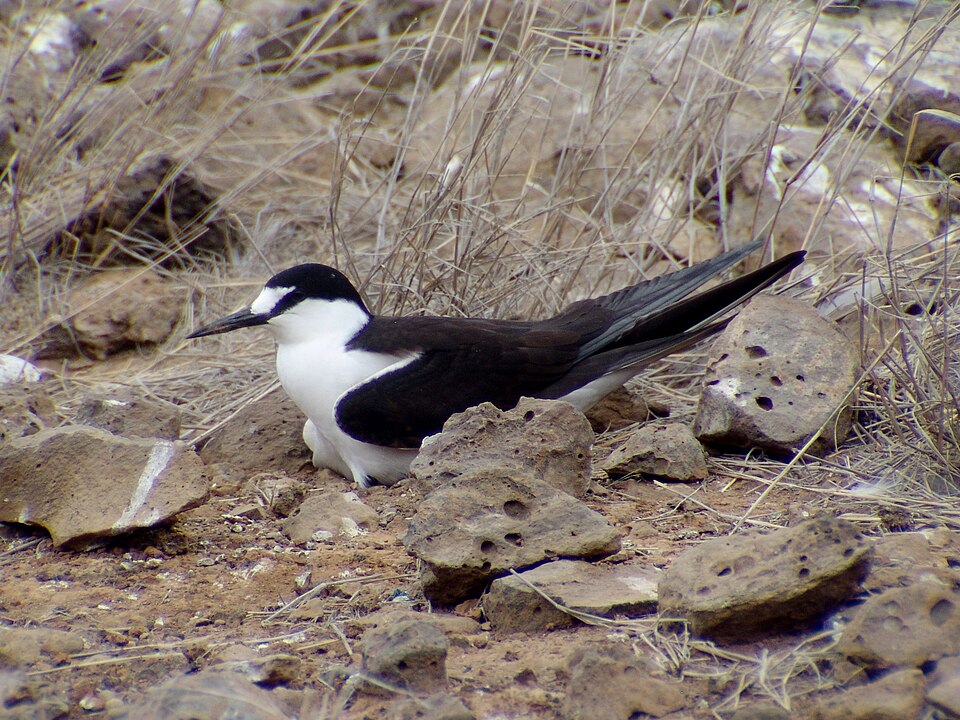
Sooty Tern (Onychoprion fuscatus) Sooty Tern
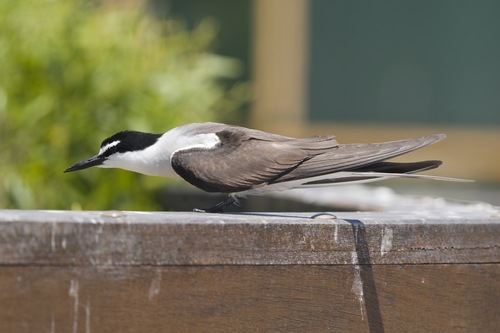
Bridled Tern (Onychoprion anaethetus) Bridled Tern

Media

Loading…

In short

The most reliable field mark between Sooty Tern and Bridled Tern is the presence of a pale hindneck collar and the shade of the upperparts: Bridled Tern shows a distinct pale collar and paler, dark grey upperparts, while Sooty Tern lacks the collar and is overall darker blackish above. Juvenile birds are especially tricky, but Sooty Tern juveniles are darker and less contrasting than Bridled Tern juveniles, which are paler below and have a more pronounced scaly pattern above. In flight or perched, check the width of the white forehead (broader in Sooty), and look for the pale collar (present only in Bridled). Size is also a clue: Sooty Tern is noticeably larger and longer-winged. These differences hold for all ages, but are most critical for separating immatures in flight.

Identification tips

  1. Pale hindneck collar: Bridled Tern shows a distinct pale collar on the hindneck in all plumages, while Sooty Tern never shows this feature. This is the single most reliable mark at any age.
  2. Upperpart shade: Sooty Tern is black to blackish-brown above, appearing much darker than Bridled Tern, which is dark grey above. This contrast is visible in all light except deep shadow.
  3. Forehead width: The white forehead patch is broader and more obvious in Sooty Tern; Bridled Tern's is narrower and more sharply defined. This is best seen on perched or close-flying birds.
  4. Juvenile pattern: Juvenile Sooty Terns are overall dark grey-black with only the lower belly whitish, and have narrow pale fringes above (scaly effect), but remain much darker than juvenile Bridled Terns, which are scaly grey above and distinctly paler below. Use this for birds in their first year, especially in flight.
  5. Tail fork: Both species have long, forked tails, but Bridled Tern's tail is more deeply forked than Sooty Tern's. This is subtle and best used in direct comparison or with experience.
  6. Bill and legs: Both species have black bills and legs, so these are not useful for separation.
  7. Size and structure: Sooty Tern is noticeably larger and more robust, with longer wings and a heavier build than Bridled Tern. This is most apparent when both are seen together, but can be judged with experience.
  8. Flight jizz: Sooty Tern often appears more powerful and direct in flight, while Bridled Tern may seem lighter and more buoyant. This is a supporting mark, not primary.
  9. Plumage contrast: Bridled Tern shows more contrast between the paler underparts and the darker upperparts, especially in juveniles and immatures. Sooty Tern is more uniformly dark above and below, except for the white forehead and underparts.
  10. Voice: If heard, Sooty Tern's loud 'wide-a-wake' call is distinctive and not matched by Bridled Tern.
  11. Habitat context: Sooty Tern is almost never found inland except after storms, while Bridled Tern may occasionally be seen closer to shore or on smaller islets.
  12. Colony size: Sooty Tern colonies are often much larger than those of Bridled Tern, but this is only useful at breeding sites.
  13. Feeding behavior: Sooty Tern typically skims the surface for food, while Bridled Tern is more likely to plunge-dive. This is subtle and not always observable.
  14. Pitfalls: Immature birds in flight are the most frequent source of confusion; always check for the pale collar and the overall darkness of the upperparts. Beware of lighting conditions that can make Bridled Tern appear darker than it is.
  15. Season and sex: No significant seasonal or sexual dimorphism is noted in either species, so all marks apply year-round and to both sexes.

Size

Sooty Tern is the larger species, measuring 36–45 cm in length with an 82–94 cm wingspan, while Bridled Tern is smaller at 30–32 cm in length and a 77–81 cm wingspan [wikipedia]. Sooty Tern is not only longer but also has proportionally longer wings and a more robust structure compared to the more lightly built Bridled Tern. This size difference is often apparent when both species are seen together, but may be subtle at a distance or in isolation.

Plumage

Juvenile and immature birds are best separated by their upperpart color and pattern: juvenile Sooty Terns are dark grey-black above and below with narrow pale fringes on the upperparts, giving a scaly effect, but are overall much darker than juvenile Bridled Terns, which are scaly grey above and distinctly paler below. Adult Sooty Terns have black to dark blackish-brown upperparts, clean white underparts, and a broad white forehead, but lack any pale collar on the hindneck. Adult Bridled Terns are paler above (dark grey, not black), have a narrower white forehead, and show a conspicuous pale collar on the hindneck. Both species have long wings and forked tails, but the Sooty Tern's tail is less deeply forked than Bridled's. In all plumages, the presence or absence of the pale collar and the shade of the upperparts are the most consistent marks.

Behaviour

Both species are highly pelagic and only come to land to breed, but Sooty Tern is even more strictly marine, rarely coming to land except at colonies and spending years at sea. Sooty Tern is more likely to be seen in large flocks, often skimming the ocean surface for food, and is less likely to be seen plunge-diving. Bridled Tern also feeds at sea but is more likely to be seen plunge-diving for fish and may use a wider variety of feeding strategies, including picking from the surface. Both nest in colonies on rocky or coral islands, but Sooty Tern colonies are often larger.

Habitat

Both species breed on tropical oceanic islands, nesting in ground scrapes or holes. Sooty Tern is almost exclusively marine and is rarely seen inland except after storms, while Bridled Tern, though also pelagic, may be encountered closer to shore or on smaller islets. Both are rare vagrants outside their normal range, but Sooty Tern is even less likely to be found away from the open ocean.

Voice

Sooty Tern has a loud, piercing 'wide-a-wake' or 'ker-wack-a-wack' call, along with a harsh alarm 'kvaark'. No distinctive vocalization is described for Bridled Tern in the provided notes, so voice is not a strong separator unless Sooty Tern's loud calls are heard.

Submit a better description

Use the same sections as the comparison. Your text is published immediately.

The most reliable field mark between Sooty Tern and Bridled Tern is the presence of a pale hindneck collar and the shade of the upperparts: Bridled Tern shows a distinct pale collar and paler, dark grey upperparts, while Sooty Tern lacks the collar and is overall darker blackish above. Juvenile birds are especially tricky, but Sooty Tern juveniles are darker and less contrasting than Bridled Tern juveniles, which are paler below and have a more pronounced scaly pattern above. In flight or perched, check the width of the white forehead (broader in Sooty), and look for the pale collar (present only in Bridled). Size is also a clue: Sooty Tern is noticeably larger and longer-winged. These differences hold for all ages, but are most critical for separating immatures in flight.

  1. Pale hindneck collar: Bridled Tern shows a distinct pale collar on the hindneck in all plumages, while Sooty Tern never shows this feature. This is the single most reliable mark at any age.
  2. Upperpart shade: Sooty Tern is black to blackish-brown above, appearing much darker than Bridled Tern, which is dark grey above. This contrast is visible in all light except deep shadow.
  3. Forehead width: The white forehead patch is broader and more obvious in Sooty Tern; Bridled Tern's is narrower and more sharply defined. This is best seen on perched or close-flying birds.
  4. Juvenile pattern: Juvenile Sooty Terns are overall dark grey-black with only the lower belly whitish, and have narrow pale fringes above (scaly effect), but remain much darker than juvenile Bridled Terns, which are scaly grey above and distinctly paler below. Use this for birds in their first year, especially in flight.
  5. Tail fork: Both species have long, forked tails, but Bridled Tern's tail is more deeply forked than Sooty Tern's. This is subtle and best used in direct comparison or with experience.
  6. Bill and legs: Both species have black bills and legs, so these are not useful for separation.
  7. Size and structure: Sooty Tern is noticeably larger and more robust, with longer wings and a heavier build than Bridled Tern. This is most apparent when both are seen together, but can be judged with experience.
  8. Flight jizz: Sooty Tern often appears more powerful and direct in flight, while Bridled Tern may seem lighter and more buoyant. This is a supporting mark, not primary.
  9. Plumage contrast: Bridled Tern shows more contrast between the paler underparts and the darker upperparts, especially in juveniles and immatures. Sooty Tern is more uniformly dark above and below, except for the white forehead and underparts.
  10. Voice: If heard, Sooty Tern's loud 'wide-a-wake' call is distinctive and not matched by Bridled Tern.
  11. Habitat context: Sooty Tern is almost never found inland except after storms, while Bridled Tern may occasionally be seen closer to shore or on smaller islets.
  12. Colony size: Sooty Tern colonies are often much larger than those of Bridled Tern, but this is only useful at breeding sites.
  13. Feeding behavior: Sooty Tern typically skims the surface for food, while Bridled Tern is more likely to plunge-dive. This is subtle and not always observable.
  14. Pitfalls: Immature birds in flight are the most frequent source of confusion; always check for the pale collar and the overall darkness of the upperparts. Beware of lighting conditions that can make Bridled Tern appear darker than it is.
  15. Season and sex: No significant seasonal or sexual dimorphism is noted in either species, so all marks apply year-round and to both sexes.

Sooty Tern is the larger species, measuring 36–45 cm in length with an 82–94 cm wingspan, while Bridled Tern is smaller at 30–32 cm in length and a 77–81 cm wingspan [wikipedia]. Sooty Tern is not only longer but also has proportionally longer wings and a more robust structure compared to the more lightly built Bridled Tern. This size difference is often apparent when both species are seen together, but may be subtle at a distance or in isolation.

Juvenile and immature birds are best separated by their upperpart color and pattern: juvenile Sooty Terns are dark grey-black above and below with narrow pale fringes on the upperparts, giving a scaly effect, but are overall much darker than juvenile Bridled Terns, which are scaly grey above and distinctly paler below. Adult Sooty Terns have black to dark blackish-brown upperparts, clean white underparts, and a broad white forehead, but lack any pale collar on the hindneck. Adult Bridled Terns are paler above (dark grey, not black), have a narrower white forehead, and show a conspicuous pale collar on the hindneck. Both species have long wings and forked tails, but the Sooty Tern's tail is less deeply forked than Bridled's. In all plumages, the presence or absence of the pale collar and the shade of the upperparts are the most consistent marks.

Both species are highly pelagic and only come to land to breed, but Sooty Tern is even more strictly marine, rarely coming to land except at colonies and spending years at sea. Sooty Tern is more likely to be seen in large flocks, often skimming the ocean surface for food, and is less likely to be seen plunge-diving. Bridled Tern also feeds at sea but is more likely to be seen plunge-diving for fish and may use a wider variety of feeding strategies, including picking from the surface. Both nest in colonies on rocky or coral islands, but Sooty Tern colonies are often larger.

Both species breed on tropical oceanic islands, nesting in ground scrapes or holes. Sooty Tern is almost exclusively marine and is rarely seen inland except after storms, while Bridled Tern, though also pelagic, may be encountered closer to shore or on smaller islets. Both are rare vagrants outside their normal range, but Sooty Tern is even less likely to be found away from the open ocean.

Sooty Tern has a loud, piercing 'wide-a-wake' or 'ker-wack-a-wack' call, along with a harsh alarm 'kvaark'. No distinctive vocalization is described for Bridled Tern in the provided notes, so voice is not a strong separator unless Sooty Tern's loud calls are heard.

Discard your changes?

You have unsaved edits. If you leave now, those changes will be lost.

Sooty Tern · Bridled Tern · My Tricky Birds