

Social Flycatcher vs Blue-black Grassquit
Myiozetetes similis versus Volatinia jacarina
Play a quiz with Social Flycatcher and Blue-black Grassquit
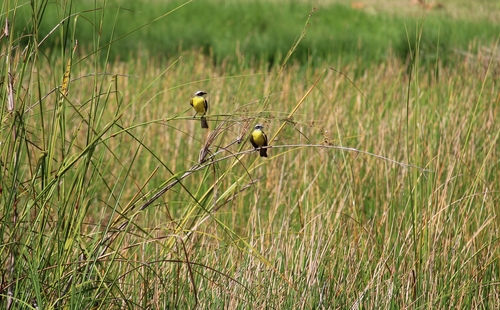 Social Flycatcher
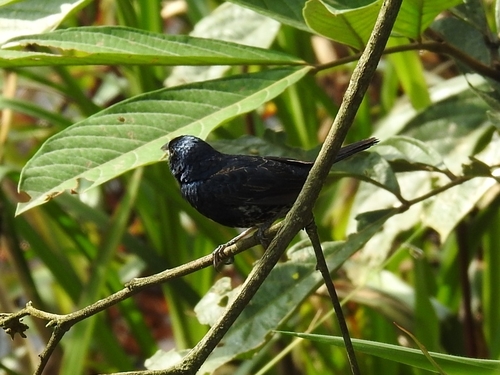 Blue-black Grassquit
In short
Juvenile and female Blue-black Grassquits show brown, streaked plumage with two faint wingbars, while Social Flycatchers of all ages have olive-brown upperparts, a bold white supercilium, and yellow underparts. In flight, adult male Grassquits flash white underwing patches (often visible only in flight), which Social Flycatchers lack. Social Flycatchers are much larger, with a robust, stubby bill and a distinctly patterned face, while Grassquits are small, short-tailed, and conical-billed. If you see a small, sparrow-like bird in weedy grasslands, it's likely a Grassquit; a larger, boldly marked flycatcher in open woodland or edge is the Social Flycatcher.
Identification tips
- Size and shape: Social Flycatcher is much larger and bulkier than Blue-black Grassquit; use this as a first check if both are present.
- Bill shape: Social Flycatcher has a broad, stubby, flycatcher bill; Grassquit's bill is sharply conical and seed-eater-like. This is especially useful at close range.
- Supercilium: Social Flycatcher always shows a bold white supercilium extending well past the eye; Grassquit never shows a strong supercilium—females/juveniles may have a faint pale eyebrow, but never as bold or extensive.
- Underpart color: Social Flycatcher has bright yellow underparts (all ages); Grassquit females/juveniles are buffy or cinnamon below with streaks, and males are solid black.
- Wingbars: Both can show faint wingbars, but in Grassquit these are on a brown background and are most obvious in females/juveniles; in Social Flycatcher, the wingbars are on a grayish-brown wing and are usually fainter, sometimes absent.
- Crown patch: Social Flycatcher adults may show a hidden red/orange crown patch (rarely visible); Grassquit never shows any crown color.
- Upperparts: Social Flycatcher is olive to brownish-olive above; Grassquit females/juveniles are warm brown with faint streaks, males are glossy black.
- Tail: Social Flycatcher has a deep grayish-brown tail with pale olive edges; Grassquit has a brown (females/juveniles) or black (males) tail, sometimes with buff tips in young birds.
- Flight marks: Only Blue-black Grassquit (especially adult males) shows a white patch at the base of the underwing, visible in flight; Social Flycatcher never shows this.
- Juvenile confusion: Juvenile Grassquits are more streaked below and have darker wings/tail than adult females; Social Flycatcher juveniles are like adults but with rufous in the wings/tail and little/no crown color.
- Perched posture: Social Flycatcher often perches upright and conspicuously on exposed branches; Grassquit is more likely to be low in grass or shrubs, sometimes on the ground.
- Habitat context: In open grassy or weedy fields, especially with low vegetation, suspect Grassquit; in areas with trees, wires, or forest edge, suspect Social Flycatcher.
- Sexual dimorphism: Grassquit is sexually dimorphic—males are glossy black, females/juveniles brown and streaked; Social Flycatcher sexes are alike.
- Behavior: Social Flycatcher sallies for insects; Grassquit males may perform display jumps in breeding season.
- Iris and legs: Both have brown irises; Social Flycatcher has black legs, Grassquit's legs are various shades of gray (not reliably diagnostic in the field).
Size
Social Flycatcher is substantially larger (16–18.5 cm, 24–27 g) than Blue-black Grassquit (8.7–10.9 cm, 8–12 g) [wikipedia]. The Flycatcher is nearly twice as long and more than double the mass. In the field, Social Flycatcher appears as a medium-sized, robust flycatcher, while the Grassquit is a tiny, finch-like bird. Bill structure also differs: Social Flycatcher has a stubby, broad-based bill typical of flycatchers, whereas Grassquit has a longish, sharply conical bill suited for seed-eating.
Plumage
- Juveniles and females (most confusion): Blue-black Grassquit juveniles and females are warm brown above with faint darker streaks and two pale wingbars, brown wings with buffy tertial edges, and buffy underparts with a streaked breast and flanks. Social Flycatcher juveniles are olive to brownish-olive above, with little or no crown color and wider rufous edges on the wing and tail, but always with a bold white supercilium and yellow underparts. Grassquit juveniles have more streaking below and darker wings/tail than adult females.
- Adult males: Blue-black Grassquit males are glossy black with blue iridescence, lacking any facial pattern, and show a white underwing patch in flight. Social Flycatcher adults are olive-brown above, with a dark grayish head, bold white supercilium, hidden red/orange crown patch, and bright yellow underparts. Their wings are deep grayish brown with pale edges, sometimes showing two faint wingbars.
- In flight: Only Grassquit (especially males) shows a white patch at the base of the underwing, visible in flight. Social Flycatcher never shows this. Juvenile Grassquits have more streaked underparts and darker wings/tail than adults; Social Flycatcher juveniles are similar to adults but with rufous in the wings/tail.
Behaviour
Social Flycatcher often perches conspicuously on exposed branches or wires, sallying out to catch insects in typical flycatcher fashion. It is usually seen singly or in pairs, sometimes in small groups, and is quite vocal and active. Blue-black Grassquit is more often seen in weedy fields or grassy edges, frequently on or near the ground, and males may perform display flights (jumping up and down) during breeding season. Grassquits are less conspicuous when perched and tend to stay low in vegetation.
Habitat
Social Flycatcher prefers open woodland, forest edges, gardens, and semi-open areas with scattered trees, often near water. Blue-black Grassquit is found in shrubby weedy fields, open thickets, grassy fields, pastures, agricultural land, and roadsides—generally more open, grassy, and disturbed habitats. Overlap can occur at edges, but Social Flycatcher is more arboreal and associated with trees, while Grassquit is more terrestrial and associated with grass or low shrubs.