

Snow Goose vs Lesser White-fronted Goose
Anser caerulescens versus Anser erythropus
Play a quiz with Snow Goose and Lesser White-fronted Goose
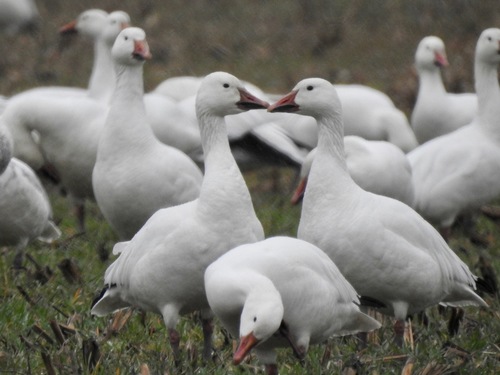 Snow Goose
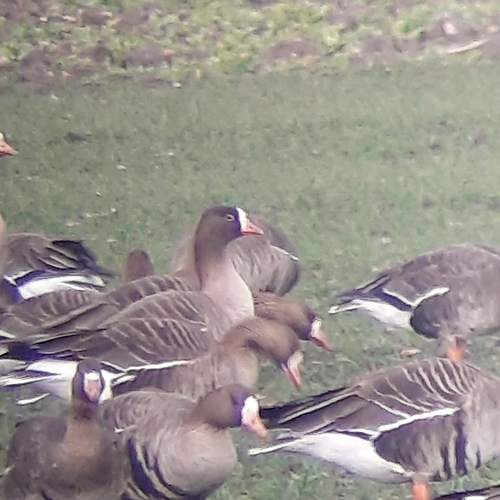 Lesser White-fronted Goose
In short
The most reliable way to separate Snow Goose from Lesser White-fronted Goose is by overall plumage and bill structure: Snow Goose (especially the white morph) is almost entirely white with black wingtips and a thick pink bill, while Lesser White-fronted Goose is gray-brown with a white face blaze, orange legs, and a much smaller, stubby bill. Juvenile Snow Geese, especially of the blue morph, can appear grayish but lack the distinctive white facial blaze and yellow eye-ring of adult Lesser White-fronted Goose. Size is also a strong clue: Snow Goose is noticeably larger and bulkier. In flight, Snow Goose shows a striking black-and-white wing pattern, while Lesser White-fronted Goose has mouse-gray upperwing coverts and lacks the sharp contrast. Both species can occur in mixed goose flocks, but their structure and plumage differences are usually clear at moderate range.
Identification tips
- White facial blaze and yellow eye-ring (adult Lesser White-fronted Goose): Look for the bold white blaze extending up to the crown and a yellow eye-ring—these are never present on Snow Goose of any age or morph.
- Overall plumage color: Adult Snow Goose (white morph) is almost entirely white with black wingtips; blue morph is bluish-gray with white only on the head, neck, and tail tip. Lesser White-fronted Goose is gray-brown with a white face and black belly bars.
- Bill structure: Snow Goose has a thick, long, pink bill with a black 'grin patch'; Lesser White-fronted Goose has a much shorter, stubby pink bill, lacking the grin patch.
- Leg color: Both species have colorful legs, but Snow Goose's are rose-red (duller in immatures), while Lesser White-fronted Goose's are bright orange.
- Wing pattern in flight: Snow Goose (all ages) shows a bold black-and-white pattern with black primaries and white coverts; Lesser White-fronted Goose has mouse-gray upperwing coverts and lacks this sharp contrast.
- Juvenile confusion: Juvenile blue-morph Snow Geese are drab gray and can look superficially similar to gray geese, but they lack the white facial blaze, yellow eye-ring, and black belly bars of Lesser White-fronted Goose.
- Belly bars: Lesser White-fronted Goose has broad black bars across the belly (adults), absent in all Snow Geese.
- Size and shape: Snow Goose is much larger and bulkier, with a longer neck and bigger head; Lesser White-fronted Goose is compact, short-necked, and mallard-sized.
- Head shape: Snow Goose has a more wedge-shaped head and thicker neck; Lesser White-fronted Goose's head is rounder and smaller in proportion.
- Vocalizations: Snow Goose is very noisy with loud honking; Lesser White-fronted Goose is quieter and higher-pitched.
- Feeding flocks: Snow Goose often forms massive, noisy flocks in open fields; Lesser White-fronted Goose usually occurs in smaller, quieter groups.
- Habitat context: In North America, a white goose with black wingtips is almost certainly a Snow Goose; in Eurasia, a small gray goose with a white face and orange legs is likely Lesser White-fronted Goose.
- Bill color in immatures: Immature Snow Geese have duller pink bills and legs, but still show the grin patch; Lesser White-fronted Goose immatures retain the short bill and orange legs.
- Rusty head stains: Snow Goose may show rusty staining on the head from feeding, but this does not create a facial blaze.
- Mixed flocks: If seen in a mixed flock with other geese, compare size and bill shape carefully—Snow Goose will stand out as larger and heavier, while Lesser White-fronted Goose will be among the smallest and most compact.
Size
Snow Goose is substantially larger and heavier than Lesser White-fronted Goose. Adult Snow Goose averages about 2630 g in mass, with a length of 64–79 cm and a wingspan of 135–165 cm. In contrast, Lesser White-fronted Goose averages 1797 g, is much shorter at 53–66 cm, and has a wingspan of 120–135 cm. This means Snow Goose is bulkier, taller, and longer-winged—often standing out in mixed flocks. The size gap is especially obvious when both are seen together, but even singly, Snow Goose looks more robust and heavy-bodied.
Plumage
Juvenile and immature Snow Geese (especially blue morphs) can be confusing, as they are drab or slate-gray with little white on the head, neck, or belly. However, they still lack the white facial blaze and yellow eye-ring of adult Lesser White-fronted Goose. Adult Snow Goose (white morph) is almost entirely white except for black wingtips, while blue morph adults are bluish-gray with white only on the head, neck, and tail tip. Both morphs have pink bills with a black 'grin patch' and rose-red legs and feet (duller in immatures). Lesser White-fronted Goose is gray-brown overall with a very conspicuous white blaze extending up to the crown, a yellow eye-ring, and broad black belly bars. Its upperwing coverts are mouse-gray, not bluish or white, and the legs are bright orange. The bill is short and stubby, unlike the longer, thicker bill of Snow Goose. In flight, Snow Goose shows a bold black-and-white pattern with black primaries and white coverts; Lesser White-fronted Goose's wings are more uniformly grayish, lacking this contrast.
Behaviour
Both species feed in flocks, especially outside the breeding season. Snow Goose is highly vocal and can be heard from a long distance, often forming very large, noisy flocks. Lesser White-fronted Goose is generally quieter and tends to occur in smaller groups, especially in its European range. Snow Goose often feeds on agricultural fields in winter, while Lesser White-fronted Goose is more likely to be found in natural wetlands or tundra, though both may overlap in some migration stopovers.
Habitat
Snow Goose is native to North America and is most often found in large flocks on open fields, marshes, and agricultural lands, particularly in winter. Lesser White-fronted Goose breeds in the northernmost Palearctic and is a scarce breeder in Europe, favoring tundra and wetland habitats. While both can be seen in migration or wintering areas with other geese, their typical ranges only overlap as vagrants or in captivity. Habitat alone is not always diagnostic, but Snow Goose is much more likely in North America, while Lesser White-fronted Goose is a Eurasian species.
Voice
Snow Goose is very vocal, with loud, nasal honking calls that carry over long distances. Lesser White-fronted Goose is generally quieter, with higher-pitched, less far-carrying calls. Voice can help in large flocks or at a distance, but is less reliable than plumage and structure for separation.