

Slaty-tailed Trogon vs Mountain Trogon
Trogon massena versus Trogon mexicanus
Play a quiz with Slaty-tailed Trogon and Mountain Trogon
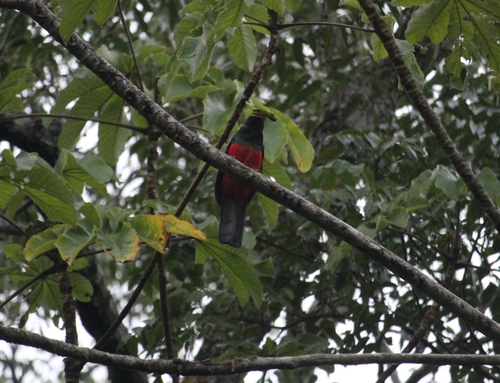 Slaty-tailed Trogon
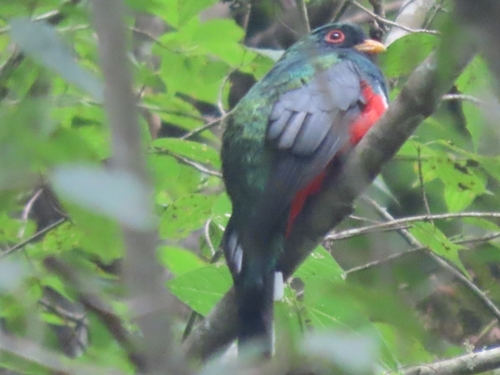 Mountain Trogon
In short
The most reliable field mark between Slaty-tailed Trogon and Mountain Trogon is the bill color in adult males: Slaty-tailed has a bright orange-red bill, while Mountain Trogon shows a bright yellow bill. In both sexes, the Slaty-tailed is much heavier and bulkier, with a distinctly slaty-gray undertail and tail, while Mountain Trogon is slimmer and has bold white blocks on the undertail (male) or black-and-white barring (female). Females are best separated by overall color: Slaty-tailed is gray above and below, Mountain is warm brown with a rufous-brown tail and prominent white facial crescents. Both species are sexually dimorphic, but their tail and bill patterns are the most practical field marks for all ages.
Identification tips
- Bill color (adult males): Slaty-tailed Trogon has a bright orange-red bill; Mountain Trogon male has a bright yellow bill. This is the fastest and most reliable mark in good light.
- Tail pattern (adult males): Slaty-tailed has a metallic green to bronzy uppertail with black tips and a uniform slaty gray undertail; Mountain Trogon has a bluish-green uppertail with black tips and a black undertail marked by three large white blocks (white tips to outer rectrices).
- Tail pattern (females): Slaty-tailed female has a black uppertail and uniform gray undertail; Mountain Trogon female has a rufous-brown uppertail and a black-and-white barred undertail with broad white tips on the inner webs.
- Facial markings (females): Mountain Trogon female shows a bold white crescent before and behind the eye, which Slaty-tailed lacks.
- Overall color (females): Slaty-tailed female is plain gray above and below, paler on the breast; Mountain Trogon female is warm brown above and on the chest, with a paler brown lower chest and red belly.
- White chest band (both sexes): Mountain Trogon of both sexes has a narrow white band separating the green (male) or brown (female) chest from the red belly; Slaty-tailed lacks this band, with green (male) or gray (female) blending directly into the red belly.
- Wing vermiculation: Both species have blackish primaries and white vermiculations on the wing coverts, but Mountain Trogon female's white streaks are more obvious on the folded wing, while Slaty-tailed's appear grayer and less distinct at a distance.
- Size and structure: Slaty-tailed is much heavier and bulkier (about twice the mass), with a stouter body and bill; Mountain Trogon is slimmer and lighter. This is most useful when seen together or with experience.
- Habitat and elevation: Slaty-tailed is a lowland to foothill species, rarely above 1,400 m; Mountain Trogon is a montane species, usually above 900 m. If seen in true montane pine-oak forest, Mountain Trogon is far more likely.
- Sexual dimorphism: Both species are strongly dimorphic, but the combination of bill color, tail pattern, and overall color is diagnostic for both sexes.
- Immature birds: No specific immature or juvenile wing or flight patterns are described; rely on tail and bill patterns, which are generally adult-like in young birds.
- Perched vs. flight views: Tail and undertail pattern are visible both perched and in flight, but bill color is easiest to see when perched or at close range.
- Common pitfalls: In poor light, the bill color can be hard to judge; focus on tail pattern and overall color. Females are often confused, but Mountain Trogon's warm brown and white facial crescents are distinctive.
- Not diagnostic: Voice is not described as a useful separation in these sources.
- Range overlap: If in doubt, consider elevation and habitat first—Slaty-tailed is almost never in true montane forest, Mountain Trogon rarely in lowland rainforest.
Size
Slaty-tailed Trogon is significantly larger and heavier, averaging about 141 g and 30–35.5 cm in length, while Mountain Trogon is much lighter (mean 71 g, range 61.5–85 g) and slightly shorter (29–31.5 cm). In the field, Slaty-tailed appears bulkier with a stouter build, while Mountain Trogon is more slender and less robust. This size difference is often apparent when seen side by side or with experience, but can be subtle if seen alone.
Plumage
- Adult males: Slaty-tailed Trogon males have a metallic green upperpart with a golden or bluish sheen, a dull black face and throat, a bright orange-red bill, and a deep red belly. Their tail is metallic green to bronzy above with black tips, and the entire undertail is slaty gray with black tips. Mountain Trogon males have a metallic green crown, nape, and upperparts, a blackish face and throat, a bright yellow bill, and a red belly separated from the green chest by a narrow white band. Their uppertail is bluish-green with black tips, and the undertail is black with three large white blocks (white tips to the outer rectrices).
- Adult females: Slaty-tailed females are gray above and below, with a paler gray breast, a dusky gray bill, and a black uppertail. Mountain Trogon females are warm brown above and on the chest, with a rufous-brown uppertail, bold white crescents before and behind the eye, and a narrow white band separating brown chest from red belly. Their undertail is black and white barred, with broad white tips on the inner webs of the rectrices.
- Wings (both sexes): Both species show blackish primaries with white vermiculations on the wing coverts, but Mountain Trogon females have more obvious white streaks along the folded wing, while Slaty-tailed's vermiculations appear more gray at a distance.
- Juvenile/immature plumage: No specific juvenile/immature wing or flight pattern differences are described in the sources; separation relies on adult-like tail and bill patterns even in young birds.
Behaviour
Both species are typical trogons, often perching quietly in the midstory or canopy, rarely sallying for fruit or insects. Slaty-tailed Trogon may appear more sluggish and heavy, while Mountain Trogon is slightly more active and can be seen moving through montane forest edges. Neither species is especially conspicuous in flight, but the heavier build of Slaty-tailed may be apparent when flushed.
Habitat
Slaty-tailed Trogon is a lowland and foothill species, found from sea level up to 600–1,400 m depending on region, primarily in tropical evergreen forests, mature secondary forests, gallery forests, coffee plantations, and mangroves. Mountain Trogon is restricted to higher elevations (914–3,048 m), favoring subtropical and tropical moist montane forests, especially pine-evergreen and pine-oak woodlands, and sometimes shade coffee plantations with oaks. Overlap in range is minimal, but confusion can occur in foothill zones where both might be possible.