

Silver Teal vs White-cheeked Pintail
Spatula versicolor versus Anas bahamensis
Play a quiz with Silver Teal and White-cheeked Pintail
 Silver Teal
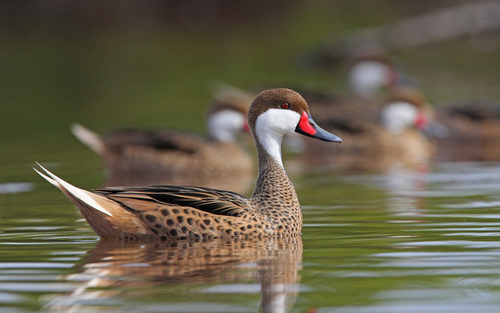 White-cheeked Pintail
In short
The most reliable field mark to separate Silver Teal from White-cheeked Pintail is the bold white cheeks of the pintail, which contrast with the Silver Teal’s dark face and black cap extending below the eyes. In flight or at rest, both have a green speculum, but the Silver Teal’s is bordered with white, while the pintail’s is not described as such. Bill color is also helpful: Silver Teal has a bluish bill with a yellow tip, while White-cheeked Pintail shows a red-based grey bill. Juvenile and female plumages are duller in both, but the cheek and bill patterns remain diagnostic. Structure can help: the pintail has a more slender, pointed tail, though not as extreme as Northern Pintail. Size is similar, but Silver Teal is slightly lighter on average.
Identification tips
- Face pattern is key: White-cheeked Pintail always shows bold white cheeks, contrasting with a brown head and body. Silver Teal never shows this; instead, it has a black cap that extends below the eyes, giving a masked look. This is the most reliable mark at all ages and seasons.
- Bill color: Silver Teal has a bluish bill with a yellow tip, while White-cheeked Pintail has a red-based grey bill (juveniles duller). Bill color is visible at close range and can be diagnostic, especially in good light.
- Speculum and wing pattern: Both have a green speculum, but Silver Teal’s is bordered with white, while the pintail’s is not described as such. Look for the white border on the speculum in flight or when the wing is stretched.
- Tail shape: White-cheeked Pintail has a more slender, pointed tail, though not as long as Northern Pintail. Silver Teal’s tail is more typical for a teal, shorter and less pointed. This is most obvious when the birds are swimming or preening.
- Overall coloration: Silver Teal appears darker-faced and more contrasting, while White-cheeked Pintail is generally brown with white cheeks. Females and juveniles of both are duller, but the cheek and bill patterns remain.
- Sex and age differences: Both species have similar sexes, with females slightly duller. Juvenile pintails have duller bills, but white cheeks are still present. Silver Teal females have less yellow at the bill base, but the face pattern remains.
- Size: Pintail is somewhat heavier on average, but overlap is substantial. Do not rely on size unless birds are side by side.
- Habitat context: Both can occur in similar habitats, but pintail is more widespread, especially in the Caribbean and on islands. Silver Teal is more tied to reed beds during breeding.
- Behavior: Both dabble for food; behavior is not a strong separator.
- Pitfalls: Do not confuse the white-bordered speculum of Silver Teal with the white cheeks of the pintail. In poor light, the pintail’s white cheeks may look less distinct, but the lack of a black cap is still clear.
- In flight: Look for the white-bordered green speculum in Silver Teal and the pointed tail in pintail. Face pattern can be seen in good light even in flight.
- Perched/swimming: Face and bill color are easiest to see when birds are at rest or swimming.
- No voice difference: No vocalization differences are described in the sources.
- Escapees: Pintails are popular in collections and may be seen as escapees in non-native areas, sometimes in leucistic (whitish) forms—do not confuse these with Silver Teal.
- Subspecies variation: Pintail subspecies differ mainly in size and dullness of plumage, but all have white cheeks.
Size
Silver Teal averages 410 g in body mass [wikidata], while White-cheeked Pintail subspecies range from about 474–710 g for males and 505–670 g for females [wikipedia]. This means the pintail is generally a bit heavier and possibly slightly larger, but the difference may not be obvious in the field unless birds are side by side. Both are medium-sized dabbling ducks, so size alone is not a strong field mark.
Plumage
Juvenile and adult Silver Teal have a black cap that extends below the eyes, giving the face a dark, masked look. Their bill is bluish with a yellow tip, and the green speculum is bordered by white. Females are slightly duller, with less yellow at the bill base. In contrast, White-cheeked Pintail of all ages has prominent white cheeks set off against a mainly brown body, and a red-based grey bill (juveniles have a duller bill). The pintail also has a green speculum, but without mention of a white border. The tail is more pointed in the pintail, a feature visible in flight or when swimming. Both sexes are similar, but females are slightly duller in both species. Juvenile pintails have duller bills, but the white cheeks remain clear.
Behaviour
Both species are dabbling ducks and feed by tipping up for aquatic plants and invertebrates. White-cheeked Pintail is noted for feeding on Ruppia and other aquatic vegetation, and is also known to nest on the ground under vegetation near water. Silver Teal prefers reed beds during the breeding season. Both are generally seen in small groups or pairs, and their behavior is typical of dabbling ducks. No major behavioral differences are highlighted in the sources.
Habitat
Both species are found in South America, often in wetlands, lakes, and marshes. Silver Teal prefers reed beds, especially during breeding (April–June), while White-cheeked Pintail is more patchily distributed, occurring in South America and the Caribbean, and is sometimes found on islands such as the Galápagos. Both nest near water, but the pintail is more likely to be encountered in a wider variety of wetland habitats, including brackish lagoons.