

Silver-backed Needletail vs Brown-backed Needletail
Hirundapus cochinchinensis versus Hirundapus giganteus
Play a quiz with Silver-backed Needletail and Brown-backed Needletail
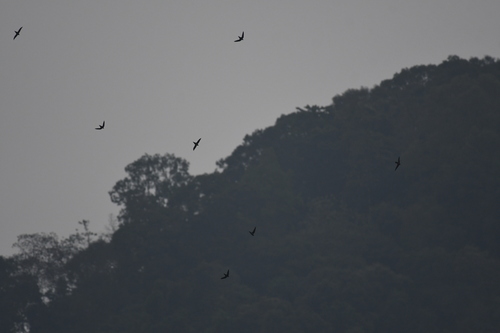 Silver-backed Needletail
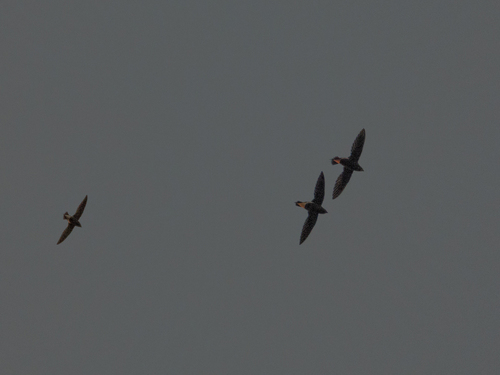 Brown-backed Needletail
In short
The most reliable field mark between Silver-backed and Brown-backed Needletails is size: Brown-backed is nearly twice as heavy and visibly bulkier in flight. Both species are large, dark swifts with white undertails and similar overall shape, but Brown-backed Needletail is the largest swift in its range, with a heavy, barrel-shaped body and especially prominent tail spines. Silver-backed is smaller and less robust, with a paler back. In the field, look for the Brown-backed's sheer bulk and darker, browner upperparts compared to the more silvery-gray back of Silver-backed. Both species are fast-flying aerial insectivores, so most views will be in flight.
Identification tips
- Size is the clearest separator: Brown-backed Needletail is nearly twice as heavy as Silver-backed and appears much bulkier and longer-winged in flight. Use this especially when seen with other swifts for scale.
- Back color: Silver-backed has a distinctly silvery-gray back, contrasting with the rest of its dark plumage. Brown-backed is uniformly dark brown above, lacking any silvery or pale area.
- Tail spines: Brown-backed Needletail's tail spines are more prominent and visible in good views, especially when the bird fans its tail.
- Body shape in flight: Brown-backed shows a heavy, barrel-chested profile, while Silver-backed is slimmer and more streamlined.
- Undertail pattern: Both species have white undertail coverts, but Brown-backed's white extends more onto the flanks. In Silver-backed, the white is more confined to the undertail.
- Flight style: Brown-backed is noted for especially fast, powerful flight, even among swifts. Silver-backed is also fast but less forceful in appearance.
- Relative size to other swifts: If seen with Alpine Swift or White-throated Needletail, Brown-backed will be obviously larger; Silver-backed will be closer in size to those species.
- Habitat context: In southern India, only Brown-backed is expected. In Southeast Asia, both can occur, but Silver-backed is more likely in lowlands and islands, Brown-backed in hill forests.
- Perched views: Both rarely perch, but if seen, Brown-backed will appear much larger and more robust, with more obvious tail spines.
- No sex or seasonal differences: Both species show little to no sexual dimorphism or seasonal plumage change, so these marks are reliable year-round.
- Juvenile/immature birds: No distinctive age-specific upperwing or juvenile marks are described for either species; use size and back color for all ages.
- White lores in Indian subspecies: Brown-backed Needletail from southern India (H. g. indicus) shows white lores, but this is not a mark for Southeast Asian birds or Silver-backed.
- Do not rely on voice: No vocal differences are described in the sources.
- Pitfall – lighting: In poor light, Silver-backed's pale back can appear darker, so use size and structure as backup.
- Pitfall – range overlap: In Southeast Asia, both may occur; always check multiple marks, especially size and back color.
Size
Brown-backed Needletail is substantially larger and heavier (body mass ~145g) than Silver-backed Needletail (~80g). Brown-backed is described as one of the largest swifts globally, noticeably bigger than even Alpine Swift, and has a very robust, barrel-like body. Silver-backed, while still a large swift, is much lighter and less bulky. This size difference is often apparent even at a distance, especially when seen with other swifts for scale.
Plumage
No age-specific upperwing or juvenile pattern differences are described in the sources, so focus is on adult plumage. Brown-backed Needletail is overall dark brown above, with a white undertail that extends onto the flanks. Its back is uniformly brown, lacking any silvery or pale panel. Silver-backed Needletail, as its name suggests, has a paler, silvery-gray back contrasting with darker wings and body. Both have white undertail coverts, but Brown-backed's white extends more onto the flanks. The tail spines are more prominent in Brown-backed. No mention of sex or seasonal differences in either species; both are similar year-round.
Behaviour
Both species are highly aerial and rarely perch except to cling vertically to cliffs or similar surfaces. Brown-backed Needletail is noted for its extremely fast flight, even among swifts, and its heavy, barrel-chested appearance in the air. Silver-backed is also fast and agile but appears slimmer and less powerful. Neither species settles on the ground voluntarily. Both feed on insects caught in flight.
Habitat
Silver-backed Needletail occurs in Southeast Asia, Sumatra, Java, and Taiwan, with vagrancy to Christmas Island. Brown-backed Needletail is resident in hill forests of southern India and Southeast Asia, extending to the Greater Sunda Islands and Palawan. Both may overlap in Southeast Asia, but Brown-backed is more likely in hill and forested areas, and Silver-backed is more restricted to Southeast Asia and nearby islands. Habitat alone is not always diagnostic in overlapping regions.
Silver-backed Needletail · Brown-backed Needletail · My Tricky Birds