
Motmot

Short-toed Eagle vs Lesser Spotted Eagle

Circaetus gallicus versus Clanga pomarina

Play a quiz with Short-toed Eagle and Lesser Spotted Eagle
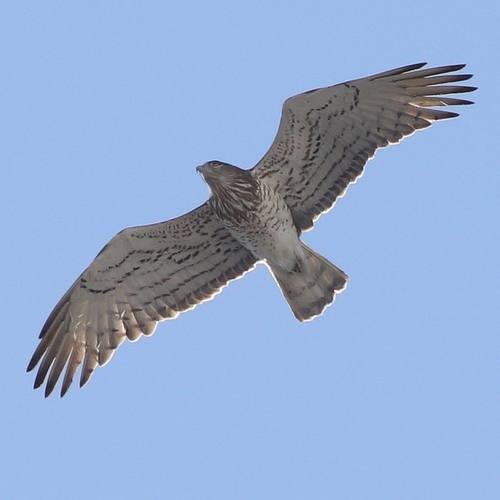
Short-toed Eagle (Circaetus gallicus) Short-toed Eagle
Lesser Spotted Eagle (Clanga pomarina) Lesser Spotted Eagle

Media

Loading…

In short

The most reliable field mark between Short-toed Eagle and Lesser Spotted Eagle is the underwing and body pattern in flight: Short-toed Eagle shows a predominantly white underside with lightly barred underwings, while Lesser Spotted Eagle is overall much darker, with adults showing a pale brown head and coverts contrasting with dark wings and body, and juveniles displaying white spots on the remiges. Structure also differs: Short-toed Eagle has a rounded, owl-like head and flat, broad wings, while Lesser Spotted Eagle appears more typical for an eagle, with a smaller head and less pronounced wing shape. Both species can be seen soaring, but Short-toed Eagle often hovers and soars on flat wings, whereas Lesser Spotted Eagle tends to glide with more pronounced fingered primaries. Age-related wing pattern differences are especially important for Lesser Spotted Eagle immatures, which show prominent white spots on the flight feathers. Habitat and behavior may overlap, but plumage and structure are usually enough for separation.

Identification tips

  1. Underwing and body color in flight (all ages): Short-toed Eagle shows a predominantly white underside with lightly barred underwings; Lesser Spotted Eagle is much darker below, with no extensive white.
  2. Juvenile wing pattern (Lesser Spotted Eagle): Juveniles have prominent white spots on the remiges (flight feathers) and a cream-colored neck patch; Short-toed Eagle juveniles do not show this pattern.
  3. Adult upperwing and rump (Lesser Spotted Eagle): Adults retain a white 'V' on the rump and may show a white patch on the upperwings; Short-toed Eagle lacks these features.
  4. Head shape and color: Short-toed Eagle has a rounded, owl-like head that is pale and strikingly yellow-eyed; Lesser Spotted Eagle has a smaller, less rounded head and a paler brown crown contrasting with the darker body.
  5. Tail pattern: Short-toed Eagle has 3–4 bars on the tail, visible in flight or when perched; Lesser Spotted Eagle's tail is less distinctly barred and appears more uniform.
  6. Flight silhouette: Short-toed Eagle soars on flat, broad wings and often hovers; Lesser Spotted Eagle has narrower wings with more pronounced fingered primaries and does not hover.
  7. Perched jizz: Short-toed Eagle appears long-legged and upright, with a pale, almost gentle facial expression; Lesser Spotted Eagle is bulkier, with a more typical eagle posture and darker overall impression.
  8. Underwing barring: Short-toed Eagle shows only light barring on the underwings; Lesser Spotted Eagle is more uniformly dark, with less contrast.
  9. Eye color: Short-toed Eagle has bright yellow eyes, which can be striking at close range; Lesser Spotted Eagle's eye color is less conspicuous.
  10. Habitat context: If seen in very open, arid, or semi-desert country, Short-toed Eagle is more likely; in more wooded or mixed landscapes, Lesser Spotted Eagle is favored.
  11. Behavior: Hovering or frequent soaring at high altitude is typical of Short-toed Eagle; Lesser Spotted Eagle is less likely to hover and more likely to glide or soar at lower altitudes.
  12. Vocalization: If you hear a dog-like yip, it's Lesser Spotted Eagle; Short-toed Eagle is usually silent.
  13. Season and range: In Western Europe, Short-toed Eagle is rare outside Spain; Lesser Spotted Eagle is mostly in Central/Eastern Europe. Both migrate to Africa, so overlap is possible in migration.
  14. Plumage pitfalls: Do not confuse the pale head of Lesser Spotted Eagle with the overall pale underparts of Short-toed Eagle; the latter is much paler overall below.
  15. Juvenile confusion: If you see white spots on the flight feathers but no covert spotting, think Lesser Spotted Eagle juvenile; Short-toed Eagle juveniles never show this pattern.

Size

Both species are large raptors, but Short-toed Eagle is slightly larger on average. Short-toed Eagle measures 59–70 cm in length with a wingspan of 162–195 cm and an average weight around 1.7 kg (though no AVONET value is given), while Lesser Spotted Eagle is about 60 cm long with a 150 cm wingspan and a mean mass of 1475.5 g [wikidata]. In the field, size difference is subtle and easily masked by posture or distance, so it is not a primary field mark.

Plumage

Juvenile and immature plumage is key for Lesser Spotted Eagle: juveniles show prominent white spots on the remiges (flight feathers) and a cream-colored neck patch, but lack covert spotting. Adults of Lesser Spotted Eagle are generally dark brown overall, with a pale brown head and coverts, and a distinctive white 'V' on the rump visible in flight. Short-toed Eagle adults are much paler below, with a mostly white underside, lightly barred underwings, and a pale brown chin, throat, and upper breast. The upperparts are greyish brown, and the tail shows 3–4 bars. The head of Short-toed Eagle is rounded and pale, giving an owl-like appearance. In all ages, Short-toed Eagle lacks the dark, uniform look of Lesser Spotted Eagle and never shows the white 'V' rump or juvenile white remige spots. Lesser Spotted Eagle juveniles are darker overall than Short-toed Eagle, with less contrast between underparts and wings, but the white spots on the flight feathers are a strong clue. In summary: look for white underparts and pale head for Short-toed Eagle, versus dark brown body, pale head, and white wing/rump markings for Lesser Spotted Eagle.

Behaviour

Short-toed Eagle spends more time soaring and often hovers like a kestrel when hunting, typically over open country or hill slopes. Its flight is on flattish, broad wings. Lesser Spotted Eagle also soars but is less prone to hovering, and its flight silhouette is more typical for an eagle, with slightly narrower wings and more pronounced fingered primaries. Both hunt small vertebrates, but Short-toed Eagle specializes in reptiles (especially snakes), while Lesser Spotted Eagle takes more mammals and birds. Both are wary and often seen at a distance.

Habitat

Both species use open or lightly wooded country, but Short-toed Eagle is more closely associated with open cultivated plains, arid scrub, and semi-desert areas, requiring trees for nesting and open ground for foraging. Lesser Spotted Eagle breeds in Central and Eastern Europe, often in open or lightly wooded habitats, and winters in Africa. Habitat overlap is possible, but Short-toed Eagle is more likely in drier, more open landscapes, while Lesser Spotted Eagle may be found in more wooded or mixed habitats.

Voice

Short-toed Eagle is generally very silent, only occasionally emitting musical whistling notes. Lesser Spotted Eagle has a distinctive dog-like yip, which may be heard during the breeding season. Vocalizations are rarely diagnostic in the field unless the bird is calling.

Submit a better description

Use the same sections as the comparison. Your text is published immediately.

The most reliable field mark between Short-toed Eagle and Lesser Spotted Eagle is the underwing and body pattern in flight: Short-toed Eagle shows a predominantly white underside with lightly barred underwings, while Lesser Spotted Eagle is overall much darker, with adults showing a pale brown head and coverts contrasting with dark wings and body, and juveniles displaying white spots on the remiges. Structure also differs: Short-toed Eagle has a rounded, owl-like head and flat, broad wings, while Lesser Spotted Eagle appears more typical for an eagle, with a smaller head and less pronounced wing shape. Both species can be seen soaring, but Short-toed Eagle often hovers and soars on flat wings, whereas Lesser Spotted Eagle tends to glide with more pronounced fingered primaries. Age-related wing pattern differences are especially important for Lesser Spotted Eagle immatures, which show prominent white spots on the flight feathers. Habitat and behavior may overlap, but plumage and structure are usually enough for separation.

  1. Underwing and body color in flight (all ages): Short-toed Eagle shows a predominantly white underside with lightly barred underwings; Lesser Spotted Eagle is much darker below, with no extensive white.
  2. Juvenile wing pattern (Lesser Spotted Eagle): Juveniles have prominent white spots on the remiges (flight feathers) and a cream-colored neck patch; Short-toed Eagle juveniles do not show this pattern.
  3. Adult upperwing and rump (Lesser Spotted Eagle): Adults retain a white 'V' on the rump and may show a white patch on the upperwings; Short-toed Eagle lacks these features.
  4. Head shape and color: Short-toed Eagle has a rounded, owl-like head that is pale and strikingly yellow-eyed; Lesser Spotted Eagle has a smaller, less rounded head and a paler brown crown contrasting with the darker body.
  5. Tail pattern: Short-toed Eagle has 3–4 bars on the tail, visible in flight or when perched; Lesser Spotted Eagle's tail is less distinctly barred and appears more uniform.
  6. Flight silhouette: Short-toed Eagle soars on flat, broad wings and often hovers; Lesser Spotted Eagle has narrower wings with more pronounced fingered primaries and does not hover.
  7. Perched jizz: Short-toed Eagle appears long-legged and upright, with a pale, almost gentle facial expression; Lesser Spotted Eagle is bulkier, with a more typical eagle posture and darker overall impression.
  8. Underwing barring: Short-toed Eagle shows only light barring on the underwings; Lesser Spotted Eagle is more uniformly dark, with less contrast.
  9. Eye color: Short-toed Eagle has bright yellow eyes, which can be striking at close range; Lesser Spotted Eagle's eye color is less conspicuous.
  10. Habitat context: If seen in very open, arid, or semi-desert country, Short-toed Eagle is more likely; in more wooded or mixed landscapes, Lesser Spotted Eagle is favored.
  11. Behavior: Hovering or frequent soaring at high altitude is typical of Short-toed Eagle; Lesser Spotted Eagle is less likely to hover and more likely to glide or soar at lower altitudes.
  12. Vocalization: If you hear a dog-like yip, it's Lesser Spotted Eagle; Short-toed Eagle is usually silent.
  13. Season and range: In Western Europe, Short-toed Eagle is rare outside Spain; Lesser Spotted Eagle is mostly in Central/Eastern Europe. Both migrate to Africa, so overlap is possible in migration.
  14. Plumage pitfalls: Do not confuse the pale head of Lesser Spotted Eagle with the overall pale underparts of Short-toed Eagle; the latter is much paler overall below.
  15. Juvenile confusion: If you see white spots on the flight feathers but no covert spotting, think Lesser Spotted Eagle juvenile; Short-toed Eagle juveniles never show this pattern.

Both species are large raptors, but Short-toed Eagle is slightly larger on average. Short-toed Eagle measures 59–70 cm in length with a wingspan of 162–195 cm and an average weight around 1.7 kg (though no AVONET value is given), while Lesser Spotted Eagle is about 60 cm long with a 150 cm wingspan and a mean mass of 1475.5 g [wikidata]. In the field, size difference is subtle and easily masked by posture or distance, so it is not a primary field mark.

Juvenile and immature plumage is key for Lesser Spotted Eagle: juveniles show prominent white spots on the remiges (flight feathers) and a cream-colored neck patch, but lack covert spotting. Adults of Lesser Spotted Eagle are generally dark brown overall, with a pale brown head and coverts, and a distinctive white 'V' on the rump visible in flight. Short-toed Eagle adults are much paler below, with a mostly white underside, lightly barred underwings, and a pale brown chin, throat, and upper breast. The upperparts are greyish brown, and the tail shows 3–4 bars. The head of Short-toed Eagle is rounded and pale, giving an owl-like appearance. In all ages, Short-toed Eagle lacks the dark, uniform look of Lesser Spotted Eagle and never shows the white 'V' rump or juvenile white remige spots. Lesser Spotted Eagle juveniles are darker overall than Short-toed Eagle, with less contrast between underparts and wings, but the white spots on the flight feathers are a strong clue. In summary: look for white underparts and pale head for Short-toed Eagle, versus dark brown body, pale head, and white wing/rump markings for Lesser Spotted Eagle.

Short-toed Eagle spends more time soaring and often hovers like a kestrel when hunting, typically over open country or hill slopes. Its flight is on flattish, broad wings. Lesser Spotted Eagle also soars but is less prone to hovering, and its flight silhouette is more typical for an eagle, with slightly narrower wings and more pronounced fingered primaries. Both hunt small vertebrates, but Short-toed Eagle specializes in reptiles (especially snakes), while Lesser Spotted Eagle takes more mammals and birds. Both are wary and often seen at a distance.

Both species use open or lightly wooded country, but Short-toed Eagle is more closely associated with open cultivated plains, arid scrub, and semi-desert areas, requiring trees for nesting and open ground for foraging. Lesser Spotted Eagle breeds in Central and Eastern Europe, often in open or lightly wooded habitats, and winters in Africa. Habitat overlap is possible, but Short-toed Eagle is more likely in drier, more open landscapes, while Lesser Spotted Eagle may be found in more wooded or mixed habitats.

Short-toed Eagle is generally very silent, only occasionally emitting musical whistling notes. Lesser Spotted Eagle has a distinctive dog-like yip, which may be heard during the breeding season. Vocalizations are rarely diagnostic in the field unless the bird is calling.

Discard your changes?

You have unsaved edits. If you leave now, those changes will be lost.

Short-toed Eagle · Lesser Spotted Eagle · My Tricky Birds