
Short-billed Dowitcher vs Long-billed Dowitcher
Limnodromus griseus versus Limnodromus scolopaceus
Play a quiz with Short-billed Dowitcher and Long-billed Dowitcher
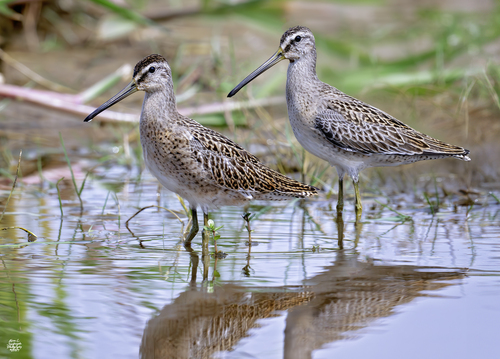 Short-billed Dowitcher
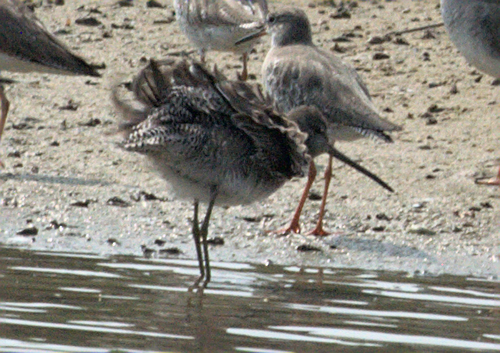 Long-billed Dowitcher
In short
The most reliable field mark between Short-billed and Long-billed Dowitchers is their vocalization—Short-billed gives a mellow call, while Long-billed gives a sharper, higher 'keek'—but this is not always available in the field. Juvenile and winter birds are notoriously difficult to separate visually, with subtle differences in the pattern and color of the tertials and underparts. In breeding plumage, Long-billed shows a solid rufous belly with barred flanks, while Short-billed varies by subspecies but never shows both a reddish belly and barred flanks together. Structure and bill length overlap considerably, so are not reliable on their own. Habitat preference can help: Long-billed is more often found in freshwater, Short-billed more often near coasts, but both can occur together during migration.
Identification tips
- Listen for calls: If you hear a sharp, high 'keek' or 'peet', suspect Long-billed; a mellow, softer call points to Short-billed. This is the most reliable field mark, especially in mixed flocks or dull plumages.
- Check age and plumage: Juvenile Long-billeds have plain, dark gray tertials with narrow buff edges and little internal pattern; Short-billed juveniles have tertials with brighter internal markings and buffy brown fringes. This is subtle and best seen at close range or in photos.
- Breeding adult underparts: Long-billed shows a solid rufous belly with barred flanks and a dark crown. Short-billed never combines both a reddish belly and barred flanks; 'hendersoni' has a reddish belly but spotted (not barred) flanks, while 'griseus' and 'caurinus' have white bellies.
- Flank pattern: In breeding plumage, look for white barring on the flanks (Long-billed) versus spots or less distinct barring (Short-billed, depending on subspecies).
- Crown and head: Long-billed in breeding plumage has a dark crown and rufous head; Short-billed is less contrasting.
- Tail pattern: Both have black-and-white barred tails, but Long-billed's black bars are almost twice as wide as the white. This is subtle and rarely diagnostic in the field.
- Rump in flight: Long-billed shows a large white rump extending up the back, but this is not unique and can be hard to see.
- Bill length: Despite the names, bill length overlaps greatly and is not reliable for separation. Only extremes are helpful, and even then, beware overlap.
- Leg color: Both species have yellowish legs; this is not a useful mark.
- Habitat preference: Long-billed is more likely in freshwater, Short-billed more likely near saltwater or coastal mudflats, but both can occur together, especially in migration.
- Breast color in winter: Both species are gray-breasted in non-breeding plumage; Long-billed's gray breast grades into a paler chin, but this is subtle.
- Behavior: Both feed with a rapid 'sewing machine' motion. Display flight is only seen in breeding Long-billed.
- Flock composition: Both species often occur in mixed flocks; do not assume all birds present are the same species.
- Sex differences: Both sexes are similar; females average slightly larger and longer-billed, but this is not useful in the field.
- When in doubt: If you cannot hear a call and the bird is not in fresh breeding plumage or a classic juvenile, it may not be safely identified to species in the field. Photographs of tertials and underparts can help, but many individuals remain ambiguous.
Size
Both species are medium-sized, stocky shorebirds with overlapping measurements. Short-billed Dowitcher averages slightly heavier (113g vs. 104g), but this difference is not apparent in the field. Bill length is also highly overlapping and cannot be used reliably for identification, despite the misleading names. Both have long, straight bills and yellowish legs.
Plumage
- Juvenile/First-winter: Juvenile Long-billed Dowitchers have dark gray tertials with narrow buff edges and very dull or absent internal markings, giving a plainer look to the upperwing. Juvenile Short-billed Dowitchers have more patterned tertials with brighter internal markings and buffy brown fringes. Juvenile Long-billeds also show a more uniform gray breast, while Short-billeds are often more patterned below.
- Adult breeding: Long-billed Dowitcher adults in breeding plumage have a dark crown, rufous head, neck, chest, and belly, with black bars on the breast and white barring on the flanks. The belly is solid reddish. Short-billed Dowitcher adults vary by subspecies: 'griseus' and 'caurinus' have white bellies, 'hendersoni' has a reddish belly but with spotted (not barred) flanks. None combine a reddish belly with barred flanks as Long-billed does.
- Non-breeding/winter: Both species become drab gray above and pale below, making visual separation extremely difficult. The breast of Long-billed is gray, gradually lightening toward the chin, while Short-billed is also gray but may show slightly different tone and pattern depending on subspecies. Tail pattern is similar: both show black and white barring, but Long-billed's black bars are almost twice as wide as the white.
- In flight: Long-billed shows a large white rump extending up the back, but this is not always visible and is not unique.
Behaviour
Both species feed by rapidly probing mud with a 'sewing machine' motion. Long-billed Dowitchers have a distinctive aerial display during breeding, with males chasing females in flight. In migration and winter, both are usually seen in flocks, often mixed. Behavior is not reliably diagnostic.
Habitat
Short-billed Dowitcher is more likely to be found near ocean coasts, tidal marshes, and mudflats, especially during migration and winter. Long-billed Dowitcher prefers freshwater habitats such as ponds and marshes, especially on the breeding grounds, but both species can overlap in migration and winter. Habitat is a helpful but not definitive clue.
Voice
Vocalization is the single most reliable field mark. Short-billed Dowitcher gives a mellow, softer call, while Long-billed Dowitcher gives a sharp, high 'keek' or 'peet' call. This difference is especially useful in flocks or during migration, when plumage differences are subtle or absent. Calls are often the only way to separate wintering or juvenile birds.
Short-billed Dowitcher · Long-billed Dowitcher · My Tricky Birds