

Sharp-tailed Grouse vs Greater Prairie-Chicken
Tympanuchus phasianellus versus Tympanuchus cupido
Play a quiz with Sharp-tailed Grouse and Greater Prairie-Chicken
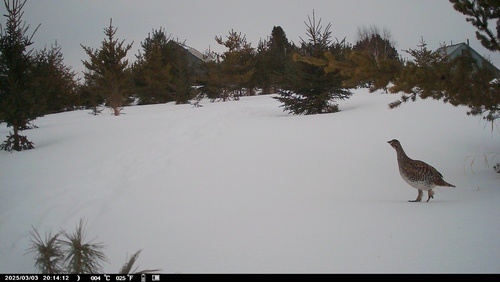 Sharp-tailed Grouse
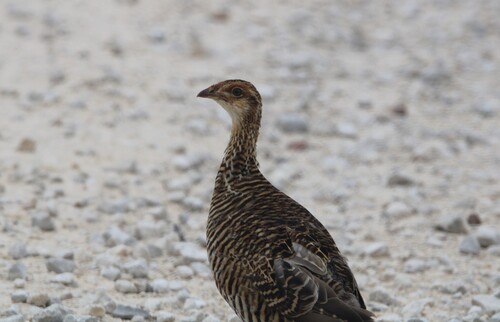 Greater Prairie-Chicken
In short
The most reliable field mark between Sharp-tailed Grouse and Greater Prairie-Chicken is the shape of the tail: Sharp-tailed Grouse has a distinctly pointed, wedge-shaped tail, while the Greater Prairie-Chicken's tail is short and rounded. In flight or when flushed, this tail difference is often the quickest way to separate them, regardless of age or sex. Both are medium-to-large prairie grouse with similar overall structure, but the Greater Prairie-Chicken is generally bulkier and rounder. Adult males of the prairie-chicken also show striking orange air sacs and elongated neck feathers on the lek, which are never present in Sharp-tailed Grouse. Immature and female birds are more challenging, but the tail shape and overall jizz remain the best clues.
Identification tips
- Tail shape is diagnostic: Sharp-tailed Grouse always shows a long, pointed, white-edged tail with a central spike, visible in all ages and sexes, both perched and in flight. Greater Prairie-Chicken has a short, rounded tail with little or no white—never pointed.
- Adult male display features: Only Greater Prairie-Chicken males have orange combs above the eye and large, inflatable orange neck sacs, especially obvious during lekking. Sharp-tailed Grouse never shows these features.
- Overall structure: Greater Prairie-Chicken is bulkier and barrel-chested, with a more rounded profile. Sharp-tailed Grouse appears slimmer and more elongated, especially in flight due to the long tail.
- Flight jizz: In flight, Sharp-tailed Grouse looks more streamlined with a pointed tail trailing behind. Greater Prairie-Chicken looks compact and short-tailed.
- Plumage pattern: Both are brown and barred, but only Greater Prairie-Chicken males have elongated neck feathers that can be raised during display. Females and immatures are more similar, but the tail shape still separates them.
- Habitat context: If found in northern/western Canada or Alaska, it is almost certainly a Sharp-tailed Grouse. Greater Prairie-Chicken is now restricted to small, managed prairies in the central U.S.
- Lekking behavior: Watch for display postures—Greater Prairie-Chicken males boom with inflated neck sacs and raised neck feathers; Sharp-tailed Grouse males fan and raise their pointed tails but lack neck sacs.
- Vocalizations: A deep, booming call on the lek is unique to Greater Prairie-Chicken. Sharp-tailed Grouse has different, less resonant display sounds.
- Sex differences: Female Greater Prairie-Chickens lack the orange comb and neck sac but still have the short, rounded tail. Female Sharp-tailed Grouse retain the pointed tail.
- Age differences: No age-specific upperwing or juvenile marks are described, so use tail shape and structure for all ages.
- Perched vs. flushed: When flushed, Sharp-tailed Grouse's pointed tail is especially obvious. Perched, the tail still protrudes and tapers to a point, unlike the prairie-chicken's stubby tail.
- Local abundance: Greater Prairie-Chicken is now very rare and local; Sharp-tailed Grouse is more widespread and common in its range.
- Confusion risk: Immature and female birds are most easily confused, but the tail shape remains reliable. Beware of poor views where tail shape is obscured.
- No reliable size separation: Both overlap in size and mass; do not rely on size alone.
- No distinctive wing pattern: No diagnostic upperwing or flight feather differences are described for any age or sex.
Size
Sharp-tailed Grouse averages about 885 g in body mass [wikidata], placing it solidly in the medium-sized grouse range. Greater Prairie-Chicken is similar but can be larger, with adults ranging from 700–1,200 g and about 43 cm in length [wikipedia]. Both are robust, chicken-like birds, but the prairie-chicken often looks bulkier and more barrel-chested, especially when displaying. In the field, size overlap is substantial, so use structure and plumage first.
Plumage
No detailed age-specific upperwing or juvenile flight pattern differences are described in the available sources. Both species are cryptically marked brown and barred, but adult male Greater Prairie-Chickens are unique in having orange combs above the eyes and inflatable orange neck sacs, especially visible during display. Sharp-tailed Grouse lacks these features entirely. The tail is the most consistent plumage difference: Sharp-tailed Grouse of all ages and sexes have a long, pointed, white-edged tail with a central spike, visible both perched and in flight. Greater Prairie-Chicken's tail is short, rounded, and lacks the pointed tip, with less white. Females and immatures of both species are more subtly marked, but the tail shape and the lack of orange facial/neck features in Sharp-tailed Grouse remain reliable.
Behaviour
Both species display on leks, but their display postures differ: Greater Prairie-Chicken males inflate their orange neck sacs and raise elongated neck feathers, producing booming calls. Sharp-tailed Grouse males display with tail raised and fanned, showing off the pointed shape, and do not have inflatable sacs. In flight, Sharp-tailed Grouse often appears more slender and long-tailed, while Greater Prairie-Chicken looks rounder and shorter-tailed. Both walk and feed on the ground in open country, but the prairie-chicken is more likely to be seen in tightly managed remnant prairies due to its rarity.
Habitat
Sharp-tailed Grouse is found in a broader range of open habitats, including prairies, grasslands, and even brushy or lightly wooded areas across northern and western North America, including Alaska and Canada [wikipedia]. Greater Prairie-Chicken is now restricted to small, managed prairie remnants in the central U.S., having disappeared from much of its former range due to habitat loss [wikipedia]. If you are in northern or western Canada or Alaska, you are almost certainly seeing a Sharp-tailed Grouse. In the core tallgrass prairie states, especially in protected or managed prairie preserves, Greater Prairie-Chicken is possible but rare.
Voice
No direct comparison of calls is provided in the sources. However, Greater Prairie-Chicken males are famous for their deep, booming display calls produced by their inflatable neck sacs, especially on the lek. Sharp-tailed Grouse lacks these booming calls and inflatable sacs; their display sounds are different and less resonant. In the field, a deep, far-carrying boom points to Greater Prairie-Chicken.
Sharp-tailed Grouse · Greater Prairie-Chicken · My Tricky Birds