

Screaming Piha vs Silver-beaked Tanager
Lipaugus vociferans versus Ramphocelus carbo
Play a quiz with Screaming Piha and Silver-beaked Tanager
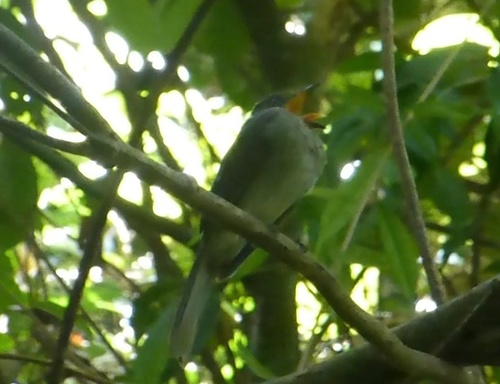 Screaming Piha
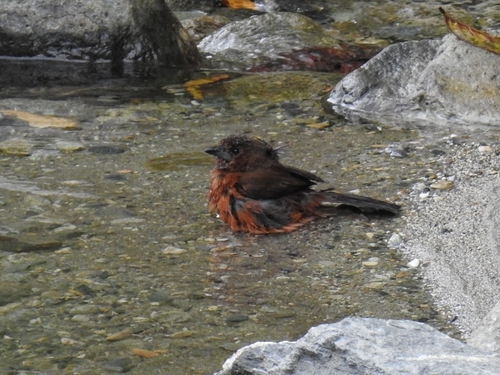 Silver-beaked Tanager
In short
Juvenile Screaming Pihas show cinnamon rufous on their wing coverts and tail tips, a feature never present in any age or sex of Silver-beaked Tanager. For adults, the most reliable field mark is overall color: Screaming Piha is a uniform medium gray with duskier wings and tail, while male Silver-beaked Tanagers are deep carmine to crimson with blackish wings and tail, and females/immatures are rich reddish-brown. Screaming Piha is much larger and heavier-bodied, with a plain dark bill, while Silver-beaked Tanager is smaller and has a thick, heavy bill with a distinctive silvery-white lower mandible in adult males. The Piha’s explosive, far-carrying song is utterly different from the tanager’s more typical tanager calls.
Identification tips
- Juvenile Screaming Piha shows cinnamon rufous on wing coverts and tail tips—never present in Silver-beaked Tanager of any age or sex; this is the best mark for immatures.
- Adult Screaming Piha is uniform medium gray above and below (throat palest), with duskier brownish wings and tail; never shows red, carmine, or brown tones.
- Adult male Silver-beaked Tanager is deep carmine to crimson on head, throat, and breast, with plush carmine-black upperparts and blackish wings/tail; never uniform gray.
- Adult female and immature Silver-beaked Tanager are rich reddish-brown above and below, with dusky wings edged rufescent brown; again, never gray.
- Bill color is diagnostic in adults: Screaming Piha has a plain black maxilla and dusky mandible (sometimes with pinkish base); male Silver-beaked Tanager has a dark blue-gray upper mandible and a striking silvery-white lower mandible with a black tip; females have a brownish dusky bill.
- Size and structure: Screaming Piha is much larger and heavier (24–26 cm, 81 g) than Silver-beaked Tanager (16–17 cm, 21–37.5 g); Piha looks long-bodied and robust, tanager compact and chunky.
- Jizz and posture: Piha perches upright and motionless, often in the shaded forest interior; tanager is more active, hops and forages in pairs or groups, often in open or edge habitats.
- Habitat: Piha is a bird of deep, humid rainforest interiors; tanager prefers forest edge, open woodland, gardens, and urban parks.
- Vocalization: Piha’s song is a piercing, explosive 'qui, qui, yo' heard at great distance, often with faint 'groo' notes; tanager’s calls are soft, typical of tanagers, and never so loud or far-carrying.
- Sexual dimorphism: Piha sexes are identical; tanager males and females are very different, with males much brighter and more contrasting.
- Iris color: Both can show reddish or brownish irises, not diagnostic.
- Leg color: Both have dark legs, not useful for separation.
- If you see a large, plain gray bird in deep forest, especially if singing explosively, it is a Piha; if you see a smaller, red or brownish bird with a heavy, pale lower bill in open or edge habitat, it is a Silver-beaked Tanager.
- In mixed flocks or at fruiting trees, size and bill shape are especially helpful—Piha towers over tanagers and has a slimmer, less conical bill.
- Remember that female/immature tanagers can look dull and brownish, but never truly gray or as large as a Piha.
Size
Screaming Piha is substantially larger and heavier than Silver-beaked Tanager. Piha measures 24–26 cm in length and weighs 68–87 g (average 81 g), while Silver-beaked Tanager is only 16–17 cm long and weighs 21–37.5 g. In the field, Piha appears bulkier and longer-bodied, with a more substantial presence than the compact, chunky tanager.
Plumage
Juvenile Screaming Piha (of both sexes) can be separated from any Silver-beaked Tanager by their cinnamon rufous wing coverts and tail tips, which are never present in tanagers of any age. Adult Screaming Piha is uniform medium gray above, with duskier brownish wings and tail, and paler gray underparts (throat palest); both sexes look alike. In contrast, adult male Silver-beaked Tanager is deep carmine to crimson on the head, throat, and breast, with plush, velvety carmine-black upperparts and blackish wings and tail; the lower belly and undertail are blackish with a crimson tinge. Adult females and immatures are rich dark rusty-red above, redder on the rump, and reddish-brown to warm brown below, with dusky wings edged rufescent brown. The Piha never shows red, carmine, or brown tones in any plumage, and the tanager never appears uniform gray. Bill color is also diagnostic: Piha has a black maxilla and dusky mandible, while male tanagers have a dark blue-gray upper mandible and a striking silvery-white lower mandible with a black tip; females have a brownish dusky bill.
Behaviour
Screaming Piha is typically seen perched upright and motionless in the forest understory to mid-story, often singing from a prominent but shaded perch, and may tip forward and back while vocalizing. It is usually solitary or loosely associated. Silver-beaked Tanager is more active, often seen in pairs or small groups, foraging in more open or edge habitats, and is less likely to perch motionless for long periods. The tanager’s heavier bill is often used to manipulate fruit or insects, giving it a different foraging jizz than the Piha.
Habitat
Screaming Piha is a bird of humid lowland rainforest interiors, favoring shaded, dense forest from the understory to mid-story, and is rarely found at forest edges or in open habitats. Silver-beaked Tanager is much more common in open woodland, forest edges, secondary growth, gardens, and even urban parks, and is rarely found deep inside mature forest. If seen in a city park or open area, it is almost certainly a tanager; in deep, undisturbed forest, Piha is more likely.
Voice
Screaming Piha is famous for its incredibly loud, far-carrying song: a piercing, repeated 'qui, qui, yo' that can be heard hundreds of meters away, often preceded by faint 'groo' notes. The song is so loud it can be physically uncomfortable at close range. Piha also gives loud mewing, squeaks, whistles, and moans. Silver-beaked Tanager, by contrast, gives typical tanager calls and songs—much softer, less far-carrying, and lacking the explosive, ringing quality of the Piha. If you hear the rainforest echoing with a single, repeated, whistled phrase, it is the Piha.