
Screaming Piha vs Dickcissel
Lipaugus vociferans versus Spiza americana
Play a quiz with Screaming Piha and Dickcissel
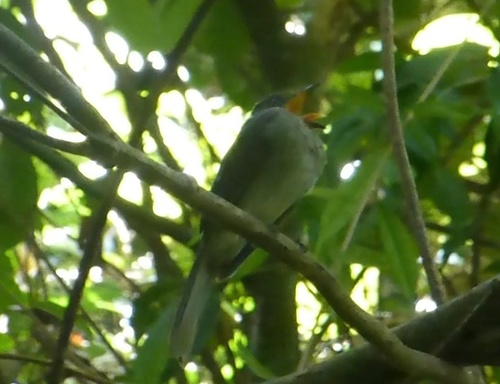 Screaming Piha
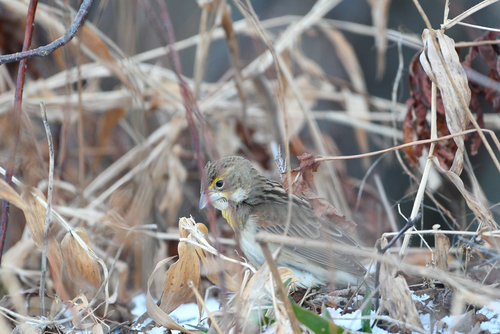 Dickcissel
In short
The most reliable field mark between Screaming Piha and Dickcissel is overall color and pattern: Screaming Piha (adult and juvenile) is a plain, medium-gray bird with no strong pattern, while Dickcissel always shows a contrasting face pattern, yellow tones, and (in males) a bold black throat patch. Juvenile Pihas can show cinnamon rufous on the wing coverts and tail tips, but never the Dickcissel's streaked back, yellow eyebrow, or rufous shoulder. Dickcissel is much smaller, with a thick, pale bill and a streaked, sparrow-like look, especially in females and immatures. If you see a large, plain gray bird in the mid-story of humid forest, it's a Piha; a small, patterned bird in open grassland or field is a Dickcissel.
Identification tips
- Juvenile Screaming Piha vs. Dickcissel of any age: Juvenile Piha is plain gray with cinnamon rufous only on wing coverts and tail tips—never streaked or with a patterned face. Dickcissel juveniles and females always show a streaked back, pale eyebrow, and rufous shoulder.
- Adult Screaming Piha: Uniform medium gray above, paler below, with duskier wings and tail; no facial pattern, no streaks, no yellow or rufous except in juveniles. Bill is blackish with a dusky/pinkish base.
- Adult male Dickcissel: Bold black throat patch, yellow breast, gray crown and cheeks, brown streaked back, rufous shoulder patch, and a large pale bill. Never plain gray.
- Female/immature Dickcissel: Brownish, streaked above, pale underparts with streaked flanks, pale supercilium (eyebrow), and rufous shoulder. Bill is always large and pale. No black throat patch, but still patterned.
- Bill shape and color: Piha has a medium-length, blackish bill with a dusky/pinkish base; Dickcissel has a short, thick, conical, pale bill typical of seed-eaters.
- Size: Piha is nearly three times heavier and much longer than Dickcissel. If the bird appears sparrow-sized, it's a Dickcissel; if it's thrush-sized or larger, it's a Piha.
- Wing pattern in flight: Dickcissel shows dark wings with a rufous patch on the shoulder; Piha is plain gray-brown with no contrasting wing markings.
- Face pattern: Piha is always plain-faced; Dickcissel always has a pale eyebrow and, in males, a striking face with a black throat patch.
- Habitat: Piha is only in humid forest, never in open fields; Dickcissel is only in open country, never in forest.
- Behavior: Piha perches quietly in mid-story, often motionless; Dickcissel is active, often in flocks, and sings from exposed perches.
- Vocalization: Piha's call is extremely loud, ringing, and can be heard from far away; Dickcissel's song is a softer, buzzy sequence, and its flight call is a low 'fpppt.'
- Iris color: Piha can have brown, grayish brown, or gray irises; Dickcissel's iris color is not distinctive for field ID.
- Leg color: Piha's legs and feet are variable (dark green, brown, gray, black), but this is not a strong field mark; Dickcissel's legs are not distinctive.
- Sex differences: Piha sexes are identical; Dickcissel males are much brighter and more patterned than females/immatures.
- Confusion risk: Only the plainness of a juvenile Piha might vaguely recall a female Dickcissel, but the lack of streaks, facial pattern, and overall size difference should prevent confusion.
Size
Screaming Piha is substantially larger and heavier (body mass ~81 g, length 24–26 cm) than Dickcissel (~27 g, length 14–16 cm). The Piha is nearly three times the mass of a Dickcissel and appears bulkier with a proportionally larger body and longer tail. Dickcissel is a small, sparrow-sized bird with a shorter, more conical bill and a compact build. In direct comparison, the Piha will always look much larger and more robust.
Plumage
Juvenile Screaming Piha can be separated from Dickcissel of any age by its plain gray plumage with cinnamon rufous only on the wing coverts and tail tips—never streaked or patterned. Dickcissel, even as a juvenile or female, shows a brownish, streaked back, a yellowish eyebrow, and a rufous shoulder patch. Adult male Dickcissel is especially distinctive with a black throat patch, yellow breast, and gray crown and cheeks, while females and immatures are duller but still show streaked flanks and a pale supercilium. Screaming Piha adults are uniform medium gray above, paler below, with duskier wings and tail, and lack any facial or breast pattern. Bill color also differs: Piha has a black maxilla and dusky mandible with a pinkish base, while Dickcissel has a large, pale bill. In flight, Dickcissel shows dark wings with a rust patch on the shoulder, while Piha remains plain gray-brown with no contrasting wing pattern.
Behaviour
Screaming Piha is typically seen perched quietly or singing from a mid-story branch in humid forest, often remaining motionless and blending into the background. Its behavior is unobtrusive except when singing. Dickcissel is much more active, often seen in flocks, foraging on the ground or low perches in open fields and grasslands. During the breeding season, male Dickcissels sing conspicuously from exposed perches. Piha rarely joins mixed flocks or feeds on the ground, while Dickcissel is gregarious outside the breeding season.
Habitat
Screaming Piha is a bird of humid lowland rainforest across much of South America (excluding southern cone countries), always in forest interior or edge, never in open country. Dickcissel is strictly a bird of open habitats: grasslands, prairies, fields, and agricultural areas in North America during breeding, and similar open habitats in Central and northern South America in winter. You will never find a Dickcissel inside dense forest, nor a Screaming Piha in open grassland.
Voice
Screaming Piha is famous for its extremely loud, ringing 'qui, qui, yo' call, often audible hundreds of meters away in rainforest, sometimes preceded by faint 'groo' notes. The song is piercing and can be physically uncomfortable at close range. Dickcissel's song is a sharp 'dick dick' followed by a buzzy 'cissel,' and its flight call is a low, electric 'fpppt.' Dickcissel's vocalizations are much softer, more mechanical, and never as loud or ringing as Piha's. Piha sings from a hidden perch in forest; Dickcissel sings from an exposed perch in open country.