

Saw-billed Hermit vs Rufous-breasted Hermit
Ramphodon naevius versus Glaucis hirsutus
Play a quiz with Saw-billed Hermit and Rufous-breasted Hermit
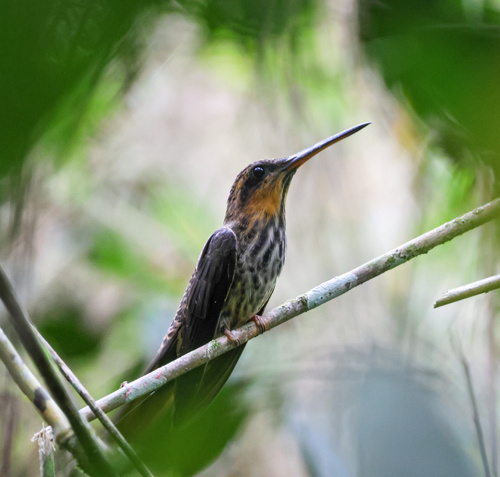 Saw-billed Hermit
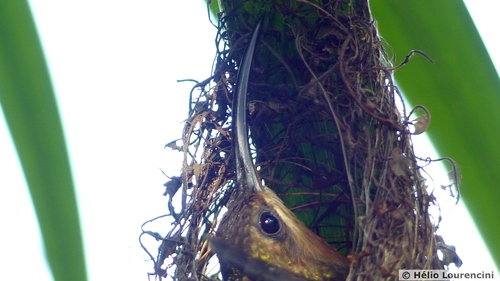 Rufous-breasted Hermit
In short
The most reliable field mark to separate Saw-billed Hermit from Rufous-breasted Hermit is the distinctive saw-like serrations on the mandible and the hooked tip of the male's bill in Saw-billed Hermit—features not present in Rufous-breasted Hermit. Saw-billed Hermit is larger, heavier, and has a bulkier, straighter bill, while Rufous-breasted Hermit is smaller with a strongly decurved, slender bill and a yellow lower mandible. Plumage also differs: Saw-billed Hermit shows scaly brown upperparts and dark-and-pale striped underparts, whereas Rufous-breasted Hermit has bronze-green upperparts and uniform rufous underparts. Tail pattern and facial markings further aid separation, especially in perched birds. Both species can be locally common, but their ranges only overlap in southeastern Brazil.
Identification tips
- Bill shape and structure: Saw-billed Hermit has a thick, straight bill with visible saw-like serrations on the mandible (both sexes) and a hooked tip in males. Rufous-breasted Hermit has a long, thin, strongly decurved bill with a yellow lower mandible and a black upper mandible. The female Rufous-breasted Hermit has an even more pronounced curve.
- Bill color: Rufous-breasted Hermit shows a yellow lower mandible, which is absent in Saw-billed Hermit (bill is uniformly dark).
- Facial pattern: Saw-billed Hermit has a bold white supercilium and a dark eye-stripe, giving a strong facial contrast. Rufous-breasted Hermit has a plainer face without a strong supercilium.
- Underparts: Saw-billed Hermit has dark and pale striping on the underparts, while Rufous-breasted Hermit has uniform rufous underparts with no striping.
- Upperparts: Saw-billed Hermit is scaly brown above; Rufous-breasted Hermit is bronze-green above with a brownish head.
- Throat color: Saw-billed Hermit has a reddish ochre throat, contrasting with the rest of the underparts. Rufous-breasted Hermit is uniformly rufous below.
- Tail pattern: Saw-billed Hermit has a purplish-black upper tail and buff on the underside of the outer feathers. Rufous-breasted Hermit has green central tail feathers, rufous outer feathers, all tipped white—a clear field mark in perched birds.
- Size and bulk: Saw-billed Hermit is larger and heavier, with a more robust appearance. Rufous-breasted Hermit is smaller and more slender.
- Behavior: Saw-billed Hermit is more aggressive in defending feeding routes, often chasing away other hummingbirds. Rufous-breasted Hermit is also aggressive but more specialized in flower choice and less likely to defend a territory.
- Habitat: Saw-billed Hermit is restricted to the humid Atlantic Forest understory in southeastern Brazil. Rufous-breasted Hermit is widespread and can be found in a variety of lowland forested habitats, often near water.
- Voice: Listen for a high, chattering twitter (Saw-billed Hermit) versus a simple high-pitched 'sweet' (Rufous-breasted Hermit). Calls are more complex in Saw-billed Hermit.
- Sex differences: In Rufous-breasted Hermit, males have yellow streaking on the upper mandible and females have a more decurved bill, but these are subtle and require close views. Saw-billed Hermit males have a hooked bill tip.
- Tail in flight: While not described in detail for flight, the tail pattern of Rufous-breasted Hermit (white-tipped, rufous outer feathers) may be visible in good light, contrasting with the darker tail of Saw-billed Hermit.
- Plumage pitfalls: Immature or worn birds may lose some contrast, but the bill shape and facial pattern remain reliable. Striping on Saw-billed Hermit underparts is usually visible even in poor light.
- Range context: If outside the humid Atlantic Forest of southeastern Brazil, Saw-billed Hermit is unlikely. In overlap zones, use bill structure and underpart pattern as primary separators.
Size
Saw-billed Hermit is notably larger and heavier, measuring 14–16 cm in length and weighing 5.3–9 g (with males heavier than females) [wikipedia]. Rufous-breasted Hermit is smaller at 10.7 cm and averages 7 g [wikipedia]. The Saw-billed Hermit is one of the three heaviest hermits, and its size is often apparent in the field, especially when seen side-by-side or with other hummingbirds.
Plumage
No age-specific upperwing or flight pattern differences are detailed for either species in the sources. For adults, Saw-billed Hermit has scaly brown upperparts and underparts with dark and pale striping, plus a reddish ochre throat and a bold white supercilium. Its tail is purplish-black above, with increasing buff on the underside towards the outer feathers. In contrast, Rufous-breasted Hermit shows bronze-green upperparts, brownish head, and uniform rufous underparts. The tail is distinctive: green central feathers, rufous outer feathers, all tipped white. Both sexes of Saw-billed Hermit share the scaly and striped look, while Rufous-breasted Hermit is more uniform below and lacks the scaly effect. Facial pattern is also a separator: Saw-billed Hermit has a dark eye-stripe and white supercilium, while Rufous-breasted Hermit is plainer-faced.
Behaviour
Both species are trap-line feeders, visiting a circuit of flowers. Saw-billed Hermit is more aggressive, actively defending its feeding route against other hummingbirds, while Rufous-breasted Hermit is described as aggressive and inquisitive but is more specialized in flower choice, only visiting blooms that match its bill curvature. Saw-billed Hermit typically feeds within 6 m of the ground but can go higher, while Rufous-breasted Hermit often nests and forages low, near streams or roadsides.
Habitat
Saw-billed Hermit is endemic to the humid coastal Atlantic Forest of southeastern Brazil, found in the understory up to 500 m elevation [wikipedia]. Rufous-breasted Hermit is much more widespread, ranging from Panama to Bolivia and on several Caribbean islands, and is generally common in suitable habitats. Their ranges only overlap in southeastern Brazil, and Saw-billed Hermit is much more habitat-restricted, favoring dense, humid forest understory.
Voice
Saw-billed Hermit gives a very high, chattering twitter as its song, with calls that are rapid, high 'bic' notes and descending 'seee' notes, especially when defending its trap-line [wikipedia]. Rufous-breasted Hermit's call is described as a high-pitched 'sweet' [wikipedia]. Both are high-pitched, but Saw-billed Hermit's vocalizations are more complex and chattering, while Rufous-breasted Hermit is simpler.
Saw-billed Hermit · Rufous-breasted Hermit · My Tricky Birds