

Sandwich Tern vs White-tailed Tropicbird
Thalasseus sandvicensis versus Phaethon lepturus
Play a quiz with Sandwich Tern and White-tailed Tropicbird
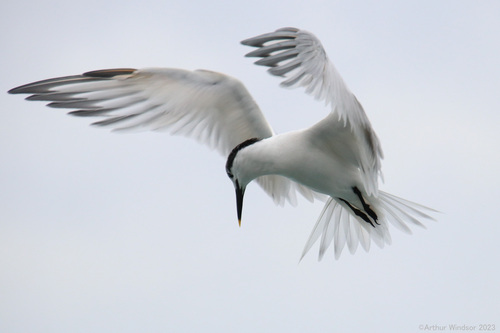 Sandwich Tern
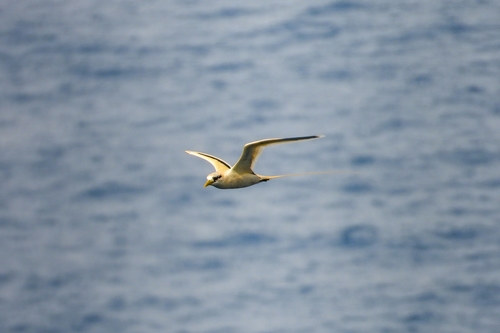 White-tailed Tropicbird
In short
The most reliable field mark to separate these two is the presence of extremely long, white central tail streamers and a bold black inner wing bar in White-tailed Tropicbird (all ages), versus the shorter, forked tail and plain pale grey upperwings of Sandwich Tern. Juvenile Sandwich Terns show a scaly upperwing and back pattern, while juvenile tropicbirds are finely barred above but lack the tail streamers. Bill color is also diagnostic: Sandwich Tern has a thin black bill with a yellow tip (adults), while White-tailed Tropicbird has a stout orange-yellow to orange-red bill (adults) or green-yellow (juveniles). In flight, the tropicbird’s long tail and striking black wing markings stand out, while the tern appears more delicate and pale overall.
Identification tips
- Tail shape and length: White-tailed Tropicbird (adult) has extremely long, white central tail streamers that double its apparent length; Sandwich Tern has a short, shallowly forked tail. Juvenile tropicbirds lack streamers but still show a longer tail than the tern.
- Upperwing pattern (all ages): Tropicbird always shows a bold black bar on the inner wing; Sandwich Tern’s upperwing is plain pale grey, sometimes with slightly darker primaries in summer but never a black bar.
- Bill color and shape: Adult Sandwich Tern has a thin, sharp black bill with a yellow tip; White-tailed Tropicbird has a thick, orange-yellow to orange-red bill (adults) or green-yellow (juveniles). Juvenile Sandwich Tern’s bill is all blackish.
- Facial pattern: Tropicbird has a striking black eye-mask; Sandwich Tern has a full black cap in breeding season, receding to a white forehead in winter, but never an isolated eye-mask.
- Back and upperwing in juveniles: Juvenile Sandwich Tern is scaly above with dark tail tips; juvenile tropicbird is finely barred above but lacks the scaly look and has no dark tail tip.
- Overall color: Tropicbird is dazzling white with black accents; Sandwich Tern is pale grey above and white below, but never pure white above.
- Flight jizz: Tropicbird soars and glides with languid, buoyant flight and trailing streamers; Sandwich Tern flies with rapid, direct wingbeats and quick, agile turns, often in flocks.
- Perched posture: Sandwich Tern often perches on sandbars or beaches in groups; tropicbird rarely perches in the open and is not seen on beaches.
- Habitat context: Sandwich Tern is coastal, often seen near land, in estuaries or at the beach; tropicbird is oceanic, usually far offshore or near remote islands.
- Vocalizations: Listen for the tern’s harsh, grating calls versus the tropicbird’s high-pitched, screamed notes.
- Seasonal changes: Sandwich Tern’s black cap recedes in winter, leaving a white forehead; tropicbird’s head pattern is stable year-round.
- Group size: Terns are often in flocks; tropicbirds are solitary or in pairs.
- Bill tip: Only Sandwich Tern shows a yellow tip on a black bill (adults); tropicbird’s bill is never black-tipped.
- Primary feather wear (advanced): In late summer, Sandwich Tern primaries may show a distinctive ‘hook tip’ due to white fringe wear, but this is subtle and not shared by tropicbird.
- Confusion risk: Juvenile Sandwich Tern’s scaly upperparts and all-dark bill can cause confusion, but lack of tail streamers and black wing bar rules out tropicbird.
Size
Sandwich Tern is a medium-large tern, 36–41 cm long (including tail) with a wingspan of 95–105 cm, and weighs 200–300 g. White-tailed Tropicbird is longer overall at 71–80 cm, but this includes extremely long tail streamers; its wingspan is slightly shorter at 89–96 cm. In the field, the tropicbird appears much larger and more elongated due to its tail, but the body bulk is not dramatically greater than the tern’s. The tern’s proportions are more compact, with shorter legs and tail, and a more slender, pointed build.
Plumage
- Juveniles/immatures:
- Sandwich Tern juveniles have a scaly pattern on the back and wings, dark tail tips, and an all-blackish bill (sometimes yellowish at the base). Their upperwings are pale grey with little to no bold patterning.
- White-tailed Tropicbird juveniles lack the long tail streamers, have a green-yellow bill, and a finely barred back. The key mark is a bold black bar on the inner wing (visible in all ages) and a black eye-mask, with otherwise white plumage.
- Adults (breeding):
- Sandwich Tern adults are very pale above and below, with pale grey upperwings, white underparts, and a black cap. The bill is black with a yellow tip. Tail is short and forked.
- White-tailed Tropicbird adults are brilliant white with a black eye-mask, a strong black bar on the inner wing, and extremely long, white central tail feathers. Bill is orange-yellow to orange-red.
- Adults (non-breeding):
- Sandwich Tern loses the black forehead, showing extensive white on the forehead after the post-breeding moult (late summer to winter). The rest of the plumage remains pale. The bill remains black with a yellow tip.
- White-tailed Tropicbird does not have a strong seasonal change; the main marks remain consistent year-round.
Behaviour
Sandwich Tern is typically seen in flocks, often perched on sandbars, beaches, or flying low over coastal waters with fast, buoyant, direct flight. It often hovers briefly before plunge-diving for fish. White-tailed Tropicbird is usually seen singly or in pairs, soaring high above the ocean or near nesting cliffs, with a graceful, buoyant, and somewhat erratic flight. It rarely perches in the open and is not seen on beaches. The tropicbird’s flight is more languid and showy, with the long tail streamers trailing behind.
Habitat
Sandwich Tern is a coastal species, breeding on sandy or shingle beaches, islands, and estuaries, and foraging over shallow coastal waters. It is rarely found far from land. White-tailed Tropicbird is strictly pelagic outside the breeding season, seen over open tropical oceans, and breeds on remote islands and cliffs. It is much less likely to be seen from shore except near nesting colonies, and never gathers in flocks on beaches or sandbars.
Voice
Sandwich Tern gives a loud, grating "kear-ik" or "kerr ink" call, often heard in noisy colonies or when birds are flying overhead. White-tailed Tropicbird has a high, screamed "keee-keee-krrrt-krrt-krrt" call, which is more piercing and less harsh than the tern’s. The tropicbird is generally quieter away from breeding sites.