
Sand Martin vs Barn Swallow
Riparia riparia versus Hirundo rustica
Play a quiz with Sand Martin and Barn Swallow
 Sand Martin
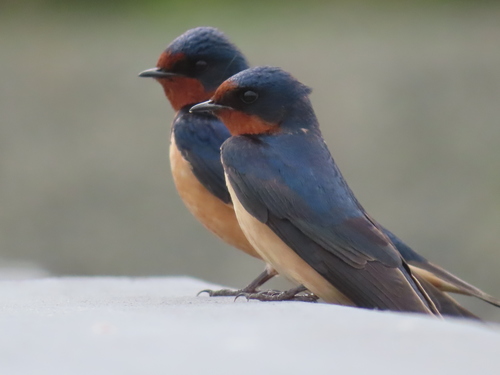 Barn Swallow
In short
The most reliable field mark to separate Sand Martin from Barn Swallow in any plumage is the presence of a narrow brown breast band on the Sand Martin, versus the broad blue breast band and rufous face of the Barn Swallow. In flight, Barn Swallow’s long, deeply forked tail with white spots is instantly distinctive, while Sand Martin has a much shorter, squarer tail. Juvenile Barn Swallows lack the long tail streamers but still show a pale rufous face and whiter underparts, unlike the uniformly brown-and-white Sand Martin. Size and structure also differ: Barn Swallow is noticeably larger and more graceful in flight, whereas Sand Martin is smaller, more compact, and flies with quicker, jerkier wingbeats.
Identification tips
- Breast Band: Sand Martin always shows a narrow brown breast band across a white chest; Barn Swallow has a broad, glossy blue-black breast band and rufous throat/face. This is the single most reliable mark in all ages and seasons.
- Tail Shape: Barn Swallow has a long, deeply forked tail with elongated outer feathers (streamers) in adults; Sand Martin’s tail is short and only slightly forked. Juvenile Barn Swallow lacks streamers but still has a longer, more pointed tail than Sand Martin.
- Upperparts Color: Sand Martin is plain brown above; Barn Swallow is steel blue above (adults) or brownish (juveniles), but never as plain as Sand Martin.
- Facial Color: Barn Swallow adults and juveniles show a rufous (red) forehead and throat; Sand Martin’s face is brown and white, never rufous.
- Underparts: Sand Martin is white below except for the breast band; Barn Swallow is off-white below but with a broad breast band and rufous throat/chin.
- White Tail Spots: Barn Swallow adults have a line of white spots at the tips of the outer tail feathers, visible in flight or when perched with tail spread; Sand Martin lacks these spots.
- Flight Style: Sand Martin flies with quick, jerky wingbeats and abrupt turns; Barn Swallow is more fluid and graceful, gliding and swooping with long tail streamers trailing.
- Size: Barn Swallow is noticeably larger and longer-winged; Sand Martin is compact and small, especially obvious if seen together or with other swallows.
- Perching Behavior: Barn Swallow often perches on wires, showing off its long tail; Sand Martin is less likely to perch in the open and more likely to be seen in flight or near nest burrows.
- Juvenile Confusion: Juvenile Barn Swallow lacks tail streamers but still shows a pale rufous face and broad breast band; juvenile Sand Martin looks like a duller adult, with rufous-tipped coverts but no rufous face or blue gloss.
- Habitat: Sand Martin is almost always near sandy or earthen banks by water; Barn Swallow is common in open country, farmland, and near buildings.
- Colony Context: Sand Martins nest in colonies in banks; Barn Swallows nest singly or in loose groups on human structures.
- Vocalizations: Barn Swallow’s calls are more musical and varied; Sand Martin’s are rough, gravelly, and less distinctive.
- Sex Differences: Only Barn Swallow shows sexual dimorphism in tail length and gloss; Sand Martin sexes look alike.
- Pitfalls: Beware juvenile Barn Swallow, which lacks streamers and can look short-tailed; check for rufous face and broad breast band to avoid confusion with Sand Martin.
Size
Barn Swallow is significantly larger, measuring 17–19 cm in length (including 2–7 cm of tail streamers), with a wingspan of 32–34.5 cm and weighing 16–22 g [wikipedia]. Sand Martin is smaller at 12–13 cm long, wingspan 26.5–29 cm, and weighs 11–16 g [wikipedia]. Even without tail streamers, Barn Swallow appears longer-winged and more elongated in flight, while Sand Martin is compact and short-tailed. If you see both together, the size and tail length difference is obvious.
Plumage
- Juveniles: Sand Martin juveniles have rufous tips to the wing coverts and secondaries, but otherwise resemble adults with brown upperparts, white underparts, and a narrow brown breast band. Juvenile Barn Swallows are browner above, have a paler rufous face, whiter underparts, and lack the long tail streamers of adults, but still show a broad, dark breast band and some facial color.
- Adults: Sand Martin adults are brown above, white below, with a narrow brown breast band and white throat. Barn Swallow adults are steel blue above, with a rufous forehead, chin, and throat, a broad blue-black breast band, and off-white underparts. The tail is long, deeply forked, and has white spots at the tips of the outer feathers.
- Flight views: Barn Swallow’s long tail streamers and blue upperparts are visible even at a distance. Sand Martin’s tail is short and square, and the brown upperparts and breast band are diagnostic.
- Sex differences: Barn Swallow females have shorter tail streamers and duller blue upperparts, but the same basic pattern. Sand Martin shows little sexual dimorphism.
Behaviour
Sand Martin has a quick, jerky flight, often low over water or open ground, with rapid wingbeats and abrupt changes in direction. It often flies in tight flocks. Barn Swallow is more graceful and buoyant, with longer, sweeping glides and more pronounced, fluid tail movements. Barn Swallows often perch on wires or fences, showing off their long tails, while Sand Martins are more likely to be seen on sandy banks or in flight. Both species are aerial insectivores, but their flight style is quite different and can be a useful clue.
Habitat
Sand Martin is closely tied to sandy or earthen banks, especially near water, where it nests in burrows. It is often seen in flocks over rivers, lakes, or gravel pits. Barn Swallow is much more flexible, nesting on buildings, bridges, and other man-made structures, and is often seen in open country, farmland, and near human habitation. While both may forage over water, Sand Martin is rarely found far from suitable nesting banks, whereas Barn Swallow is common in a wide range of open habitats.
Voice
Sand Martin gives a continuous, gravelly twittering in flight, and a harsh alarm when threatened. Barn Swallow’s calls include a witt or witt-witt, a loud splee-plink when excited, and sharp alarm calls (siflitt, flitt-flitt) for predators. Barn Swallow’s song is more musical and complex, while Sand Martin’s is rougher and less varied. Both species are more vocal near colonies, but Barn Swallow’s calls are generally louder and more varied.